Human Rights Protection and the FIFA World Cup: A Never-Ending Match? - By Daniela Heerdt

Editor’s note: Daniela Heerdt is a PhD candidate at Tilburg Law School in the Netherlands. Her PhD research deals with the establishment of responsibility and accountability for adverse human rights impacts of mega-sporting events, with a focus on FIFA World Cups and Olympic Games. She recently published an article in the International Sports Law Journal that discusses to what extent the revised bidding and hosting regulations by FIFA, the IOC and UEFA strengthen access to remedy for mega-sporting events-related human rights violations.


The 21st FIFA World Cup is currently underway. Billions of people around the world follow the matches with much enthusiasm and support. For the time being, it almost seems forgotten that in the final weeks leading up to the events, critical reports on human rights issues related to the event piled up. This blog explains why addressing these issues has to start well in advance of the first ball being kicked and cannot end when the final match has been played. More...


Doing Business Right – Monthly Report – May 2018 - By Abdurrahman Erol

Introduction

This report compiles all relevant news, events and materials on Doing Business Right based on the coverage provided on our twitter feed @DoinBizRight and on various websites. You are invited to contribute to this compilation via the comments section below, feel free to add links to important cases, documents and articles we might have overlooked.

Highlights

OECD Due Diligence Guidance released

On 31 May, the OECD published “OECD Due Diligence Guidance for Responsible Business Conduct”. Issued after a multi-stakeholder process with OECD and non-OECD countries and representatives from business, trade unions and civil society, the guidance provides practical knowledge to businesses on due diligence recommendations and related provisions of the Guidelines for Multinational Enterprises. The guidance also aims at aligning different approaches of governments and stakeholders to due diligence for responsible business conduct by promoting a common understanding.More...

New Policy Brief - The Case for a Court of Arbitration for Business and Human Rights - By Antoine Duval & Catherine Dunmore

Two members of the Doing Business Right team, Antoine Duval and Catherine Dunmore have just published a policy brief feeding into the current debates on the use (and usefulness) of arbitration in the business and human rights context. More precisely, the brief makes the case for the creation of a single Court of Arbitration for Business and Human Rights. 

Here is the abstract: 

This policy brief makes the case for a single Court of Arbitration for Business and Human Rights (CABHR). It first highlights the challenges faced by victims of human rights violations caused or directly linked to the activities of transnational corporations (TNCs) in accessing effective remedy. It then discusses the opportunities and challenges in using arbitration to provide a remedy in the business and human rights context. If arbitration is to be used, we argue that it should be in the framework of a single CABHR, which could draw some inspiration from the structure and operation of the Court of Arbitration for Sport (CAS). The policy brief concludes by highlighting four core issues which stakeholders should focus on in the process of setting up a CABHR.

You can download the paper for free on SSRN.

Doing Business Right – Monthly Report – March & April 2018 - By Abdurrahman Erol

Introduction

This report compiles all relevant news, events and materials on Doing Business Right based on the daily coverage provided on our twitter feed @DoinBizRight and on various websites. You are invited to complete this compilation via the comments section below. Feel free to add links to important cases, documents and articles we might have overlooked.


The Headlines

Shell-Eni Bribery Case: On 5 March, the corporate bribery trial against oil companies Shell and Eni was postponed to 14 May by a court in Milan, Italy.  The charges against the companies are bribery and corruption in the 2011 purchase of a Nigerian offshore oilfield, one of the most valuable oilfields in Africa. Although both firms denied the charges, the corruption watchdog Global Witness claimed that hundreds of millions of dollars had been paid to Nigeria’s former president and his former oil minister as pocket bribes. Global Witness calls the case one of the biggest corruption scandals in the history of the oil sector. The trial in the Milan court is expected to last 12-18 months.

Jesner v. Arab Bank: On 24 April, in a 5-4 vote, the US Supreme Court ruled in the Jesner v. Arab Bank case that foreign corporations cannot be brought before US courts under the Alien Tort Statute (ATS). Between 2004 and 2010, thousands of foreign nationals sued Arab Bank under the ATS, claiming that the Bank’s officials allowed money transfers through the New York branch of the Bank to Hamas who committed violent acts in Israel and Occupied Palestinian Territories. The Supreme Court held that foreign corporations cannot be sued under the ATS. Furthermore, the Court claimed that international law today does not recognize “a specific, universal, and obligatory norm of corporate [tort] liability”, which is a prerequisite to bringing a lawsuit under the ATS. In the Court’s lead opinion, Justice Kennedy stated that "Courts are not well suited to make the required policy judgments that are implicated by corporate liability in cases like this one.” In her dissenting opinion joined by three other justices, Justice Sotomayor claimed that the decision "absolves corporations from responsibility under the ATS for conscience-shocking behavior."

Fifth Anniversary of Rana Plaza: April 24th also marked the fifth anniversary of the deadly collapse of Rana Plaza in Dhaka, Bangladesh. Rana Plaza was a five-story commercial building which housed several garment factories employing around 5000 people. The global outcry after the disaster which claimed at least 1134 lives led to numerous initiatives to change business-as-usual in the garment and textile supply chains in Bangladesh and beyond. Despite these initiatives which employed various approaches to the issue of worker safety in the supply chains, it is widely acknowledged that there is still a long way to go to create a safe working environment for workers in the garment and textile supply chains. On 12 April, the Asser Institute hosted a one-day conference on Rana Plaza to take stock of the regulatory and policy initiatives aimed at improving workers’ safety in the garment supply chain (You will find our background paper here).

 Okpabi v. Royal Dutch Shell - Episode. 3? On 27 April, more than 40 UK and international human rights, development and environment NGOs, later supported by academics from different states, urged the UK Supreme Court to allow two Nigerian fishing communities to appeal against the Okpabi v Royal Dutch Shell ruling of the Court of Appeal in February which denied responsibility for UK-based Royal Dutch Shell for the pipeline spills, dating back as far as 1989, which affected approximately 40000 Nigerian farmers and fishermen. The NGOs claimed that the Court of Appeal’s decision erred in many ways as it seriously restricts parent company liability and limits the options available to victims of corporate human rights violations seeking remedy in the UK.More...


New Event! The Jesner ruling of the U.S. Supreme Court: The ‘end of the beginning’ for corporate liability under the Alien Tort Statute - 24 May at the Asser Institute in The Hague

The headline of the New York Times on 24 April summed it up: ‘Supreme Court Bars Human Rights Suits Against Foreign Corporations. The Jesner decision, released earlier that day by the U.S. Supreme Court, triggered a tremor of indignation in the human rights movement given the immunity it conferred to foreign corporations violating human rights against suits under the Alien Tort Statute, and led to a flood of legal and academic commentaries online. This panel discussion, organised with the support of the Netherlands Network of Human Rights Research, will address various aspects of the judgment. Its aim is to better understand the road travelled by American courts leading up to the decision with regard to the application of the Alien Tort Statute to corporations, to compare the decision with the position taken in other jurisdictions, and to discuss the ruling's potential broader impact on the direction taken by the business and human rights movement.


Where: T.M.C. Asser Instituut in The Hague

When: Thursday 24 May at 2:30 pm


Speakers:

  • Phillip Paiement (Tilburg University) - The Jesner case and the ATS: An American perspective
  • Lucas Roorda (Utrecht University) - A comparative perspective on Jesner and corporate liability for human rights violations
  • Nadia Bernaz (Wageningen University) - Lessons for the business and human rights movement after Jesner


Register here!

Five Years Later: Evaluating the French and Dutch responses to Rana Plaza - By Abdurrahman Erol

Editor’s note: Abdurrahman is currently working for Doing Business Right project at the Asser Institute as an intern. He received his LL.M. International and European Law from Tilburg University and currently he is a Research Master student at the same university.


The collapse of the Rana Plaza attracted public attention from various parts of the world. As a result, the demand to ensure that businesses do not contribute to or commit human rights violations, particularly multinational enterprises (MNEs) which can easily engage in forum shopping between states with lax regulations, started to make itself heard. This increased public interest drove national governments to start addressing this issue in an attempt to prevent MNEs from getting involved in human rights abuses along their supply chains.  In this respect, to deal with the human rights abuses committed by MNEs in the ready-made garment (RMG) sector and beyond, numerous transnational and national initiatives have emerged in different forms since the Rana Plaza disaster. These initiatives include agreements (e.g. the Bangladesh Accord on Fire and Building Safety)  with binding commitments, traditional voluntary CSR-based multi-stakeholder initiatives (e.g. the Alliance for Bangladesh Worker Safety), domestic legal (e.g. the UK Modern Slavery Act and the French law on the duty of vigilance), administrative measures (e.g. the reform of the Department of Inspections for Factories and Establishments in Bangladesh for better factory and labour inspections) or agreements between governmental bodies, businesses and some other stakeholders (e.g. the German Partnership for Sustainable Textiles and the Dutch Agreement on Sustainable Garment and Textile).

These concerted efforts, to ensure responsible business conduct show an extreme variety in terms of their scope, approaches and parties involved.  In particular, the French law on the duty of vigilance and the Dutch agreement on sustainable garment will be the focus on this blog since while the adoption of the former was accelerated by the disaster, the latter was an indirect response to it. It is crucial to scrutinise the implementation of these initiatives and whether or not they positively transform the business-as-usual in the RMG sector. In this blog, after brief explanations of the French and Dutch initiatives, some of the concerns and problems, which may be encountered in their implementation process, will be presented. More...

FIve Years Later: Why do the Accord, the Alliance and the National Initiative perform differently in terms of remediations? - By Abdurrahman Erol

Editor’s note: Abdurrahman is currently working for Doing Business Right project at the Asser Institute as an intern. He received his LL.M. International and European Law from Tilburg University and currently he is a Research Master student at the same university.

After the collapse of Rana Plaza which claimed the lives of 1,138 mostly garment workers and left thousands more injured, the global outcry for improved worker safety in the ready-made garment (RMG) industry of Bangladesh caused by global public interest, media attention and harrowing stories of workers has led to the emergence of various international and national initiatives to address the issue. Three of these initiatives are the Accord on Fire and Building Safety in Bangladesh (the Accord), the Alliance for Bangladesh Worker Safety (the Alliance) and the National Tripartite Plan of Action on Fire Safety and Structural Integrity in the Garment Sector of Bangladesh (the National Initiative).

Although on the surface, these initiatives appear to be quite similar and have the primary objective of improving worker safety in the RMG sector of Bangladesh through inspections and identification of fire, structural and electrical remediations for garment factories, they show considerable differences when looked more carefully. These differences influence the outcomes of the three initiatives on factory remediation for fire, structural and electrical safety in the RMG sector in Bangladesh. In this blog, after a brief description of each initiative (for a broader description, see here), I will discuss the effectiveness of the remediation processes introduced by the Accord, the Alliance and the National Tripartite Plan.More...


Five Years Later: Locating justice, seeking responsibility for Rana Plaza - By Raam Dutia

Editor's Note: Raam is currently an intern with the Doing Business Right team at the Asser Institute. He recently received his LL.M. Advanced Studies in Public International Law (cum laude) from Leiden University and has worked at an international law firm in London on a range of debt capital markets transactions

The collapse of the Rana Plaza building on 24 April 2013 in Bangladesh left at least 1,134 people dead and over 2,500 others wounded, while survivors and the families of the dead continue to suffer trauma in the aftermath of the disaster. This first blog of our special series assesses the extent to which litigation and particular "soft" mechanisms have secured justice and compensation for victims and brought the relevant actors – whether global brands or individuals – to account for their alleged culpability for the collapse. To do this, it firstly examines the avenues that have been taken to hold corporations legally accountable in their home jurisdictions for their putative contributions to the collapse on the one hand, and individuals (particularly local actors) legally accountable before the courts in Bangladesh on the other. It then considers the effects of softer mechanisms aimed at compensating victims and their dependants. More...


Five Years Later: What have we learned from the Rana Plaza disaster?

Five years ago, the Rana Plaza building collapsed, taking with it at least 1134 innocent lives and injuring more than 2000 others. This industrial tragedy of incomparable scale constitutes a milestone in the business and human rights discussion. There will always be a 'before' and an 'after' Rana Plaza. Its aftershock triggered potentially seismic changes in the regulation of transnational corporations, such as the much-discussed French law on the ‘devoir de vigilance’. It is, therefore, essential to scrutinize with great care the aftermath of the tragedy: the innovations it triggered in the transnational regulation of the garment supply chain, the different processes initiated to compensate the victims, and in general the various hard and soft, private and public, legal and non-legal initiatives stemming from the urge to tackle a fundamental injustice. Thus, in the days to come we will feature a series of blogs on Rana Plaza and its consequences prepared by our outstanding interns: Raam Dutia and Abdurrahman Erol.More...

Background paper - Rana Plaza: Legal and regulatory responses - By Raam Dutia & Abdurrahman Erol

Editor’s note: You will find attached to this blog the background paper to the event Five Years Later: Rana Plaza and the Pursuit of a Responsible Garment Supply Chain hosted by the Asser Institute in The Hague on 12 April. 


Background paper: executive summary

Raam Dutia & Abdurrahman Erol (Asser Institute)

The collapse of the Rana Plaza building on 24 April 2013 in Savar, Bangladesh, left at least 1,134 people dead and over 2,500 others wounded, while survivors and the families of the dead continue to suffer trauma in the aftermath of the disaster. The tragedy triggered a wave of compassion and widespread feelings of guilt throughout the world as consumers, policy makers and some of the most well-known companies in Europe and North America were confronted with the mistreatment and abject danger that distant workers face in service of a cheaper wardrobe.

Partly in order to assuage this guilt, a number of public and private regulatory initiatives and legal responses have been instituted at the national, international and transnational levels. These legal and regulatory responses have variously aimed to provide compensation and redress to victims as well as to improve the working conditions of garment workers in Bangladesh. Mapping and reviewing how these responses operate in practice is essential to assessing whether they have been successful in remedying (at least partially) the shortcomings that led to the deaths of so many and the injury and loss suffered by scores more.

This briefing paper outlines and provides some critical reflections on the steps taken to provide redress and remedy for the harm suffered by the victims of the catastrophe and on the regulatory mechanisms introduced to prevent its recurrence. It broadly traces the structure of the panels of the event. 

In line with Panel 1 (Seeking Justice, Locating Responsibility), the paper begins by focusing on litigation that has been conducted to secure justice and compensation for the victims, as well as to bring the relevant actors to account for their alleged culpability for the collapse. To this end, the paper examines the avenues that have been taken to hold corporations legally accountable in their home jurisdictions for their putative contributions to the collapse on the one hand, and individuals (particularly local actors) legally accountable before the courts in Bangladesh on the other; it then considers softer mechanisms aimed at compensating victims and their dependants. 

In keeping with Panel 2 (Never again! Multi-level regulation of the garment supply chain after Rana Plaza: Transnational Responses), the paper then considers the transnational (public and private) regulatory responses following the tragedy, enacted by stakeholders including NGOs, industry associations, trade unions and governments and largely connected to issues surrounding labour standards and health and safety.

Finally, in line with Panel 3 (Never again! Multi-level regulation of the garment supply chain after Rana Plaza: National Responses), the paper looks at numerous (soft and hard) regulatory developments at the national level in response to the Rana Plaza collapse. It charts the legislative response by the government of Bangladesh to attempt to shore up safety, working conditions and labour rights in garment factories. It also focuses on legislative and other arrangements instituted by certain national governments in the EU, and how these arrangements relate to the United Nations Guiding Principles on Business and Human Rights and the OECD Guidelines on Multinational Enterprises.
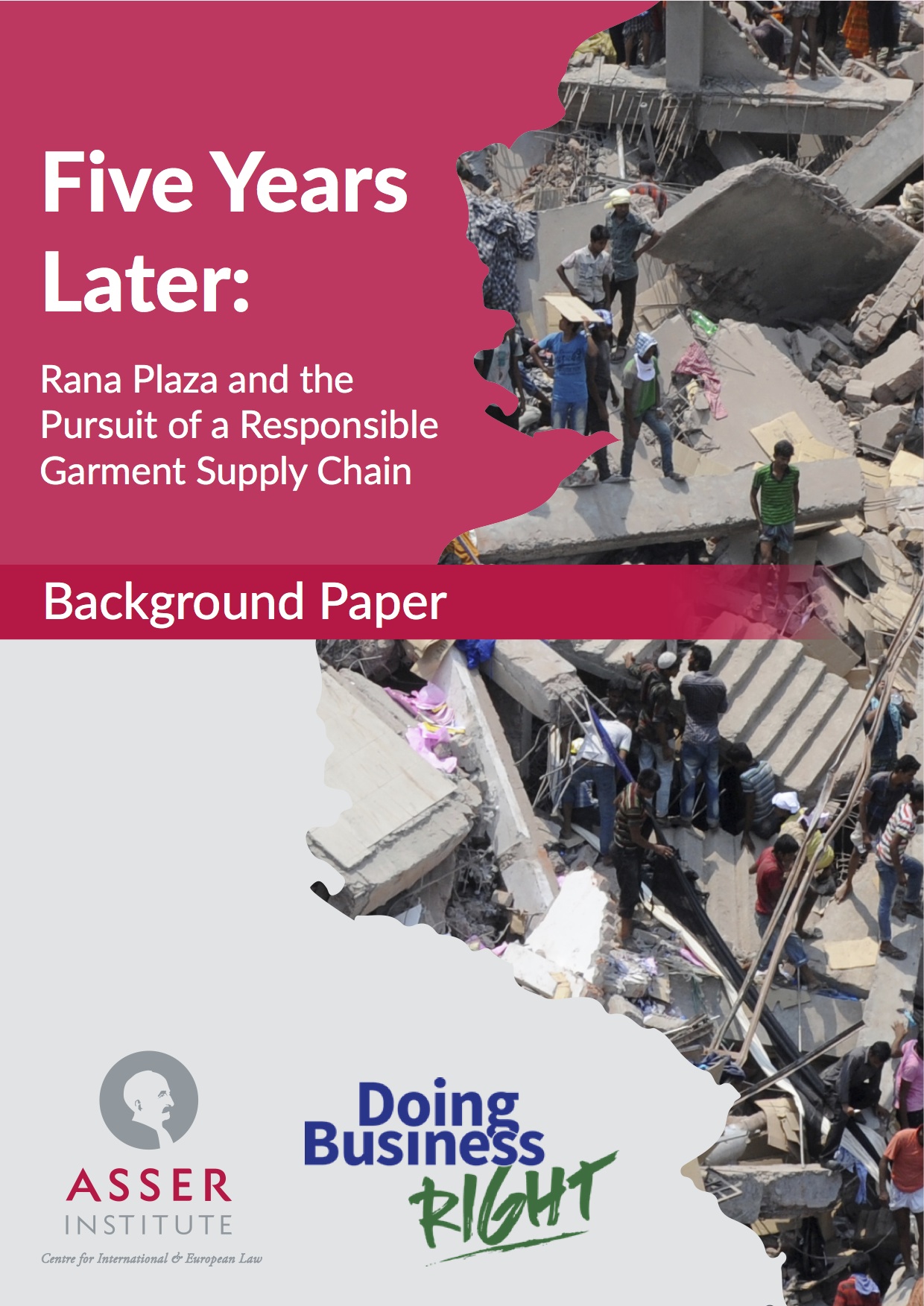

Download the full paper: RanaPlazaBackgroundPaper.pdf (3.5MB)
Doing Business Right Blog | The Norwegian Transparency Act 2021 – An important step towards human rights responsibilities for corporations - By Nora Kenan

The Norwegian Transparency Act 2021 – An important step towards human rights responsibilities for corporations - By Nora Kenan

Editor’s note: Nora Kenan has been an intern at the Asser Institute for the past five months and is about to complete her LL.B. in International & European Law at The Hague University of Applied Sciences. Upon graduating, she will proceed with a Master’s in human rights at the University of Utrecht.


The Norwegian Transparency Act [1](‘Åpenhetsloven’), also known as the ‘Act on Business Transparency and Work with Fundamental Human Rights and Decent Work’ was proposed in April 2021. Now, two months later, the Act has officially been adopted by the Norwegian government and represents yet another mandatory due diligence initiative which has been trending across various jurisdiction in the recent years. The Act will require all large and medium-size corporations in Norway to disclose the measures taken to ensure the respect for human rights throughout their entire supply chain.

Various Norwegian organizations have been campaigning for years in favor of such a law. The official preparations began in 2017, when the Parliament (‘Regjeringen’) requested the Government (‘Stortinget’) to explore the possibility of introducing a law that would oblige companies to inform consumers about the steps that they take to follow up on various human rights responsibilities. The Government appointed a law firm as well as a group of experts, the Ethics Information Committee, to conduct thorough research on the matter, and to investigate whether there were any other legal obligations standing in the way of a proposal of this kind, such as for example EEA-obligations or bilateral/multilateral agreements. As a result of this research, it was concluded that there was indeed room for imposing human rights obligations on corporations. Shortly after, the Ethics Information Committee published a report in which they proposed the introduction of a due diligence legislation – more specifically, the Transparency Act. The Act consists of fifteen paragraphs (§)[2], and each paragraph has a commentary which further describes how it should be interpreted and applied.[3]

The objective of the law is essentially to promote corporate respect of human rights and decent working conditions in the production of goods and provision of services, as well as to ensure public access to information on the steps taken by corporations to safeguard these goals (§1). By making this information public, individuals and stakeholders in general are given the chance to directly question the activities of a company.

Key elements

The Act is based on various global standards related to human rights and business, such as the OECD Guidelines for Multinational Enterprises and the United Nations Guiding Principles on Business and Human Rights (UNGPs) – similar to other mandatory due diligence initiatives. However, this Act introduces a rather unique approach to transparency and regulatory oversight, namely the Right to Information and the Duty to Disclose. In its essence, the Act covers all the elements of human rights due diligence (HRDD), such as detecting the negative impacts of corporate activity on human rights, continuously assess and take action to mitigate these negative impacts, as well as to report about their efforts. Even though many human – and workers’ rights conventions are listed throughout the Act, such as the International Covenant on Economic, Social and Cultural Rights (ICCPR) and ILO Declaration on Fundamental Rights and Principles at Work, the commentaries emphasize that these are non-exhaustive examples and accordingly refers to, inter alia, the UN Convention on the Rights of the Child and the ILO Indigenous and Tribal Peoples Convention.[4]  The Act uses these conventions to clarify what is meant by ‘decent working conditions’, adding that ‘decent working conditions’ entails the protection fundamental human rights as according to these conventions, as well as safe and secure working conditions and an income that is sufficient for the workers to support themselves and their families (§3(c)).

Personal scope of application

The Act is applicable to all larger companies domiciled in Norway, regardless of whether they offer their products or services within the Norwegian borders. Further, foreign corporations who sell their products or services in Norway and who have tax obligations to the Norwegian government also fall within the scope of this Act (§2). In order to define a ‘large company’, the Act makes a reference to §1-5 of the Norwegian Accounting Act.[5] Alternatively, a corporation is also considered a ‘large company’ if it meets at least two of the following three requirements:

1. Turnover of at least 70 million NOK (approximately, €6.880.000 (June 2021))

2. Balance-sheet total of at least 30 million NOK (approximately, €2.950.000 (June 2021))

3. Average amount of employees in a financial year: 50 man-years (§3(a)).

The Ministry’s own calculations stipulates that this will entail approximately 8800 companies. To give an insight to the comprehensiveness of this scope, the French duty of vigilance law applies to 200-300 corporations.  

Scope of due diligence obligation

The Act imposes an obligation for companies to carry out due diligence assessments in accordance with the OECD Guidelines for Multinational Enterprises with the aim of documenting what actions they take to prevent and limit human rights risks. Essentially, such a due diligence process entails (i) the embedment of responsible business conduct into the company’s policies and management systems; (ii) mapping the actual and potential negative impacts on human rights and decent working conditions that the company has either caused or contributed to, or which are directly linked to their corporate activities; (iii) implementation appropriate measures to stop, prevent or limit negative impacts; (iv) monitoring of the implementation and results; (v) communication with the affected stakeholders about how negative impacts are dealt with; and (vi) arranging for or cooperate on remedy and compensation where this is required. The due diligence assessments should be proportionate to the size and nature of the company, and to the context in which the company operates (§4).

Right to information

As the wording of the Act reveals, the element of transparency lies at the core of this Act and is embodied in an explicitly recognized Right to Information (§6). This paragraph establishes the right, upon a written request, to receive information from a corporation on how they tackle actual and potential negative consequences of their corporate activities, be it with regards to general or specific information (§6). However, the Act establishes some exceptions in the form of grounds upon which a request for information may be rejected, such as for example if the request seems obviously unreasonable, or if it concerns commercially privileged information. Despite these exceptions, the provision remains strong in nature as it sets clear guidelines on how requests should be dealt with, and that it should, generally speaking, be handled within 3 weeks (§7). Furthermore, rejections can be appealed, and fines may be issued in case of repeated infringements by the company, meaning unreasonable denials of requests.

Duty to disclose

Hand in hand with the right to information is the duty to disclose. The Act creates a duty for corporations to disclose their due diligence processes, which must be made available and accessible on the website of the corporation and include, at the minimum: a general description of due diligence policies and routines for handling risks to human rights and decent work, information on the negative impacts identified by the company, as well as information on measures taken to cease or prevent these negative impacts and the expected results (§5). Besides disclosing information on its website and responding to requests for information, corporations must also disclose all information necessary for the Norwegian Consumer Authority (‘Forbrukertilsynet’) and the Market Council (‘Marketsrådet’) to carry out their duties (§10). The company must respect the set deadlines and provide the information orally or in writing, depending on the request. As for the requests coming from either one of these two parties, matters of corporate confidentiality are, generally speaking, to be disregarded.    

Enforcement and sanctions

The Norwegian Consumer Authority will be responsible for implementing and enforcing the law. They shall, on their own initiative or the upon inquiries from others, seek to influence corporations to comply with the law (§9). Anyone can bring a complaint with the Norwegian Consumer Authority through their website. In case of a complaint, the Norwegian Consumer Authority will forward it to the Market Council who will deal with the claim. If it is found that the corporation has not sufficiently complied with the law, the Norwegian Consumer Authority together with the Market Council may issue injunctions for non-compliance with due diligence obligations or the right to information, fines for non-compliance with the duty to disclose and for repetitive breach of due diligence obligations or the right to information (§11-14). The Act does not give the victims of human rights abuses a right to seek remedy in court. Further, it does not provide for civil liability for harm caused, which fails to live up the recent legislative and judicial developments in other HRDD initiatives.

Conclusion

Inspired by John Ruggie’s Protect, Respect and Remedy Framework and the United Nations Guiding Principles on Business and Human Rights, the Norwegian Transparency Act introduces a duty for corporations to respect human rights, which is a far-reaching step in the right direction. The adoption of a HRDD act is in itself a historical happening.  This Act primarily focuses on the element of transparency and regulatory oversight enshrined in the Right to Information and the Duty to Disclose. Additionally, the Act is not limited to a corporation and its subsidiaries but covers its entire supply chain.

That being said, there is, according to one of the member of the Ethics Information Committee, still room for improvement. First of all, the Act does not cover any environmental impacts. However, the Environment Information Act of 2003 also contains some of the elements that are present in the Transparency Act, such as the Right to Information. Yet, this might emerge as a point for improvement at a later stage. Other points of improvement relate to access to justice for victims of corporate abuses. Since the Act is focused on consumer rights, it could also be appropriate for it to include a right for individuals to bring a case against a corporation in a court. Lastly, the fact that not all corporations fall within the scope of this Act can also be a point of criticism. Arguably, the size of the company is not what determines whether or not they take part in human rights breaches throughout their supply chain. Nevertheless, the Act in its entirety constitutes a remarkable milestone which forms part of the ongoing HRDD legislative wave across various European countries.


[1] Only available in Norwegian.

[2] § means ‘Paragraph’ and is used to indicate articles in Norwegian law. One paragraph consists of multiple sub-paragraphs. 

[3] See pages 105-117 of the report.

[4] Commentary on §3

[5] Only available in Norwegian


Comments are closed