Toolkit for Evaluating the Legal Acceptability of Military AI Systems
Why use this Toolkit?
Artificial intelligence (AI) is increasingly incorporated into a wide range of military systems and capabilities. Their functions may include analysing information, supporting human decision-making, navigation, object recognition and classification, and functions within weapon systems. As these systems move from development to deployment, questions of legal acceptability arise throughout their lifecycle—not only at the point of use. Assessing these questions early and repeatedly matters. Decisions made during development, testing, acquisition and configuration can shape how a system ultimately performs and the risks it presents during military operations. Equally, changes in the system, its intended use, or the operational environment may require earlier assessments to be revisited.
This Toolkit for Assessing the Legal Acceptability of Military AI Systems provides a structured method for identifying and assessing factors that may affect the legal acceptability of AI-enabled military systems under international humanitarian law (IHL). It is intended to support those involved in the development, acquisition, review, deployment, or use of military AI systems, including persons from the Armed Forces, Ministry of Defence, and Industry.
* This Toolkit accompanies the report From Development to Deployment: A Framework for Evaluating the Legal Acceptability of Military AI Systems. The report sets out the legal and methodological foundations of the framework, the rationale for the variables included in the Toolkit, and its intended applications. This Toolkit provides the practical component of that framework, by guiding users through a structured, context-sensitive assessment of military AI systems.
Who should use this Toolkit?
The Toolkit is intended for legal advisers, military personnel, policymakers, procurement and acquisition teams, developers, industry personnel and others involved in the development, review, acquisition, deployment, or use of military AI systems. It can support assessment throughout a system’s lifecycle—from development and acquisition to deployment and operational use. Although focused on legal acceptability under IHL, its effective use may require input from legal, operational, and technical personnel.
The Toolkit is designed to assess a specific AI system in relation to an intended or proposed operational context. Because legal acceptability under IHL is inherently context-dependent, the concrete risk evaluation of an AI system may be different depending on how, where, and for what purpose it is intended to be used. Rather than producing an automated pass/fail result, this Toolkit supports structured legal reasoning and informed decision-making. It helps users identify relevant sources of risk, areas requiring further information or safeguards, and factors relevant to determining whether and under what conditions a system may be used in the proposed context.
How does the Toolkit work?
The Toolkit is built around 27 variables organised into seven thematic clusters. A “variable” represents a technical, operational, environmental, human, or institutional factor that may influence the legal acceptability of an AI system under IHL. Each variable is presented as a self-contained assessment page, comprising a description of the concept, a qualitative risk evaluation scale, an explanation of its legal relevance, and guidance on how it interacts with other variables. Together, the variables provide a structured basis for identifying and assessing the factors that contribute to legal risk.
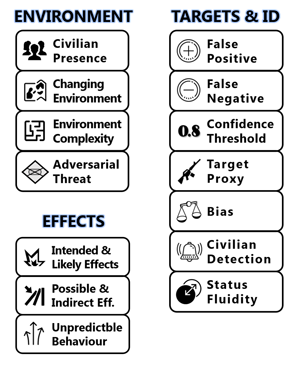
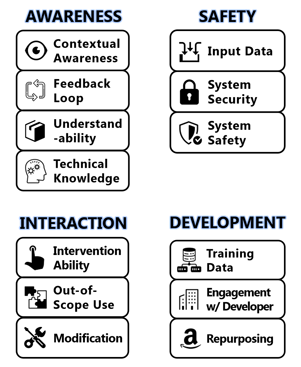
Interactive: Click on a variable to go to the relevant page
Each variable in this Toolkit contains of the following elements:
- Concept: A short explanation of the variable, supported by practical examples to facilitate understanding even for non-experts.
- Evaluation Scale: A five-point qualitative risk scale that helps evaluators assess the extent to which the variable may contribute to legal risk under IHL in the anticipated operational context.
- Legal Relevance: A brief explanation of why the variable is legally relevant, linked to one or more of the D-C-P concern categories (see below).
- Relationship Chart: A visual overview of how the variable interacts with other variables, including dependencies, influential relationships, risky pairings or disqualifying combinations, trade-offs, and complementary safeguards.
- Chart Legend: An explanation of the symbols used in the Relationship Chart, and how the linked variables interact.
The characteristics and context-of-use of military AI systems may affect compliance with IHL, including the rules of distinction, proportionality, and precautions in attack. Assessing these implications is an important part of determining whether, and under what conditions, a military AI system may be lawfully used in a particular operational context.
The legal relevance of each variable is identified by reference to one or more of three core IHL concern categories (‘D-C-P’) below. These categories indicate the principal way(s) in which a variable may affect IHL compliance. For a more detailed discussion of the applicable IHL framework and its relevance to the assessment of military AI systems, see the accompanying report.
|
D DISTINCTION |
Distinction-related concerns: The risk that the characteristics or context-of-use of the AI system may impair the ability to reliably distinguish between military objectives and civilians or civilian objects, including by contributing to misidentification or other classification errors. |
|
C CIVILIAN HARM |
Civilian harm-related concerns: The risk that the characteristics or context-of-use of the AI system may contribute to incidental civilian harm that is excessive in relation to the concrete and direct military advantage anticipated, including by affecting the information or assessments relevant to proportionality. |
|
P PRECAUTIONS |
Precautions-related concerns: The risk that limitations in the AI system’s performance, predictability, understandability, or controllability may impair the ability of those planning or executing an attack to take feasible precautions to avoid, and in any event minimise, incidental civilian harm. |
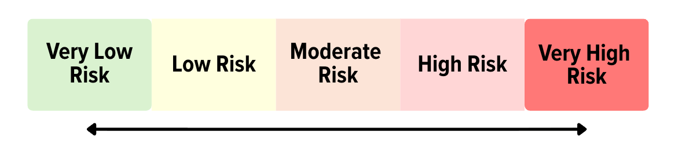
Each variable’s risk level is assessed using a qualitative Evaluation Scale. Evaluators should use available evidence and their professional judgment to determine which descriptor best reflects the anticipated operational context. The Toolkit guides users through a step-by-step process to identify relationships between variables, recognise high-risk or disqualifying combinations, consider possible mitigation measures, and ultimately reach an overall assessment of the AI system.
|
Very Low Risk |
Little or no identifiable risk to IHL compliance in the anticipated use-context. |
|
Low Risk |
Limited risk. Some attention may be required, but unlikely to raise significant legal concerns on its own. |
|
Moderate Risk |
Some risk to IHL compliance, depending on the operational context and its interaction with other variables. Caution and further assessment recommended. |
|
High Risk |
High risk to IHL compliance. Mitigation measures or additional safeguards should normally be considered before deployment. |
|
Very High Risk |
Significant legal risk. Unless adequately mitigated or justified by the broader assessment, deployment may be inappropriate. |
Variables should not be considered in isolation. A variable presenting limited risk on its own may become more significant when combined with other factors; conversely, risks associated with one variable may be mitigated by safeguards reflected in another. The Relationship Chart and Chart Legend in each variable page show how variables may interact, and the Relationship Matrix (see below) provides a global overview of all relationships between variables.
The Toolkit supports, rather than prescribes, the legal assessment process. There is no mandatory sequence in which applicable variables must be evaluated, and institutions may adapt the process to suit their own procedures and decision-making structures. However, the basis for the assessment, including decisions on variable applicability and risk evaluation, should be recorded to support transparency and consistency. The recommended workflow below provides one practical approach to applying the Toolkit in a structured, transparent, and context-sensitive manner.
Recommended workflow
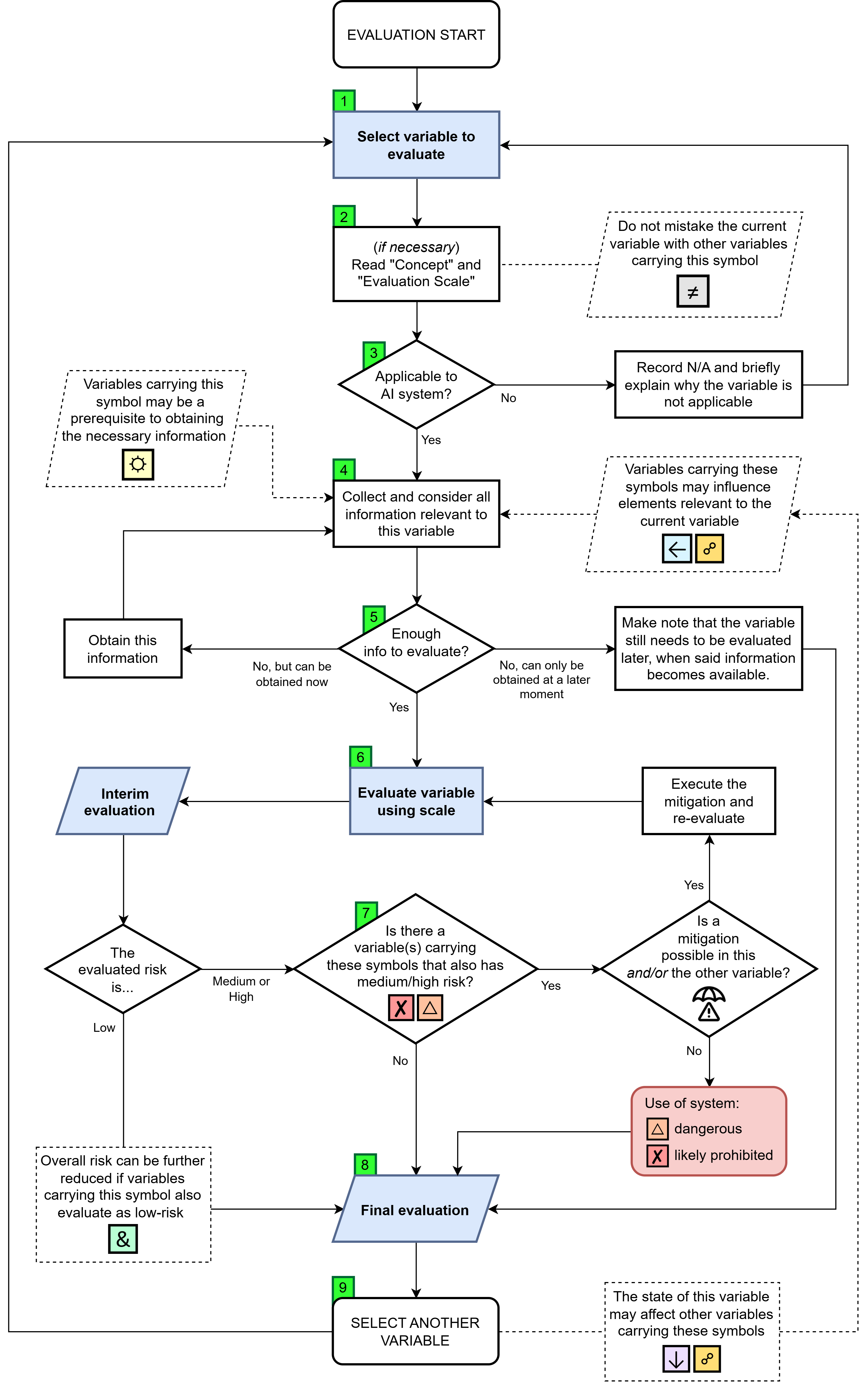
The following ten steps provide a recommended workflow for applying the Toolkit in a structured, transparent, and context-sensitive manner. The workflow guides evaluators from defining the system and scope of the assessment, through the evaluation of applicable variables and identification of information gaps, to the consideration of legal relevance and appropriate risk-mitigation measures.
The workflow is intended to be flexible. Depending on the evaluator’s role, the stage of the AI system lifecycle, and relevant institutional processes, the order or application of individual steps may be adapted where appropriate.
See also the Evaluation Flowchart below, which summarises the recommended workflow discussed in this section.
|
STEP 0 |
Prepare and Scope the Assessment |
Before beginning the assessment, confirm that you have:
-
Identified the AI system under consideration.
-
Defined its intended operational context, as the legal acceptability of a military AI system is inherently context-dependent.
-
Collected the available technical, operational, and institutional information relevant to the assessment.
|
STEP 1 |
Identify the Variable to Evaluate |
Begin by selecting a variable to assess. There is no prescribed order in which variables must be evaluated. The starting point will depend on the purpose of the assessment, the information available, and the stage of the AI system lifecycle.
|
STEP 2 |
Familiarise Yourself with the Variable |
Read the Concept and Evaluation Scale sections before assessing the variable. These explain what the variable assesses and what information may be relevant for the Evaluation Scale.
 |
Variables marked with this symbol in the Relationship Chart are commonly confused with the variable under consideration. Reviewing them can help distinguish similar concepts and avoid misinterpretation. |
|
STEP 3 |
Is the Variable Applicable to the System? |
Not every variable in the Toolkit will be relevant to every AI system or proposed use. Before continuing, determine if the variable is applicable to the system and its proposed use-context (see the table below).
|
Observation |
Classify as |
What do to next |
|
The variable concerns a factor that is present or could materially affect the AI system, its proposed use, or its IHL-relevant effects. |
Applicable |
Proceed with the variable in the assessment |
|
The variable concerns a feature, function, or circumstance that is not relevant to the system or proposed use. |
Not Applicable |
Record N/A and briefly explain why the variable does not apply. |
In determining applicability, consider the scope and definition of each variable in light of the specific system and proposed use. A lack of sufficient information to evaluate an otherwise relevant variable does not make that variable “Not Applicable” (instead, see Step 5).
This Step should be revisited if the AI system, its proposed use, or the operational context changes.
|
STEP 4 |
Gather the Relevant Information |
Using the Concept and Evaluation Scale sections as a guide, collect the information needed to assess the variable. Depending on the AI system, this may include technical, operational, environmental, human factors, or institutional information.
 |
The evaluator’s ability to assess the current variable may depend on variables marked with this symbol in the Relationship Chart. Consider if this is the case before continuing, and whether more relevant information about the current variable could be obtained from these sources. |
  |
Variables marked with these symbols in the Relationship Chart may influence the current variable (through a linear and inverse relationship respectively), and should therefore be considered when gathering the relevant information. |
|
STEP 5 |
Check Whether You Have Sufficient Information |
Before assessing the variable, confirm that sufficient information is available to apply the Evaluation Scale. If the available information is insufficient, determine whether the missing information can be obtained now or is expected to become available only at a later stage, and proceed accordingly:
-
The information can be obtained now: Pause the assessment of this variable until the necessary information has been obtained (e.g. from a superior, developer, or through additional testing). In the meantime, you may continue evaluating another variable.
-
The information will only become available later: This may occur where evaluation depends on information that only emerges during a later stage of the system’s lifecycle. For example, determining the number or concentration of civilians in an operational area (see [Civilian Presence]) may only be possible possible at the point of operational planning or use. Where appropriate, a provisional evaluation may be recorded on the basis of clearly identified assumptions and the information currently available. The evaluation should be revisited once the necessary information becomes available, where necessary by a different evaluator at a later stage of the AI system lifecycle.
|
STEP 6 |
Assess the Variable Using the Evaluation Scale |
Using the Evaluation Scale, determine which risk descriptor best reflects the variable in the anticipated operational context. Base the assessment on the available evidence and your professional judgement.
Where a variable includes multiple indicators, consider all of them together when determining the overall risk level. The overall evaluation should reflect the combined effect of the indicators on the particular context, rather than any single indicator in isolation.
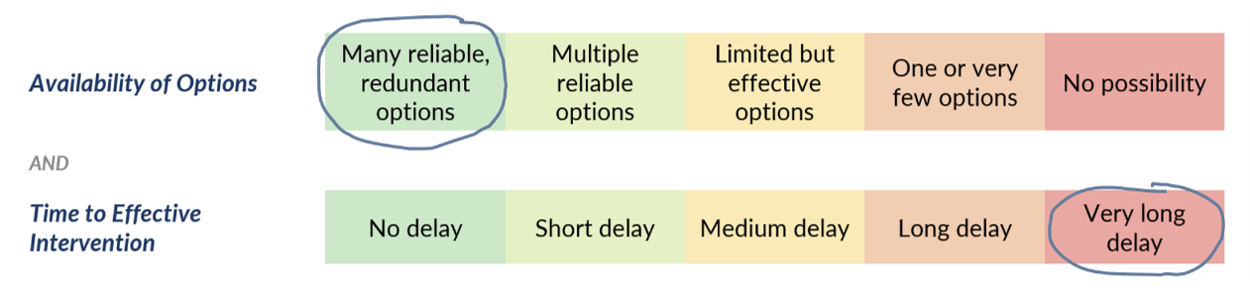
For example, the variable [Intervention Ability] above includes two indicators. A reasonable evaluator may conclude that overall risk remains high even where the first indicator scores positively. In the example above, multiple options for stopping or recalling a malfunctioning AI system may provide limited protection if all of those options are subject to significant delays.
|
STEP 7 |
Review Variable Relationships for ‘Risky Pairings’ |
Once you have assessed the variable, review its Relationship Chart. This highlights interactions with other variables that may affect the overall risk assessment. Pay particular attention to variables marked with symbols which identify high-risk ( ) or critically dangerous (
 ) combinations.
-
If a variable on the Relationship Chart with the
or symbol has not yet been evaluated, evaluate that variable first before continuing.
If the current variable and another variable connected by a or symbol both present medium or high risk, you have identified a ‘Risky Pairing’. In this case, consider whether the risk associated with one or both variables can be reduced through mitigation measures.
-
Where effective mitigation is possible, implement the relevant measures and reassess the affected variable(s) under Step 6.
-
Where the risks cannot be adequately mitigated, there is notable risk of legal noncompliance. Record the residual risk and consider its implications later as part of the overall assessment of legal acceptability under Step 10.
 |
This symbol in the Relationship Chart identifies suggested mitigation measures for the current variable. Consult the Chart Legend for more details on these suggested measures. |
|
This symbol in the Relationship Chart highlights “trade-offs”, where reducing risk in one variable may increase risk in another. Consider these interactions before implementing mitigation measures. |
|
STEP 8 |
Confirm the Final Risk Evaluation |
Confirm the final qualitative risk assessment for the variable after considering all relevant information, related variables, and any mitigation measures. Record the outcome and basis for the evaluation before proceeding to the next variable.
 |
Variables marked with this symbol in the Relationship Chart complement the current variable. Low risk in both may provide an additional layer of safety or redundancy. |
 |
Variables with this symbol in the Relationship Chart may be influenced by the current variable. The evaluation of the current variable may therefore affect their risk level. Take this into consideration when evaluating these variables. |
|
STEP 9 |
Repeat the Process for Remaining Variables |
Return to Step 1 and repeat the process. Continue until all variables have either been evaluated, or identified for later reassessment under Step 4.
|
FINAL STEP |
Reach an Overall Assessment of Legal Acceptability of the AI System |
Once all variables have been considered, assess the results together, including relevant interactions between variables, residual risks following mitigation, and any outstanding information gaps or provisional evaluations identified under Step 5. On this basis, reach an overall assessment of the legal acceptability of the AI systemin the proposed use-context.
The assessment should identify:
-
whether the proposed use is legally acceptable on the information available; and
-
whether additional information, safeguards, mitigation measures, or modifications are required before a determination can be made.
Where the evaluator is not the relevant decision-maker, the assessment should inform the appropriate authorisation or decision-making process.
Evaluation Flowchart
Relationship Matrix