Editor's note: Marine Montejo is a graduate from the College of
Europe in Bruges and is currently an intern at the ASSER International Sports
Law Centre.
The result of the Brexit referendum on 23
June 2016 took the European Union (almost) by surprise. A lot has been said and
written about the impact of the United Kingdom leaving the EU. As in all other
areas, the British sport sector will also face the effects of the modification
of the relationship between the EU and its (probable) former Member State, the
UK. It is nearly impossible to foresee all consequences as the UK has not even
triggered article 50 TFEU yet to officially start the exit negotiations.
However, as the UK position toward the EU will change in any case, this two-part
blog aims to examine the main practical implications of such an exit for the
UK, but also for the EU, in relation to the actual application of EU law in
sport and the EU sport policy.
Unless stated otherwise, the use of the
terms Brexit in this blog should be understood as a complete exit of the UK
from the European Union. This blog focus in particular on this worst case
scenario and its consequences for UK sport. However, it is highly improbable
that the future Brexit negotiations with the EU will end up without some kind
of special agreement between the two parties the first of which being an EEA
type of agreement with full access to the internal market and applicability of
EU law.
The first part of this blog will examined
the consequences for UK sport in terms of access to the EU internal market and
the applicability of free movement principles. The second part is focused on specific
impacts with regard of others domain of EU law for professional and grassroots
UK sport. More...
Editor’s note: This report compiles all relevant news,
events and materials on International and European Sports Law based on the
daily coverage provided on our twitter feed @Sportslaw_asser. You are
invited to complete this survey via the comments section below, feel free to
add links to important cases, documents and articles we might have
overlooked.
The headlines
What a month June
turned out to be. Waking up the morning after the 23rd, the results
of the UK referendum on EU membership were final. The words of Mark Twain: “Apparently
there is nothing that cannot happen today”, might provide the most apt
description of the mood felt at the time.[1]
The Leave campaign’s narrow victory has brought along tremendous economic,
political and legal uncertainties for both the UK and the (other) Member
States. To give but one example, with regard to the implications of Brexit on Europe’s
most profiting football league, we recommend an older blog
by Daniel Geey and Jonny Madill. More...
It’s been a long wait, but they’re finally here!
On Monday, the European Commission released its decisions regarding State aid to seven Spanish professional football clubs (Real Madrid on two occasions) and five Dutch professional football clubs. The decisions mark the end of the formal
investigations, which were opened in 2013. The Commission decided as follows:
no State aid to PSV Eindhoven (1); compatible aid to the Dutch clubs FC Den
Bosch, MVV Maastricht, NEC Nijmegen and Willem II (2); and incompatible aid granted
to the Spanish football clubs Real Madrid, FC Barcelona, Valencia CF, Athletic
Bilbao, Atlético Osasuna, Elche and Hércules (3).
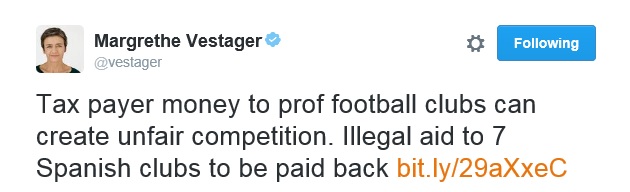
The recovery decisions in particular are truly historic.
The rules on State aid have existed since the foundation of the European
Economic Community in 1958, but it is the very first time
that professional football clubs have been ordered to repay aid received from
(local) public authorities.[1]
In a way, these decisions complete a development set in motion with the Walrave
and Koch ruling of 1974, where
the CJEU held that professional sporting activity, and therefore also football,
is subject to EU law. The landmark Bosman case of 1995 proved to be of great significance as
regards free movement of (professional) athletes and the Meca-Medina case of 2006 settled that EU competition rules were
equally applicable to the regulatory activity of sport. The fact that the first
ever State aid recovery decision concerns major clubs like Real Madrid, FC
Barcelona and Valencia, give the decisions extra bite. Therefore, this blog
post will focus primarily on the negative/recovery decisions[2],
their consequences and the legal remedies available to the parties involved.[3]
More...
Editor’s note: This report compiles all relevant news, events and
materials on International and European Sports Law based on the daily coverage
provided on our twitter feed @Sportslaw_asser. You are invited to complete this survey via the
comments section below, feel free to add links to important cases, documents
and articles we might have overlooked.
The Headlines
Challenged
membership put a lot of emphasis on football federations in May. The Court of Arbitration for Sport (“CAS”) has
rendered an award, on 27 April 2016, ordering the FIFA Council to
submit the application of the Gibraltar Football Association (GFA) for FIFA
membership to the FIFA Congress (the body authorised to admit new members to FIFA). The GFA has sought since 1999 to become a member of
UEFA and FIFA. In May 2013, it became a
member of the UEFA and went on to seek membership of FIFA. More...
Forget the European Championship currently held in France or the
upcoming Olympic Games in Rio. Doping scandals are making the headlines more than
ever in 2016. From tennis star Sharapova receiving a two-year ban for her use of
the controversial ‘meldonium’, to the seemingly never-ending doping scandals in
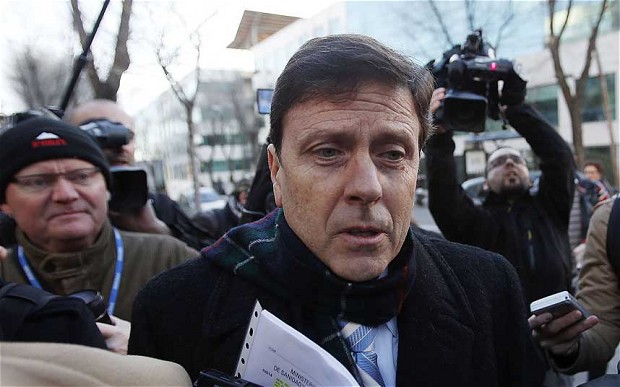
athletics. As if this was not enough, a new chapter
was added on 14 June to one of the most infamous and obscure doping sagas in
history: the Operación Puerto.
The special criminal appeal chamber,
the Audiencia Provincial, has held that the more than 200 blood bags of
professional athletes that have been at the center of the investigations since
2006 can be delivered to the relevant sporting authorities, such as the Spanish
Anti-Doping Agency (AEPSAD), WADA, the UCI and the Italian Olympic Committee
(CONI). In other words, there is now a good chance that the identities of the
involved athletes might eventually be revealed.
Source: http://www.telegraph.co.uk/sport/othersports/cycling/9834122/Operation-Puerto-doctor-Eufemiano-Fuentes-treated-tennis-players-athletes-footballers-and-a-boxer.html
This case note will analyze the court’s ruling and summarize its most
important findings. Given the amount of time passed since the scandal first
came to light (2004), the blog will commence with a short background summary of
the relevant facts. More...
Editor's note: Prof. Dr. Ekşi is a full-time lecturer and chair of
Department of Private International Law at Özyeğin University Faculty of Law.
Prof. Ekşi is the founder and also editor in chief of the Istanbul Journal
of Sports Law which has been in publication since 2019.
Editor's note: Lindsay Brandon is Associate Attorney at Law Offices of Howard
L. Jacobs
“Tell the white people of America and
all over the world that if they don’t seem to care for the things black people
do, they should not go to see black people perform.” – American sprinter and Olympic Medalist John Carlos
On 21 April 2021, the Athletes’ Commission
(AC) of the International Olympic Committee (“IOC”) received
the “full support of the IOC Executive Board for a set of recommendations in
regard to the Rule 50 of the Olympic Charter and Athlete Expression at the
Olympic Games.” This came over a year after the 2020 Tokyo Olympic Games were
postponed due to the Covid-19 pandemic, and almost a year after the IOC and AC
embarked on an “extensive qualitative and quantitative” consultation process to
reform Rule 50 involving over
3,500 athletes from around the globe.
Since its introduction of the new
guidelines in January 2020, Rule
50 has been touted by the IOC as a means to protect the neutrality of sport
and the Olympic Games, stating that “No kind of demonstration or political,
religious or radical propaganda is permitted in any Olympic sites, venues, or
other areas.” In other words, the
Olympics are a time to celebrate sport, and any political act or demonstration
might ruin their “moment
of glory”.
In fact, the Rule 50 Guidelines say
that a fundamental principle of sport is that it is neutral, and “must be
separate from political, religious or any other type of interference.” But this
separation is not necessarily rooted in totality in modern sports culture[1],
particularly in the United States (“U.S.”).
This is evidenced by the United States Olympic and Paralympic Committee
(“USOPC”) committing
to not sanctioning Team USA athletes for protesting at the Olympics. The
USOPC Athletes stated “Prohibiting athletes to freely express their views
during the Games, particularly those from historically underrepresented and
minoritized groups, contributes to the dehumanization of athletes that is at
odds with key Olympic and Paralympic values.” More...