Asser International Sports Law Blog

Our International Sports Law Diary
The Asser International Sports Law Centre is part of the T.M.C. Asser Instituut

In blood we trust? The Kreuziger Biological Passport Case. By Thalia Diathesopoulou

Over the last twenty years, professional cycling has developed the reputation of one of the “most drug soaked sports in the world”.[1] This should not come as a surprise. The sport’s integrity has plummeted down due to an unprecedented succession of doping scandals. La crème de la crème of professional cyclists has been involved in doping incidents including Tyler Hamilton, Floyd Landis, Alejandro Valverde and Lance Armstrong. The once prestigious Tour de France has been stigmatized as a race of “pharmacological feat, not a physical one”.[2]

In view of these overwhelming shadows, in 2008, the International Cycling Union (UCI), in cooperation with the World Anti-Doping Agency (WADA) took a leap in the fight against doping. It became the first International Sports Federation to implement a radical new anti-doping program known as the Athlete Biological Passport (ABP).[3] More...

The International Sports Law Digest – Issue II – July-December 2014

I. Literature


1. Antitrust/Competition Law and Sport

G Basnier, ‘Sports and competition law: the case of the salary cap in New Zealand rugby union’, (2014) 14 The International Sports Law Journal 3-4, p.155

R Craven, ‘Football and State aid: too important to fail?’ (2014) 14 The International Sports Law Journal 3-4, p.205

R Craven, ‘State Aid and Sports Stadiums: EU Sports Policy or Deference to Professional Football (2014) 35 European Competition Law Review Issue 9, 453


2. Intellectual Property Rights in Sports law / Betting rights/ Spectators’ rights/ Sponsorship Agreements

Books

W T Champion and K DWillis, Intellectual property law in the sports and entertainment industries (Santa Barbara, California; Denver, Colorado; Oxford, England: Praeger 2014)

J-M Marmayou and F Rizzo, Les contrats de sponsoring sportif (Lextenso éditions 2014) 

More...


Should the CAS ‘let Dutee run’? Gender policies in Sport under legal scrutiny. By Thalia Diathesopoulou

The rise of Dutee Chand, India’s 100 and 200-meter champion in the under 18-category, was astonishing. Her achievements were more than promising: after only two years, she broke the 100m and 200m national junior records, competed in the 100m final at the World Youth Athletics Championships in Donetsk and collected two gold medals in the Asian Junior Championships in Chinese Taipei. But, in July 2014, this steady rise was abruptly halted. Following a request from the Athletics Federation of India (AFI), the Sports Authority of India (SAI) conducted blood tests on the Indian sprinters. Dutee was detected with female hyperandrogenism, i.e a condition where the female body produces high levels of testosterone. As a result, a few days before the Commonwealth Games in Glasgow, the AFI declared Dutee ineligible to compete under the IAAF Regulations and prevented her from competing in future national and international events in the female category. Pursuant to the IAAF ‘Hyperandrogenism Policy’, the AFI would allow Dutee to return to competition only if she lowers her testosterone level beneath the male range by means of medical or surgical treatment.[1] On 25 September 2014, Dutee filed an appeal before the CAS, seeking to overturn the AFI’s decision and declare IAAF and IOC’s hyperandrogenism regulations null and void. She is defending her right to compete the way she actually is: a woman with high levels of testosterone. Interestingly enough, albeit a respondent, AFI supports her case.

IAAF and IOC rules set limits to female hyperandrogenism, which is deemed an unfair advantage that erodes female sports integrity. While these rules have been contested with regard to their scientific and ethical aspects, this is the first time that they will be debated in court. This appeal could have far-reaching ramifications for the sports world. It does not only seek to pave the way for a better ‘deal’ for female athletes with hyperandrogenism, who are coerced into hormonal treatment and even surgeries to ‘normalise’ themselves as women[2], but it rather brings the CAS, for the first time, before the thorny question:

How to strike a right balance between the core principle of ‘fair play’ and norms of non-discrimination, in cases where a determination of who qualifies as a ‘woman’ for the purposes of sport has to be made? More...

The O’Bannon Case: The end of the US college sport’s amateurism model? By Zygimantas Juska

On 8 August, U.S. District Judge Claudia Wilken ruled in favour of former UCLA basketball player O'Bannon and 19 others, declaring that NCAA's longstanding refusal to compensate athletes for the use of their name, image and likenesses (NILs) violates US antitrust laws. In particular, the long-held amateurism justification promoted by the NCAA was deemed unconvincing.

On 14 November, the NCAA has appealed the judgment, claiming that federal judge erred in law by not applying a 1984 Supreme Court ruling. One week later, the NCAA received support from leading antitrust professors who are challenging the Judge Wilken’s reasoning in an amicus curiae. They are concerned that the judgment may jeopardize the proper regulation of college athletics. The professors argued that if Wilken’s judgment is upheld, it

would substantially expand the power of the federal courts to alter organizational rules that serve important social and academic interests…This approach expands the ‘less restrictive alternative prong’ of the antitrust rule of reason well beyond any appropriate boundaries and would install the judiciary as a regulatory agency for collegiate athletics”.   

More...

Image Rights in Professional Basketball (Part II): Lessons from the American College Athletes cases. By Thalia Diathesopoulou

In the wake of the French Labour Union of Basketball (Syndicat National du Basket, SNB) image rights dispute with Euroleague and EA Games, we threw the “jump ball” to start a series on players’ image rights in international professional basketball. In our first blogpost, we discussed why image rights contracts in professional basketball became a fertile ground for disputes when it comes to the enforcement of these contracts by the Basketball Arbitral Tribunal (BAT). Indeed, we pointed out that clubs might take advantage of the BAT’s inconsistent jurisprudence to escape obligations deriving from image rights contracts.

In this second limb, we will open a second field of legal battles “around the rim”: the unauthorized use of players’ image rights by third parties. We will use as a point of reference the US College Athletes image rights cases before US Courts and we will thereby examine the legal nature of image rights and the precise circumstances in which such rights may be infringed. Then, coming back to where we started, we will discuss the French case through the lens of US case law on players’ image rights. 


Source: http://philadelphia.cbslocal.com/2013/09/27/ea-sports-settles-college-likeness-case/ More...


UEFA’s tax-free Euro 2016 in France: State aid or no State aid?

Last week, the French newspaper Les Echos broke the story that UEFA (or better said its subsidiary) will be exempted from paying taxes in France on revenues derived from Euro 2016. At a time when International Sporting Federations, most notably FIFA, are facing heavy criticisms for their bidding procedures and the special treatment enjoyed by their officials, this tax exemption was not likely to go unnoticed. The French minister for sport, confronted with an angry public opinion, responded by stating that tax exemptions are common practice regarding international sporting events. The former French government agreed to this exemption. In fact, he stressed that without it “France would never have hosted the competition and the Euro 2016 would have gone elsewhere”. More...

Image Rights in Professional Basketball (Part I): The ‘in-n-out rimshot’ of the Basketball Arbitral Tribunal to enforce players’ image rights contracts. By Thalia Diathesopoulou

A warning addressed to fans of French teams featuring in the recently launched video game NBA 2K15: Hurry up! The last jump ball for Strasbourg and Nanterre in NBA 2K 15 may occur earlier than expected. The French Labour Union of Basketball (Syndicat National du Basket, SNB) is dissatisfied that Euroleague and 2K Games did not ask (nor paid) for its permission before including the two teams of Pro A in the NBA 2K15 edition. What is at issue? French basketball players’ image rights have been transferred to SNB, which intends to start proceedings before the US Courts against 2K Games requesting 120.000 euros for unauthorized use of the players’ image rights. SNB is clear: it is not about the money, but rather to defend the players’ rights.[1] Strasbourg and Nanterre risk to “warm up” the virtual bench if this litigation goes ahead. 

Source: http://forums.nba-live.com/viewtopic.php?f=149&t=88661&start=250 More...

Sport and EU Competition Law: uncharted territories - (II) Mandatory player release systems with no compensation for clubs. By Ben Van Rompuy

The European Commission’s competition decisions in the area of sport, which set out broad principles regarding the interface between sports-related activities and EU competition law, are widely publicized. As a result of the decentralization of EU competition law enforcement, however, enforcement activity has largely shifted to the national level. Since 2004, national competition authorities (NCAs) and national courts are empowered to fully apply the EU competition rules on anti-competitive agreements (Article 101 TFEU) and abuse of a dominant position (Article 102 TFEU).

Even though NCAs and national courts have addressed a series of interesting competition cases (notably dealing with the regulatory aspects of sport) during the last ten years, the academic literature has largely overlooked these developments. This is unfortunate since all stakeholders (sports organisations, clubs, practitioners, etc.) increasingly need to learn from pressing issues arising in national cases and enforcement decisions. In a series of blog posts we will explore these unknown territories of the application of EU competition law to sport.

In this second installment of this blog series, we discuss a recent judgment of the regional court (Landgericht) of Dortmund finding that the International Handball Federation (IHF)’s mandatory release system of players for matches of national teams without compensation infringes EU and German competition law.[1] More...

Sports Politics before the CAS II: Where does the freedom of speech of a Karate Official ends? By Thalia Diathesopoulou

On 6 October 2014, the CAS upheld the appeal filed by the former General Secretary of the World Karate Federation (WKF), George Yerolimpos, against the 6 February 2014 decision of the WKF Appeal Tribunal. With the award, the CAS confirmed a six-months membership suspension imposed upon the Appellant by the WKF Disciplinary Tribunal.[1] At a first glance, the case at issue seems to be an ordinary challenge of a disciplinary sanction imposed by a sports governing body. Nevertheless, this appeal lies at the heart of a highly acrimonious political fight for the leadership of the WKF, featuring two former ‘comrades’:  Mr Yerolimpos and Mr Espinos (current president of WKF). As the CAS puts it very lucidly, "this is a story about a power struggle within an international sporting body"[2], a story reminding the Saturn devouring his son myth.

This case, therefore, brings the dirty laundry of sports politics to the fore. Interestingly enough, this time the CAS does not hesitate to grapple with the political dimension of the case. More...

Sports Politics before the CAS: Early signs of a ‘constitutional’ role for CAS? By Thalia Diathesopoulou

It took almost six months, a record of 26 witnesses and a 68 pages final award for the CAS to put an end to a long-delayed, continuously acrimonious and highly controversial presidential election for the Football Association of Thailand (FAT). Worawi Makudi can sit easy and safe on the throne of the FAT for his fourth consecutive term, since the CAS has dismissed the appeal filed by the other contender, Virach Chanpanich.[1]

Interestingly enough, it is one of the rare times that the CAS Appeal Division has been called to adjudicate on the fairness and regularity of the electoral process of a sports governing body. Having been established as the supreme judge of sports disputes, by reviewing the electoral process of international and national sports federations the CAS adds to its functions a role akin to the one played by a constitutional court in national legal systems. It seems that members of international and national federations increasingly see the CAS as an ultimate guardian of fairness and validity of internal electoral proceedings. Are these features - without prejudice to the CAS role as an arbitral body- the early sign of the emergence of a Constitutional Court for Sport? More...

Asser International Sports Law Blog | All posts by oskar van maren

Asser International Sports Law Blog

Our International Sports Law Diary
The Asser International Sports Law Centre is part of the T.M.C. Asser Instituut

International and European Sports Law – Monthly Report – February 2016

Editor’s note: This report compiles all relevant news, events and materials on International and European Sports Law based on the daily coverage provided on our twitter feed @Sportslaw_asser. You are invited to complete this survey via the comments section below, feel free to add links to important cases, documents and articles we might have overlooked. 


The Headlines

The eagerly awaited FIFA Presidential elections of 26 February provided for a “new face” at the pinnacle of international football for the first time since 1998. One could argue whether Infantino is the man capable of bringing about the reform FIFA so desperately needs or whether he is simply a younger version of his predecessor Blatter. More...


Book Review: Despina Mavromati & Matthieu Reeb, The Code of the Court of Arbitration for Sport—Commentary, Cases, and Materials (Wolters Kluwer International 2015). By Professor Matthew Mitten

Editor’s note: Professor Mitten is the Director of the National Sports Law Institute and the LL.M. in Sports Law program for foreign lawyers at Marquette University Law School in Milwaukee, Wisconsin. He currently teaches courses in Amateur Sports Law, Professional Sports Law, Sports Sponsorship Legal and Business Issues Workshop, and Torts. Professor Mitten is a member of the Court of Arbitration for Sport (CAS), and has served on the ad hoc Division for the XXI Winter Olympic Games in Sochi, Russia.

This Book Review is published at 26 Marquette Sports Law Review 247 (2015).


This comprehensive treatise of more than 700 pages on the Code of the Court of Arbitration for Sport (CAS) (the Code) is an excellent resource that is useful to a wide audience, including attorneys representing parties before the CAS, CAS arbitrators, and sports law professors and scholars, as well as international arbitration counsel, arbitrators, and scholars.  It also should be of interest to national court judges and their law clerks because it facilitates their understanding of the CAS arbitration process for resolving Olympic and international sports disputes and demonstrates that the Code provides procedural fairness and substantive justice to the parties, thereby justifying judicial recognition and enforcement of its awards.[1]  Because the Code has been in existence for more than twenty years—since November 22, 1994—and has been revised four times, this book provides an important and much needed historical perspective and overview that identifies and explains well-established principles of CAS case law and consistent practices of CAS arbitrators and the CAS Court Office.  Both authors formerly served as Counsel to the CAS and now serve as Head of Research and Mediation at CAS and CAS Secretary General, respectively, giving them the collective expertise and experience that makes them eminently well-qualified to research and write this book.More...


International and European Sports Law – Monthly Report – January 2016

Editor’s note: Our first innovation for the year 2016 will be a monthly report compiling relevant news, events and materials on International and European Sports Law based on the daily coverage provided on our twitter feed @Sportslaw_asser. You are invited to complete this survey via the comments section below, feel free to add links to important cases, documents and articles we might have overlooked. 


The Headlines

The world of professional sport has been making headlines for the wrong reasons in January. Football’s governing body FIFA is in such a complete governance and corruption mess that one wonders whether a new President (chosen on 26 February[1]) will solve anything. More recently, however, it is the turn of the athletics governing body, IAAF, to undergo “the walk of shame”. On 14 January the WADA Independent Commission released its second report into doping in international athletics. More...


Unpacking Doyen’s TPO Deals: FC Twente's Game of Maltese Roulette. By Antoine Duval and Oskar van Maren

The first part of our “Unpacking Doyen’s TPO deals” blog series concerns the agreements signed between Doyen Sports and the Dutch football club FC Twente. In particular we focus on the so-called Economic Rights Participation Agreement (ERPA) of 25 February 2014. Based on the ERPA we will be able to better assess how TPO works in practice. To do so, however, it is necessary to explore FC Twente’s rationale behind recourse to third-party funding. Thus, we will first provide a short introduction to the recent history of the club and its precarious financial situation. More...

To pay or not to pay? That is the question. The case of O’Bannon v. NCAA and the struggle of student athletes in the US. By Zlatka Koleva

Editor's note
Zlatka Koleva is a graduate from the Erasmus University Rotterdam and is currently an Intern at the ASSER International Sports Law Centre.

The decision on appeal in the case of O’Bannon v. NCAA seems, at first sight, to deliver answers right on time regarding the unpaid use of names, images and likenesses (NILs) of amateur college athletes, which has been an ongoing debate in the US after last year’s district court decision that amateur players in the college games deserve to receive compensation for their NILs.[1] The ongoing struggle for compensation in exchange for NILs used in TV broadcasts and video games in the US has reached a turning point and many have waited impatiently for the final say of the Court of Appeal for the 9th circuit. The court’s ruling on appeal for the 9th circuit, however, raises more legitimate concerns for amateur sports in general than it offers consolation to unprofessional college sportsmen. While the appellate court agreed with the district court that NCAA should provide scholarships amounting to the full cost of college attendance to student athletes, the former rejected deferred payment to students of up to 5,000 dollars for NILs rights. The conclusions reached in the case relate to the central antitrust concerns raised by NCAA, namely the preservation of consumer demand for amateur sports and how these interests can be best protected under antitrust law. More...


The European Commission’s ISU antitrust investigation explained. By Ben Van Rompuy

In June 2014, two prominent Dutch speed skaters, Mark Tuitert (Olympic Champion 1500m) and Niels Kerstholt (World Champion short track), filed a competition law complaint against the International Skating Union (ISU) with the European Commission.
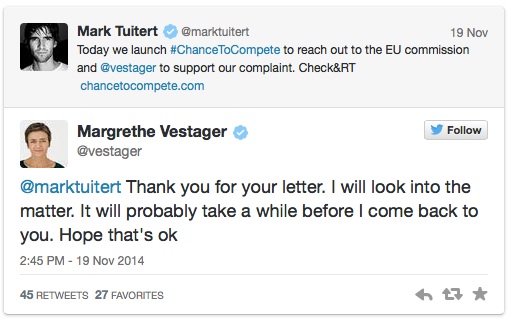

ChanceToCompeteTwitter.png (50.4KB)


Today, the European Commission announced that it has opened a formal antitrust investigation into International Skating Union (ISU) rules that permanently ban skaters from competitions such as the Winter Olympics and the ISU World and European Championships if they take part in events not organised or promoted by the ISU. The Commissioner for Competition, Margrethe Vestager, stated that the Commission "will investigate if such rules are being abused to enforce a monopoly over the organisation of sporting events or otherwise restrict competition. Athletes can only compete at the highest level for a limited number of years, so there must be good reasons for preventing them to take part in events."

Since the case originates from legal advice provided by the ASSER International Sports Law Centre, we thought it would be helpful to provide some clarifications on the background of the case and the main legal issues at stake. More...


The Scala reform proposals for FIFA: Old wine in new bottles?

Rien ne va plus at FIFA. The news that FIFA’s Secretary General Jérôme Valcke was put on leave and released from his duties has been quickly overtaken by the opening of a criminal investigation targeting both Blatter and Platini.

With FIFA hopping from one scandal to the next, one tends to disregard the fact that it has been attempting (or rather pretending) to improve the governance of the organisation for some years now. In previous blogs (here and here), we discussed the so-called ‘FIFA Governance Reform Project’, a project carried out by the Independent Governance Committee (IGC) under the leadership of Prof. Dr. Mark Pieth of the Basel Institute on Governance. Their third and final report, published on 22 April 2014, listed a set of achievements made by FIFA in the area of good governance since 2011, such as establishing an Audit and Compliance Committee (A&C). However, the report also indicated the reform proposals that FIFA had not met. These proposals included the introduction of term limits for specific FIFA officials (e.g. the President) as well as introducing an integrity review procedure for all the members of the Executive Committee (ExCo) and the Standing Committees. More...

Not comfortably satisfied? The upcoming Court of Arbitration for Sport case of the thirty-four current and former players of the Essendon football club. By James Kitching

Editor's note: James Kitching is Legal Counsel and Secretary to the AFC judicial bodies at the Asian Football Confederation. James is an Australian and Italian citizen and one of the few Australians working in international sports law. He is admitted as barrister and solicitor in the Supreme Court of South Australia. James graduated from the International Master in the Management, Law, and Humanities of Sport offered by the Centre International d'Etude du Sport in July 2012.


Introduction

On 12 May 2015, the Court of Arbitration for Sport (CAS) announced that the World Anti-Doping Agency (WADA) had filed an appeal against the decision issued by the Australian Football League (AFL) Anti-Doping Tribunal (AADT) that thirty-four current and former players of Essendon Football Club (Essendon) had not committed any anti-doping rule violation (ADRV) identified within the AFL Anti-Doping Code (AADC). The players had each been charged with using Thymosin-Beta 4 (TB4) during the 2012 AFL season.

On 1 June 2015, WADA announced that it had filed an appeal against the decision by the AADT to clear Mr. Stephen Dank (Dank), a sports scientist employed at Essendon during the relevant period, of twenty-one charges of violating the AADC. Dank was, however, found guilty of ten charges and banned for life.

This blog will solely discuss the likelihood of the first AADT decision (the Decision) being overturned by the CAS. It will briefly summarise the facts, discuss the applicable rules and decision of the AADT, review similar cases involving ‘non-analytical positive’ ADRVs relating to the use of a prohibited substance or a prohibited method, and examine whether the Code of Sports-related Arbitration (CAS Code) is able to assist WADA in its appeal.

This blog will not examine the soap opera that was the two years leading-up to the Decision. Readers seeking a comprehensive factual background should view the excellent up-to-date timeline published by the Australian Broadcasting Corporation. More...


The New FIFA Intermediaries Regulations under EU Law Fire in Germany. By Tine Misic

I'm sure that in 1985, plutonium is available in every corner drugstore, but in 1955, it's a little hard to come by.” (Dr. Emmett L. Brown)[1]


Back to the future?

Availing oneself of EU law in the ambit of sports in 1995 must have felt a bit like digging for plutonium, but following the landmark ruling of the European Court of Justice (ECJ) in the Bosman case[2], 20 years later, with all the buzz surrounding several cases where EU law is being used as an efficient ammunition for shelling various sports governing or organising bodies, one may wonder if in 2015 EU law is to be “found in every drug store” and the recent cases (see inter alia Heinz Müller v 1. FSV Mainz 05, Daniel Striani ao v UEFA, Doyen Sports ao v URBSFA, FIFA, UEFA) [3] cannot but invitingly evoke the spirit of 1995.

One of the aforementioned cases that also stands out pertains to the injunction decision[4] issued on 29 April 2015 by the Regional Court (Landesgericht) in Frankfurt am Main (hereinafter: the Court) in the dispute between the intermediary company Firma Rogon Sportmanagement (hereinafter: the claimant) and the German Football Federation (Deutschen Fußball-Bund, DFB), where the claimant challenged the provisions of the newly adopted DFB Regulations on Intermediaries (hereinafter: DFB Regulations)[5] for being incompatible with Articles 101 and 102 TFEU.[6] The Court, by acknowledging the urgency of the matter stemming from the upcoming transfer window and the potential loss of clients, deemed a couple of shells directed at the DFB Regulations to be well-aimed, and granted an injunction due to breach of Article 101 TFEU. More...


Compatibility of fixed-term contracts in football with Directive 1999/70/EC. Part 2: The Heinz Müller case. By Piotr Drabik

Introduction
The first part of the present blog article provided a general introduction to the compatibility of fixed-term contracts in football with Directive 1999/70/EC[1] (Directive). However, as the Member States of the European Union enjoy a considerable discretion in the implementation of a directive, grasping the impact of the Directive on the world of football would not be possible without considering the national context. The recent ruling of the Arbeitsgericht Mainz (the lowest German labour court; hereinafter the Court) in proceedings brought by a German footballer Heinz Müller provides an important example in this regard. This second part of the blog on the legality of fixed-term contract in football is devoted to presenting and assessing the Court’s decision.


I. Facts and Procedure
Heinz Müller, the main protagonist of this case, was a goalkeeper playing for 1.FSV Mainz 05 a club partaking to the German Bundesliga. More...