Asser International Sports Law Blog

Our International Sports Law Diary
The Asser International Sports Law Centre is part of the T.M.C. Asser Instituut

Free Webinar - The impact of the Diarra case on the football transfer system - 18 October 2024 - 15:00 CET

The Court of Justice of the European Union has recently handed down its judgement in the Lassana Diarra case (C-650/22 FIFA v. BZ).

Given the importance of this case to the sports industry, LawInSport, the Asser Instituut and the Association for the Study of Sport and the EU (Sport & EU) are hosting a joint webinar to bring together experts to unpack and provide clarity on the complex legal, regulatory & commercial issues stemming from this case. This free webinar will be hosted from 14:00 UK time (15:00 CET) on 18 October 2024.


Register HERE 


Speakers

Our expert speakers come from academia, law and sport. Our confirmed speakers are:


Register HERE 

Conference - ISLJ Annual Conference 2024 - 24-25 October - Asser Institute - The Hague

On 24 and 25 October 2024, the Asser Institute in The Hague will host the 2024 edition of the  International Sports Law Journal (ISLJ)  Conference. The ISLJ is the leading academic journal in transnational sports law and governance and is proud to provide a platform for transnational debates on the state of the field. The conference will address a number of issues of interest to the ISLJ and its readers. 

Register HERE

Drivers and effects of reform in transnational sports governance 

Transnational sports governance seems to be in a permanently unstable state of crisis and reform. At regular interval, international sports governing bodies face scandals triggered by corruption investigations or human rights violations, as well as adverse judidicial decisions. These are often followed by waves of institutional reforms, such as the creation of new bodies (E.g. the Athletics Integrity Unit), the adoption of new codes and regulation (such as Codes of Ethics) or human rights commitments (e.g. FIFA and the IOC’s Human Rights Policy/Strategy). This dynamic of crisis and reform will be at the heart of this year’s ISLJ conference, as a number of panels will critically investigate the triggers, transformative effects and limited impacts of reforms in transnational sports governance.  

Football in the midst of international law and relations 
As the war in Gaza and Russia’s invasion of Ukraine continue to rage, it has become even clearer that the football world can hardly be entirely abstracted from international relations. Yet, FIFA and UEFA continue to insist on their neutrality and to deny that their governance is (or should be) affected by the world’s political affairs. During the conference, we will engage with case studies in which football is entangled with international politics and law. In particular, the speakers will delve into the role of FIFA and UEFA in such situations and on the legal standards and processes that should be applied throughout their decision-making.  

Olympic challenges of today and tomorrow 
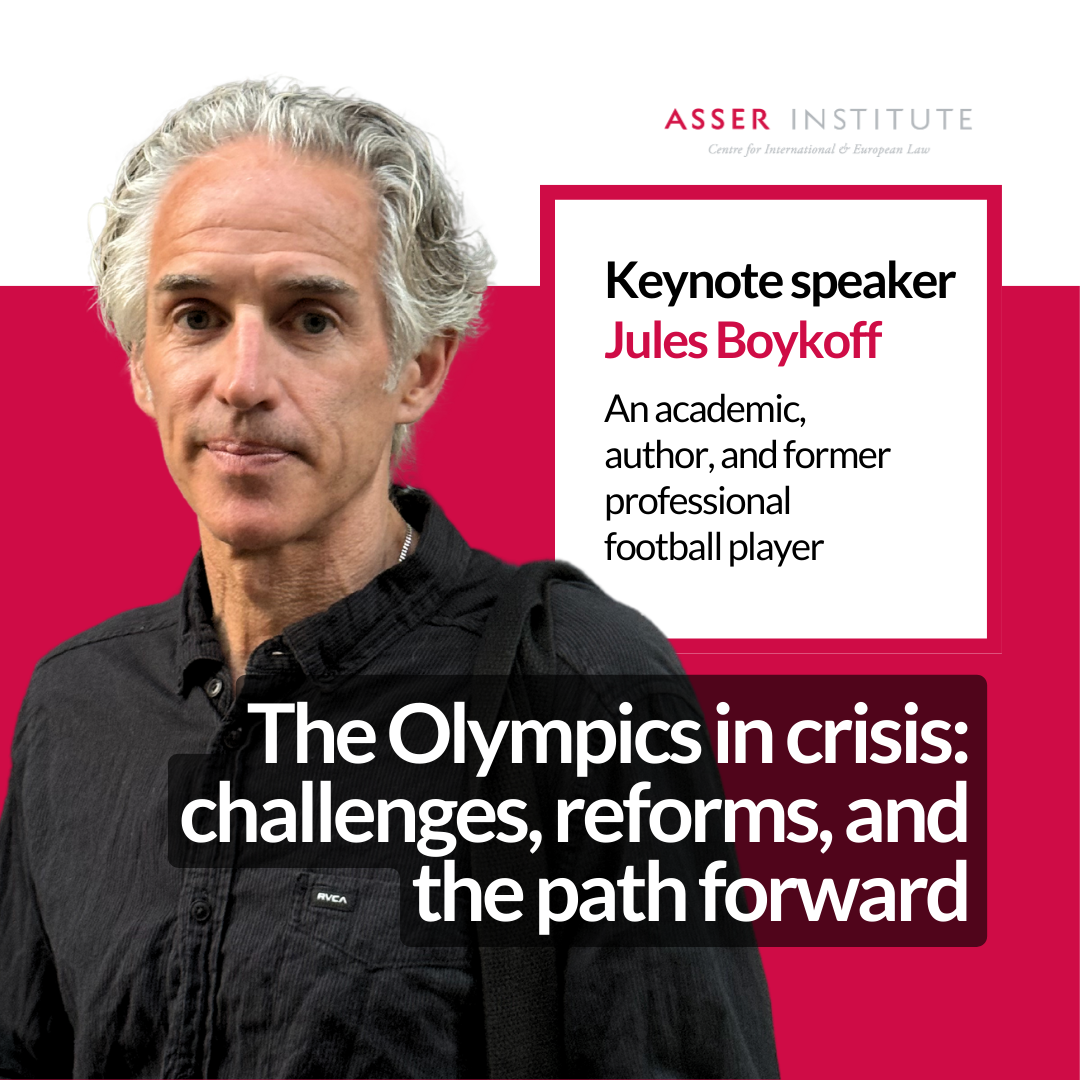
While the Paris 2024 Olympics have come to a close, the legal questions they have raised are far from exhausted. Instead, the Olympics have highlighted new issues (such as the question of the legality of the hijab ban imposed by the French Federation on its athletes) or old ones (such as the question whether Olympians should be remunerated by the IOC or the international federations), which will be discussed by our speakers. Finally, with the help of our keynote speaker, Prof. Jules Boykoff, a longstanding critique of the current Olympic regime, we will explore the IOC’s capacity to adapt to challenges while resisting radical change to the current model of olympism.   

Download the full programme 

Online participation available 
Following the success of our webinar option in the past years, we are once again allowing online participation to the conference at an affordable price. Thus, we hope to internationalise and diversify our audience and to reach people who are not in a position to travel to The Hague.  

We look forward to welcoming you in person in The Hague or digitally to this new iteration of the ISLJ conference. 

Register HERE

Speakers 


Register HERE

Conference - Empowering athletes’ human rights: Global research conference on athletes’ rights - Asser Institute - 23 October

The newly launched ‘Global Sport and Human Rights Research Network’, an initiative jointly hosted by the T.M.C. Asser Instituut and the Centre for Sport and Human Rights, together with the European Union-funded project ‘Human Rights Empowered Through Athletes Rights (H.E.R.O.)' is organising an in-person conference on October 23 at the Asser Institute in The Hague, to map the field of athletes' rights and engage in critical discussions on protection of these rights and how to prevent rights violations.

The one-day conference will kick off with a presentation by the H.E.R.O. team on their research results, followed by a short panel discussion. The rest of the day will be filled with four panels on different aspects related to the topic of athletes’ human rights, with speakers from academic institutions around the world.

Check out the full programme HERE and register for free HERE

undefinedundefined

Co-funded by the European Union logo in png for web usage

Luxembourg calls…is the answer from Nyon the way forward? Assessing UEFA’s response to the ECJ’s ISU judgment - By Saverio Spera


Editor's note: Saverio P. Spera is an Italian qualified attorney-at-law. He has practiced civil and employment law in Italy and briefly worked at the Asser International Sports Law Centre before joining FIFA in 2017. Until May 2024, he has worked within the FIFA legal division - Litigation Department, and lectured in several FIFA sports law programmes. In the spring of 2024 he has co-founded SP.IN Law, a Zurich based international sports law firm.


On 21 December 2023 a judicial hat-trick stormed the scene of EU sports law. That day, the European Court of Justice (the “ECJ”) issued three decisions: (i) European Superleague Company, SL v FIFA and UEFA (Case C-333/21); (ii) UL and SA Royal Antwerp Football Club v Union royale belge des sociétés de football association ASBL (Case C-680/21)and (iii) International Skating Union (ISU) v. European Commission – Case C-124/21.

These judgments were much scrutinised (see herehere and here) in the past 6 months. For the reader’s relief, this paper will not venture into adding another opinion on whether this was a fatal blow to the foundation of EU sports law or if, after all, the substantive change is minimal (as persuasively argued here). It will analyse, instead, UEFA’s recent amendments of its Statutes and Authorisation Rules governing International Club Competitions (the “Authorisation Rules”) and whether these amendments, clearly responding to the concerns raised in the ISU judgment with respect to the sports arbitration system,[1] might pave the way for other Sports Governing Bodies (SGBs) to follow suit and what the implications for CAS arbitration might be. More...

The International Cricket Council and its human rights responsibilities to the Afghanistan women's cricket team - By Rishi Gulati

Editor's note: Dr Rishi Gulati is Associate Professor in International Law at the University of East Anglia (UK) and Barrister in Law. He has a PhD from King’s College London, Advanced Masters in Public International Law from Leiden University, and a Bachelor of Laws from the Australian National University. Amongst other publications, he is the author of Access to Justice and International Organisations (Cambridge University Press, 2022). He has previously worked for the Australian Government, has consulted for various international organizations, and regularly appears as counsel in transnational cases.

On 1 December 2024, Jay Shah, the son of India’s powerful Home Minister and Modi confidante Amit Shah, will take over the role of the Independent Chair of the International Cricket Council (ICC). This appointment reflects the influence India now has on the governance of cricket globally. A key test Jay Shah will face is whether or not the ICC should suspend the Afghanistan Cricket Board (ACB) from its membership as Afghanistan no longer maintains a women’s cricket team contrary to the organization’s own rules, as well as its human rights responsibilities. More...

Women’s Football and the Fundamental Right to Occupational Health and Safety: FIFA’s Responsibility to Regulate Female Specific Health Issues - By Ella Limbach

Editor's noteElla Limbach is currently completing her master’s degree in International Sport Development and Politics at the German Sport University Cologne. Her interests include human rights of athletes, labour rights in sport, the intersection of gender, human rights and sport and the working conditions in women’s football. Previously, she graduated from Utrecht University with a LL.M in Public International Law with a specialization in International Human Rights Law. This blog was written during Ella's internship at the Asser Institute where she conducted research for the H.E.R.O. project. The topic of this blog is also the subject of her master's thesis.

Women’s football has experienced exponential growth over the past decade, though the professionalization of the women’s game continues to face barriers that can be tied to the historical exclusion of women from football and insufficient investment on many levels. While attendance records have been broken and media coverage has increased, the rise in attention also highlighted the need for special accommodations for female footballers regarding health and safety at the workplace. Female footballers face gender specific circumstances which can have an impact on their health such as menstruation, anterior cruciate ligament (ACL) injuries and the impact of maternity. As the recent ILO Brief on ‘Professional athletes and the fundamental principles and rights at work' states “gender issues related to [occupational health and safety] risks are often neglected (p. 23).” While it could be argued that from a human rights point of view article 13(c) of the Convention on the Elimination of Discrimination of Women stipulates “the right to participate in […] sports [on an equal basis to men],” reality shows that so far practices of men’s football were simply applied to women’s football without taking into consideration the physiological differences between male and female players and the implications that can have for female players’ health. The ILO Declaration on Fundamental Principles and Rights at Work(ILO Declaration, amended in 2022) includes “a safe and healthy working environment” as one of the fundamental rights at work (Art. 2e). This begs the question whether the scope of the right to occupational health and safety at the workplace includes the consideration of female specific health issues in women’s football. More...

[Call for Papers] - International Sports Law Journal - Annual Conference - Asser Institute, The Hague - 24-25 October 2024 - Reminder!

The Editors of the International Sports Law Journal (ISLJ) invite you to submit abstracts for the next edition of the ISLJ Conference on International Sports Law, which will take place on 24 and 25 October 2024 at the Asser Institute in The Hague. The ISLJ, published by Springer and TMC Asser Press, is the leading academic publication in the field of international sports law and the conference is a unique occasion to discuss the main legal issues affecting international sports and its governance with renowned academic experts.

We welcome abstracts from academics and practitioners on all issues related to international and transnational sports law and their impact on the governance of sport. We also welcome panel proposals (including a minimum of three presenters) on specific issues of interest to the Journal and its readers. For this year’s edition, we specifically invite submissions on the following themes and subthemes:


Reformism in transnational sports governance: Drivers and impacts

  • Legal and social drivers of reforms in transnational sports governance   
  • The role of strategic litigation (before the EU/ECtHR/National courts) as a driver of reform;
  • The role of public/fan pressure groups on clubs, competition organisers and governments as a driver of change.
  • The impact of internal reforms in transnational sports governance: Cosmetic or real change? (e.g. IOC Agenda 2020+5, FIFA governance reforms, CAS post-Pechstein changes, WADA sfter the Russian doping scandal)
  • Emerging alternatives to private sports governance – the UK’s Independent Football Regulator.


The organization and regulation of mega sporting events: Current and future challenges 

  • Mega-sporting events as legalized sites of digital surveillance 
  • Greening mega-sporting events (e.g. carbon neutral pledges, environmental footprints of events, the impact of multiple hosting sites)
  • Mega-sporting events and the protection of human rights and labour rights (e.g. Paris 2024 Social Charter, Euro 2024 human rights commitments)
  • The Olympic Games and athletes’ economic rights (remuneration/advertisement)
  • Reviews of the legal issues raised at Euro 2024 in Germany and the Paris 2024 Olympic Games
  • Previews of the legal issues likely to have an impact on the FIFA 2026 World Cup and the Milano-Cortina 2026 Winter Olympic Games


Please send your abstract of 300 words and CV no later than 15 July 2024 to a.duval@asser.nl. Selected speakers will be informed by 30 July.

The selected participants will be expected to submit a draft of their paper by 1 October 2024. Papers accepted and presented at the conference are eligible for publication in a special issue of the ISLJ, subject to peer-review. 

The Asser Institute will provide a limited number of travel & accommodation grants (max. 300€). If you wish to be considered for a grant, please explain why in your submission.


[New Event] Feminist theory and sport governance: exploring sports as sites of cultural transformation - 9 July -15:00-17:00 - Asser Institute


This seminar is part of the Asser International Sports Law Centre's event series on the intersection between transnational sports law and governance and gender. Dr Pavlidis will present her take on feminist theories and sport governance by exploring sports and in particular Australian rules football and roller derby as sites of cultural transformation.

Register HERE

Australian rules football is Australia's most popular spectator sport and for most of its history it has been a men's-only sport, including in its governance and leadership. This is slowly changing. Roller derby on the other hand has been reinvented with an explicitly DIY (Do It Yourself) governance structure that resists formal incorporation by 'outsiders'. This paper provides an overview of sport governance in the Australian context before focusing in on these two seemingly disparate sport contexts to explore the challenges of gender inclusive governance in sport.

Dr Adele Pavlidis is an Associate Professor in Sociology with the School of Humanities, Languages and Social Science at Griffith University in Australia. She has published widely on a range of sociocultural issues in sport and leisure, with a focus on gender and power relations. Theoretically her work traverses contemporary scholarship on affect, power and organisations, and she is deeply interested in social, cultural and personal transformation and the entanglements between people, organisations, and wellbeing.

We look forward to hearing Dr Pavlidis present on this topic, followed by reflections and comments by Dr Åsa Ekvall from the Erasmus Center for Sport Integrity & Transition, and Dr Antoine Duval from the T.M.C. Asser Institute. There will also be a Q&A with the audience.

Download the latest programme here 

Register HERE


[Call for papers] - International Sports Law Journal - Annual Conference - Asser Institute, The Hague - 24-25 October 2024

The Editors of the International Sports Law Journal (ISLJ) invite you to submit abstracts for the next edition of the ISLJ Conference on International Sports Law, which will take place on 24 and 25 October 2024 at the Asser Institute in The Hague. The ISLJ, published by Springer and TMC Asser Press, is the leading academic publication in the field of international sports law and the conference is a unique occasion to discuss the main legal issues affecting international sports and its governance with renowned academic experts.

We welcome abstracts from academics and practitioners on all issues related to international and transnational sports law and their impact on the governance of sport. We also welcome panel proposals (including a minimum of three presenters) on specific issues of interest to the Journal and its readers. For this year’s edition, we specifically invite submissions on the following themes and subthemes:


Reformism in transnational sports governance: Drivers and impacts

  • Legal and social drivers of reforms in transnational sports governance   
  • The role of strategic litigation (before the EU/ECtHR/National courts) as a driver of reform;
  • The role of public/fan pressure groups on clubs, competition organisers and governments as a driver of change.
  • The impact of internal reforms in transnational sports governance: Cosmetic or real change? (e.g. IOC Agenda 2020+5, FIFA governance reforms, CAS post-Pechstein changes, WADA sfter the Russian doping scandal)
  • Emerging alternatives to private sports governance – the UK’s Independent Football Regulator.


The organization and regulation of mega sporting events: Current and future challenges 

  • Mega-sporting events as legalized sites of digital surveillance 
  • Greening mega-sporting events (e.g. carbon neutral pledges, environmental footprints of events, the impact of multiple hosting sites)
  • Mega-sporting events and the protection of human rights and labour rights (e.g. Paris 2024 Social Charter, Euro 2024 human rights commitments)
  • The Olympic Games and athletes’ economic rights (remuneration/advertisement)
  • Reviews of the legal issues raised at Euro 2024 in Germany and the Paris 2024 Olympic Games
  • Previews of the legal issues likely to have an impact on the FIFA 2026 World Cup and the Milano-Cortina 2026 Winter Olympic Games


Please send your abstract of 300 words and CV no later than 15 July 2024 to a.duval@asser.nl. Selected speakers will be informed by 30 July.

The selected participants will be expected to submit a draft of their paper by 1 October 2024. Papers accepted and presented at the conference are eligible for publication in a special issue of the ISLJ, subject to peer-review. 

The Asser Institute will provide a limited number of travel & accommodation grants (max. 300€). If you wish to be considered for a grant, please explain why in your submission.


[Online Summer Programme] - International sports and human rights - 22 - 29 May 2024 - Last spots!

Join us for the first online version of our unique training programme on ‘Sport and human rights’ jointly organised by the Centre for Sport and Human Rights and the Asser Institute taking place on May 22-24 & May 27-29.

After the success of the first editions in 2022 and 2023 the programme returns, focusing on the link between the sport and human rights and zooming in on a number of topics, such as the UN Guiding Principles for Business and Human Rights and their application in sports. We will also adopt a human rights lens to sport governance and address freedom of speech, the rights of athletes, and access to remedy.

Tackling contemporary human rights challenges in sport

The programme brings together the latest in academic research with practical experiences from working in the field in an interactive package, fostering productive exchanges between the speakers and participants. Theoretical knowledge will be complemented by exposure to hands-on know-how.

Participants will have the opportunity to learn from experts from the Asser Institute, the Centre for Sport and Human Rights, and high-profile external speakers from both academia and practice.

What will you gain?

  • An extensive introduction to the emergence of the sport and human rights movement
  • A greater understanding of the normative framework for human rights standards in sport
  • A comprehensive overview of the latest developments in the interplay between gender and sports
  • Practical know-how to govern  human rights in the context of sporting organisations
  • Practical know-how to address  human rights risks in the context of day-to-day sports, including safeguarding
  • Practical know-how to access remedy in human rights disputes
  • The opportunity to engage in discussions and network with leading academics and professionals

Topics addressed in this summer programme include:

  • The emergence of the sport and human rights discussion/movement
  • The integration of human rights in the governance of sport
  • The protection of athletes’ rights
  • Access to remedy for sport-related human rights harms


Read the full programme.

Register HERE


In partnership with:

undefined    undefined

Asser International Sports Law Blog | Our International Sports Law Diary <br/>The <a href="http://www.sportslaw.nl" target="_blank">Asser International Sports Law Centre</a> is part of the <a href="https://www.asser.nl/" target="_blank"><img src="/sportslaw/blog/media/logo_asser_horizontal.jpg" style="vertical-align: bottom; margin-left: 7px;width: 140px" alt="T.M.C. Asser Instituut" /></a>

Asser International Sports Law Blog

Our International Sports Law Diary
The Asser International Sports Law Centre is part of the T.M.C. Asser Instituut

New Video! Zoom In on World Anti-Doping Agency v. Russian Anti-Doping Agency - 25 February

Dear readers,

If you missed it (or wish to re-watch it), the video of our third Zoom In webinar from 25 February on the CAS award in the World Anti-Doping Agency v. Russian Anti-Doping Agency case is available on the YouTube channel of the Asser Institute:


Stay tuned and watch this space, the announcement for the next Zoom In webinar, which will take place on 31 March, is coming soon!

A Reflection on Recent Human Rights Efforts of National Football Associations - By Daniela Heerdt (Tilburg University)

Editor's Note: Daniela Heerdt is a PhD researcher at Tilburg Law School in the Netherlands. Her PhD research deals with the establishment of responsibility and accountability for adverse human rights impacts of mega-sporting events, with a focus on FIFA World Cups and Olympic Games. She published a number of articles on mega-sporting events and human rights, in the International Sports Law Journal, Tilburg Law Review, and the Netherlands Quarterly of Human Rights.


In the past couple of years, the Fédération Internationale de Football Association (FIFA) made remarkable steps towards embedding human rights into their practices and policies. These developments have been discussed at length and in detail in this blog and elsewhere, but a short overview at this point is necessary to set the scene. Arguably, most changes were sparked by John Ruggie’s report from 2016, in which he articulated a set of concrete recommendations for FIFA “on what it means for FIFA to embed respect for human rights across its global operations”, using the UN Guiding Principles on Business and Human Rights (UNGPs) as authoritative standard.[i] As a result, in May 2017, FIFA published a human rights policy, in which it commits to respecting human rights in accordance with the UNGPs, identifies its salient human rights risks, and acknowledges the potential adverse impacts it can have on human rights in general and human rights of people belonging to specific groups. In October 2017, it adopted new bidding regulations requiring bidders to develop a human rights strategy and conduct an independent human rights risk assessment as part of their bid. In March 2017, FIFA also created a Human Rights Advisory Board, which regularly evaluated FIFA’s human rights progress and made recommendations on how FIFA should address human rights issues linked to its activities. The mandate of the Advisory Board expired at the end of last year and the future of this body is unknown at this point.

While some of these steps can be directly connected to the recommendations in the Ruggie report, other recommendations have largely been ignored. One example of the latter and focus of this blog post is the issue of embedding human rights at the level of national football associations. It outlines recent steps taken by the German football association “Deutscher Fussball-Bund” (DFB) and the Dutch football association “Koninklijke Nederlandse Voetbalbond” (KNVB) in relation to human rights, and explores to what extent these steps can be regarded as proactive moves by those associations or rather spillover effects from FIFA’s human rights efforts. More...

New Event! Zoom In on World Anti-Doping Agency v. Russian Anti-Doping Agency - 25 February - 16:00-17:30 CET

On Thursday 25 February 2021 from 16.00-17.30 CET, the Asser International Sports Law Centre, in collaboration with Dr Marjolaine Viret (University of Lausanne), organizes a Zoom In webinar on the recent award of the Court of Arbitration for Sport (CAS) in the case World Anti-Doping Agency (WADA) v. Russian Anti-Doping Agency (RUSADA), delivered on 17 December 2020.


Background
In its 186 pages decision the CAS concluded that RUSADA was non-compliant with the World Anti-Doping Code (WADC) in connection with its failure to procure the delivery of the authentic LIMS data (Laboratory Information Management System) and underlying analytical data of the former Moscow Laboratory to WADA. However, the CAS panel did not endorse the entire range of measures sought by WADA to sanction this non-compliance. It also reduced the time frame of their application from four to two years. The award has been subjected to a lot of public attention and criticisms, and some have expressed the view that Russia benefited from a lenient treatment.   

This edition of our Zoom in webinars will focus on assessing the impact of the award on the world anti-doping system. More specifically, we will touch upon the decision’s effect on the capacity of WADA to police institutionalized doping systems put in place by certain states, the ruling’s regard for the rights of athletes (Russian or not), and its effect on the credibility of the world anti-doping system in the eyes of the general public.


To discuss the case with us, we are very happy to welcome the following speakers:


Participation is free, register HERE.

Revisiting FIFA’s Training Compensation and Solidarity Mechanism - Part. 5: Rethinking Redistribution in Football - By Rhys Lenarduzzi

Editor’s note: Rhys Lenarduzzi recently completed a Bachelor of Law (LL.B) and Bachelor of Philosophy (B.Phil.) at the University of Notre Dame, Sydney, Australia. As a former professional athlete, then international sports agent and consultant, Rhys is interested in international sports law, policy and ethics. He is currently undertaking an internship at the T.M.C. Asser Institute with a focus on Transnational Sports Law.


As one may have gathered from the series thus far, the question that comes out of this endeavour for me, is whether redistribution in football would be better divorced from the transfer system?

In my introductory blog I point towards historical, cultural, and of course the legal explanations as to why redistribution was established, and why it might be held onto despite obvious flaws. In my second blog, I point out how the training compensation and solidarity mechanisms work in practice through an African case study, as well as the hindrance caused and the Eurocentricity of the regulations. The key take-away from my third blog on the non-application of training compensation in women’s football might be that training compensation should apply to both men’s and women’s football, or neither. The sweeping generalisation that men’s and women’s football are different as justification for the non-application to the women’s game is not palatable, given inter alia the difference between the richest and poorest clubs in men’s football. Nor is it palatable that the training compensation mechanism is justified in men’s football to incentivise training, yet not in women’s football.

In the fourth blog of this series, I raise concerns that the establishment of the Clearing House prolongs the arrival of a preferable alternative system. The feature of this final blog is to consider alternatives to the current systems. This endeavour is manifestly two-fold; firstly, are there alternatives? Secondly, are they better?  More...


Revisiting FIFA’s Training Compensation and Solidarity Mechanism - Part. 4: The New FIFA Clearing House – An improvement to FIFA’s training compensation and solidarity mechanisms? - By Rhys Lenarduzzi

Editor’s note: Rhys Lenarduzzi recently completed a Bachelor of Law (LL.B) and a Bachelor of Philosophy (B.Phil.) at the University of Notre Dame, Sydney, Australia. As a former professional athlete, then international sports agent and consultant, Rhys is interested in international sports law, policy and ethics. He is currently undertaking an internship at the T.M.C. Asser Institute with a focus on Transnational Sports Law.

In September 2018, the Football Stakeholders Committee endorsed the idea of a Clearing House that was subsequently approved in October of the same year by the FIFA Council. A tender process commenced in July 2019 for bidders to propose jurisdiction, operation and establishment. Whilst many questions go unanswered, it is clear that the Clearing House will be aimed at closing the significant gap between what is owed and what is actually paid, in respect to training compensation and solidarity payments. The Clearing House will have other functions, perhaps in regard to agents’ fees and other transfer related business, though those other operations are for another blog. It will hence act as an intermediary of sorts, receiving funds from a signing and therefore owing club (“new” club) and then moving that money on to training clubs. Whilst separate to FIFA, to what extent is unclear.

I have landed at the position of it being important to include a section in this blog series on the soon to commence Clearing House, given it appears to be FIFA’s (perhaps main) attempt to improve the training compensation and solidarity mechanisms. As will be expanded upon below, I fear it will create more issues than it will solve. Perhaps one should remain patient and optimistic until it is in operation, and one should be charitable in that there will undoubtedly be teething problems. However, it is of course not just the function of the Clearing House that is of interest, but also what moving forward with the project of the Clearing House represents and leaves unaddressed, namely, the issues I have identified in this blog series. More...

New Event! Zoom In on International Skating Union v. European Commission - 20 January - 16.00-17.30 (CET)

On Wednesday 20 January 2021 from 16.00-17.30 CET, the Asser International Sports Law Centre, in collaboration with Dr Marjolaine Viret, is organising a Zoom In webinar on the recent judgment of the General Court in the case International Skating Union (ISU) v European Commission, delivered on 16 December 2016. The Court ruled on an appeal against the first-ever antitrust prohibition decision on sporting rules adopted by the European Commission. More specifically, the case concerned the ISU’s eligibility rules, which were prohibiting speed skaters from competing in non-recognised events and threatened them with lifelong bans if they did (for more details on the origin of the case see this blog). The ruling of the General Court, which endorsed the majority of the European Commission’s findings, could have transformative implications for the structure of sports governance in the EU (and beyond).

We have the pleasure to welcome three renowned experts in EU competition law and sport to analyse with us the wider consequences of this judgment.


Guest speakers:

Moderators:


Registration HERE


Zoom In webinar series

In December 2020, The Asser International Sports Law Centre in collaboration with Dr Marjolaine Viret launched a new series of zoom webinars on transnational sports law: Zoom In. You can watch the video recording of our first discussion on the arbitral award delivered by the Court of Arbitration for Sport (CAS) in the Blake Leeper v. International Association of Athletics Federations (IAAF) case on the Asser Institute’s Youtube Channel. Click here to learn more about the Zoom In webinar series.

Revisiting FIFA’s Training Compensation and Solidarity Mechanism - Part. 3: The Curious Non-Application of Training Compensation to Women’s Football – By Rhys Lenarduzzi

Editor’s note: Rhys Lenarduzzi is a final semester Bachelor of Law (LL.B) and Bachelor of Philosophy (B.Phil.) student, at the University of Notre Dame, Sydney, Australia. As a former professional athlete, then international sports agent and consultant, Rhys is interested in international sports law, policy and ethics. He is currently undertaking an internship at the T.M.C. Asser Institute with a focus on Transnational Sports Law.


As recently as September 2020, questions were raised in the European Parliament on the non-application of training compensation to women’s football. Whilst this blog will predominantly consider potential inconsistencies in reasoning for and against training compensation in men’s and women’s football, the questions before the Commission were largely on the theme of disrespect and discrimination. Somewhat unfortunately, the questions raised were side-stepped, with Ms Gabriel (Commissioner for Innovation, Research, Culture, Education and Youth) simply stating that: “The TFEU does not give the Commission the competence to interfere in the internal organisation of an independent international organisation such as FIFA.” This might be true in theory, though one might feel some degree of uneasiness if privy to the Commission’s role in the 2001 FIFA regulatory overhaul.

It is currently explicit in the regulations and the commentary, that in women’s football, signing clubs are not required to compensate training clubs for developing players, through the training compensation mechanism that exists in men’s football. Though it is a contentious comment and as will be expanded below, this may not have always been the case.

At Article 20 of the FIFA Regulations on the Status and Transfer of Players (RSTP), one will find that the principles of training compensation shall not apply to women’s football. Further, in FIFA’s recently released Women’s Football Administrator Handbook (the handbook), it states that disputes relating to training compensation are limited for the moment to male players only.[1]

Regulations on solidarity contributions on the other hand do apply to women’s football, but given transfer fees are not so common, the use of the mechanism is not either. As an indication of how uncommon the activation of the solidarity contribution mechanism in women’s football might be, FIFA reported in the handbook just four claims with the Players’ Status Department in 2016 (three claims involving the same player), and zero since.[2] That is in comparison to hundreds of claims made per season in men’s football, where signing and owing clubs had not fulfilled their obligation to pay the solidarity contribution.

Given the aforementioned, this blog will largely focus on training compensation and how it came to be the case that this mechanism, often presented as critical in the context of men’s football, does not apply in women’s football. To do so, I will first discuss the reasoning advanced in an unpublished CAS award, which one may reasonably suspect played a fundamental role in shaping the current exemption. I will then turn to FIFA’s timely response to the award and the adoption of its Circular No. 1603. Finally, I will point out the disconnect in FIFA’s decision to adopt two radically different approaches to the issue of training compensation in male and female professional football. More...


New Event! Zoom In on Transnational Sports Law - Blake Leeper v. IAAF - 4 December at 4pm (CET)

The Asser International Sports Law Centre in collaboration with Dr Marjolaine Viret is launching a new series of zoom webinars on transnational sports law: Zoom In. The first discussion (4 December at 16.00) will zoom in on the recent arbitral award delivered by the Court of Arbitration for Sport (CAS) in the Blake Leeper v. International Association of Athletics Federations (IAAF) case.

In this decision, reminiscent of the famous Pistorius award rendered a decade ago, the CAS panel ruled on the validity of an IAAF rule that places the burden on a disabled athlete to prove that a mechanical aid used to compete in IAAF-sanctioned competitions does not give them an overall competitive advantage. While siding with the athlete, Blake Leeper, on the burden of proof, the CAS panel did conclude that Leeper’s prosthesis provided him an undue advantage over other athletes and hence that the IAAF could bar him from competing in its events.

To reflect on the key aspects of the decision and its implications, we have invited scholars with different disciplinary backgrounds to join the zoom discussion. 

Confirmed guests

 Moderators


The webinar is freely available, but registration here is necessary.

Last call to register to the 2021 edition of the Sports Law Arbitration Moot - Deadline 1 December

Dear all,

Our Slovenian friends (and former colleague) Tine Misic and Blaž Bolcar are organising the second edition of the Sports Law Arbitration Moot (SLAM).

The best four teams of the SLAM competition will compete in the finals, which will be held in Ljubljana, Slovenia, on 30th and 31st March, 2021.

This is a great opportunity for students to familiarise themselves with the world of sports arbitration, to meet top lawyers and arbitrators in the field, and to visit beautiful Ljubljana.

Go for it!

You'll find more information and can register at https://sportlex.si/slam/en

Pistorius revisited: A comment on the CAS award in Blake Leeper v. IAAF - By Marjolaine Viret

On 23 October 2020, a panel of the Court of Arbitration for Sport (‘CAS’) rendered an award in the matter opposing Mr Blake Leeper (‘Mr Leeper’ or ‘the Athlete’) to the International Association of Athletics Federation (‘IAAF’).[1] The CAS panel was asked to make a ruling on the validity of the IAAF rule that places on a disabled athlete the burden to prove that a mechanical aid used to compete in IAAF-sanctioned competitions does not give such athlete an overall competitive advantage.

The award is remarkable in that it declared the shift of the burden of proof on the athlete invalid, and reworded the rule so that the burden is shifted back on the IAAF to show the existence of a competitive advantage. Thus, while the IAAF won its case against Blake Leeper as the panel found that the sport governing body had discharged its burden in casu, the outcome can be viewed as a victory for disabled athletes looking to participate in IAAF-sanctioned events. It remains to be seen how this victory will play out in practice. Beyond the immediate issue at stake, the case further presents an illustration of how – all things equal – assigning the burden of proof can be decisive for the real-life impact of a policy involving complex scientific matters, as much as the actual legal prerequisites of the underlying rules.

This article focuses on some key aspects of the award that relate to proof issues in the context of assessing competitive advantage. Specifically, the article seeks to provide some food for thought regarding burden and degree of proof of an overall advantage, the contours of the test of ‘overall advantage’ designed by the CAS panel and its possible bearing in practice, and potential impact of the ruling on other areas of sports regulations such as anti-doping.

The award also analyses broader questions regarding the prohibition of discrimination in the regulation of sports, as well as the interplay with international human rights instruments such as the European Convention on Human Rights (‘ECHR’), which are not explored in depth here. More...