Asser International Sports Law Blog

Our International Sports Law Diary
The Asser International Sports Law Centre is part of the T.M.C. Asser Instituut

The 2006 World Cup Tax Evasion Affair in Germany: A short guide. By Gesa Kuebek

Editor's note:

Gesa Kuebek holds an LLM and graduated from the University of Bologna, Gent and Hamburg as part of the Erasmus Mundus Master Programme in Law and Economics and now work as an intern for the Asser Instituut.


On Monday, 9 November, the German Football Association (DFB) announced in a Press Release the resignation of its head, Wolfgang Niersbach, over the 2006 World Cup Affair. In his statement, Niersbach argued that he had “no knowledge whatsoever” about any “payments flows” and is now being confronted with proceedings in which he was “never involved”. However, he is now forced to draw the “political consequences” from the situation. His resignation occurred against the backdrop of last week’s raid of the DFB’s Frankfurt headquarters and the private homes Niersbach, his predecessor Theo Zwanziger and long-standing DFB general secretary Horst R. Schmidt. The public prosecutor’s office investigates a particularly severe act of tax evasion linked to awarding the 2006 World Cup. The 2006 German “summer fairy-tale” came under pressure in mid-October 2015, after the German magazine “Der Spiegel” shocked Fußballdeutschland by claiming that it had seen concrete evidence proving that a €6.7 million loan, designated by the FIFA for a “cultural programme”, ended up on the account of Adidas CEO Robert-Louis Dreyfuß. The magazine further argued that the money was in fact a secret loan that was paid back to Dreyfuß. Allegedly, the loan was kept off the books intentionally in order to be used as bribes to win the 2006 World Cup bid. The public prosecutor now suspects the DFB of failing to register the payment in tax returns. German FA officials admit that the DFB made a “mistake” but deny all allegations of vote buying. However, the current investigations show that the issues at stakes remain far from clear, leaving many questions regarding the awarding of the 2006 World Cup unanswered.

The present blog post aims to shed a light on the matter by synthetizing what we do know about the 2006 World Cup Affair and by highlighting the legal grounds on which the German authorities investigate the tax evasion. More...


Blog Symposium: Ensuring proportionate sanctions under the 2015 World Anti-Doping Code. By Mike Morgan

Introduction: The new WADA Code 2015
Day 1: The impact of the revised World Anti-Doping Code on the work of National Anti-Doping Agencies
Day 2: The “Athlete Patient” and the 2015 World Anti-Doping Code: Competing Under Medical Treatment
Day 3: Proof of intent (or lack thereof) under the 2015 World Anti-Doping Code

Editor's note
Mike Morgan is the founding partner of Morgan Sports Law LLP. His practice is focused exclusively on the sports sector. He advises on regulatory and disciplinary issues and has particular experience advising on doping and corruption disputes.

Mike acted on behalf of National Olympic Committees at three of the last four Olympic Games and has represented other sports bodies, clubs and high profile athletes in proceedings before the High Court, the FIFA Dispute Resolution Chamber, the American Arbitration Association and the Court of Arbitration for Sport. More...


Blog Symposium: Proof of intent (or lack thereof) under the 2015 World Anti-Doping Code. By Howard L. Jacobs

Introduction: The new WADA Code 2015
Day 1: The impact of the revised World Anti-Doping Code on the work of National Anti-Doping Agencies
Day 2: The “Athlete Patient” and the 2015 World Anti-Doping Code: Competing Under Medical Treatment
Day 4: Ensuring proportionate sanctions under the 2015 World Anti-Doping Code

Editor's note

Howard Jacobs is solo practitioner in the Los Angeles suburb of Westlake Village, California. Mr. Jacobs has been identified by various national newspapers and publications as one of the leading sports lawyers in the world. His law practice focuses on the representation of athletes in all types of disputes, with a particular focus on the defense of athletes charged with doping offenses.Mr. Jacobs has represented numerous professional athletes, Olympic athletes, world record holders,  and amateur athletes in disputes involving doping, endorsements, unauthorized use of name and likeness, salary issues, team selection issues, and other matters.  He is at the forefront of many cutting edge legal issues that affect athletes, winning cases that have set precedents that have benefited the athlete community. More information is available at www.athleteslawyer.com. More...


Blog Symposium: The “Athlete Patient” and the 2015 World Anti-Doping Code: Competing Under Medical Treatment. By Marjolaine Viret and Emily Wisnosky

Introduction: The new WADA Code 2015
Day 1: The impact of the revised World Anti-Doping Code on the work of National Anti-Doping Agencies
Day 3: Proof of intent (or lack thereof) under the 2015 World Anti-Doping Code
Day 4: Ensuring proportionate sanctions under the 2015 World Anti-Doping Code

Editor's Note
Marjolaine Viret: An attorney-at-law at the Geneva bar, specialising in sports and health law. Her doctoral work in anti-doping was awarded a summa cum laude by the University of Fribourg in early 2015. She gained significant experience in sports arbitration as a senior associate in one of Switzerland’s leading law firms, advising clients, including major sports federations, on all aspects of anti-doping. She also holds positions within committees in sports organisations and has been involved in a variety of roles in the implementation of the 2015 WADC. Her book “Evidence in Anti-Doping at the Intersection of Science & Law” is scheduled for publication in 2015.

Emily Wisnosky: An attorney-at-law admitted to the California bar, she currently participates in the WADC 2015 Commentary research project as a doctoral researcher. She also holds an LLM from the University of Geneva in International Dispute Settlement, with a focus on sports arbitration. Before studying law, she worked as a civil engineer. More...


Blog Symposium: The impact of the revised World Anti-Doping Code on the work of National Anti-Doping Agencies. By Herman Ram

Introduction: The new WADA Code 2015
Day 2: The “Athlete Patient” and the 2015 World Anti-Doping Code: Competing Under Medical Treatment
Day 3: Proof of intent (or lack thereof) under the 2015 World Anti-Doping Code
Day 4: Ensuring proportionate sanctions under the 2015 World Anti-Doping Code

Editor's note
Herman Ram is the Chief Executive Officer of the Anti-Doping Authority the Netherlands, which is the National Anti-Doping Organization of the country. He has held this position since 2006. After working twelve years as a librarian, Herman Ram started his career in sport management in 1992, when he became Secretary general of the Royal Netherlands Chess Federation. In 1994, he moved on to the same position at the Netherlands Badminton Federation. He was founder and first secretary of the Foundation for the Promotion of Elite Badminton that was instrumental in the advancement of Dutch badminton. In 2000 he was appointed Secretary general of the Netherlands Ski Federation, where he focused, among other things, on the organization of large snowsports events in the Netherlands. Since his appointment as CEO of the Anti-Doping Authority, he has developed a special interest in legal, ethical and managerial aspects of anti-doping policies, on which he has delivered numerous presentations and lectures. On top of that, he acts as Spokesperson for the Doping Authority. Herman Ram holds two Master’s degrees, in Law and in Sport Management. More...


Blog Symposium: The new WADA Code 2015 - Introduction

Day 1: The impact of the revised World Anti-Doping Code on the work of National Anti-Doping Agencies
Day 2: The “Athlete Patient” and the 2015 World Anti-Doping Code: Competing Under Medical Treatment
Day 3: Proof of intent (or lack thereof) under the 2015 World Anti-Doping Code
Day 4: Ensuring proportionate sanctions under the 2015 World Anti-Doping Code

On 1 January, a new version of the World Anti-Doping Code (WADC or Code) entered into force. This blog symposium aims at taking stock of this development and at offering a preliminary analysis of the key legal changes introduced. The present blog will put the WADC into a more general historical and political context. It aims to briefly retrace the emergence of the World Anti-Doping Agency (WADA) and its Code. It will also reconstruct the legislative process that led to the adoption of the WADC 2015 and introduce the various contributions to the blog symposium.More...


To pay or not to pay? That is the question. The case of O’Bannon v. NCAA and the struggle of student athletes in the US. By Zlatka Koleva

Editor's note
Zlatka Koleva is a graduate from the Erasmus University Rotterdam and is currently an Intern at the ASSER International Sports Law Centre.

The decision on appeal in the case of O’Bannon v. NCAA seems, at first sight, to deliver answers right on time regarding the unpaid use of names, images and likenesses (NILs) of amateur college athletes, which has been an ongoing debate in the US after last year’s district court decision that amateur players in the college games deserve to receive compensation for their NILs.[1] The ongoing struggle for compensation in exchange for NILs used in TV broadcasts and video games in the US has reached a turning point and many have waited impatiently for the final say of the Court of Appeal for the 9th circuit. The court’s ruling on appeal for the 9th circuit, however, raises more legitimate concerns for amateur sports in general than it offers consolation to unprofessional college sportsmen. While the appellate court agreed with the district court that NCAA should provide scholarships amounting to the full cost of college attendance to student athletes, the former rejected deferred payment to students of up to 5,000 dollars for NILs rights. The conclusions reached in the case relate to the central antitrust concerns raised by NCAA, namely the preservation of consumer demand for amateur sports and how these interests can be best protected under antitrust law. More...


The European Commission’s ISU antitrust investigation explained. By Ben Van Rompuy

In June 2014, two prominent Dutch speed skaters, Mark Tuitert (Olympic Champion 1500m) and Niels Kerstholt (World Champion short track), filed a competition law complaint against the International Skating Union (ISU) with the European Commission.
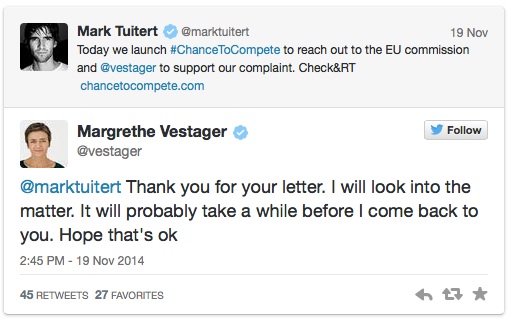

ChanceToCompeteTwitter.png (50.4KB)


Today, the European Commission announced that it has opened a formal antitrust investigation into International Skating Union (ISU) rules that permanently ban skaters from competitions such as the Winter Olympics and the ISU World and European Championships if they take part in events not organised or promoted by the ISU. The Commissioner for Competition, Margrethe Vestager, stated that the Commission "will investigate if such rules are being abused to enforce a monopoly over the organisation of sporting events or otherwise restrict competition. Athletes can only compete at the highest level for a limited number of years, so there must be good reasons for preventing them to take part in events."

Since the case originates from legal advice provided by the ASSER International Sports Law Centre, we thought it would be helpful to provide some clarifications on the background of the case and the main legal issues at stake. More...


Interview with Wil van Megen (Legal Director of FIFPro) on FIFPro’s EU Competition Law complaint against the FIFA Transfer System

Editor’s note
Wil is working as a lawyer since 1980. He started his legal career at Rechtshulp Rotterdam. Later on he worked for the Dutch national trade union FNV and law firm Varrolaan Advocaten. Currently he is participating in the Labour Law Section of lawfirm MHZ-advocaten in Schiedam in the Netherlands. He is also a member of a joint committee advising the government in labour issues.

Since 1991 he is dealing with the labour issues of the trade union for professional football players VVCS and cyclists’ union VVBW. Since 2002, he works for FIFPro, the worldwide union for professional football players based in Hoofddorp in the Netherlands. He is involved in many international football cases and provides legal support for FIFPro members all over the world. Wil was also involved in the FIFPro Black Book campaign on match fixing and corruption in Eastern Europe. More...


The Scala reform proposals for FIFA: Old wine in new bottles?

Rien ne va plus at FIFA. The news that FIFA’s Secretary General Jérôme Valcke was put on leave and released from his duties has been quickly overtaken by the opening of a criminal investigation targeting both Blatter and Platini.

With FIFA hopping from one scandal to the next, one tends to disregard the fact that it has been attempting (or rather pretending) to improve the governance of the organisation for some years now. In previous blogs (here and here), we discussed the so-called ‘FIFA Governance Reform Project’, a project carried out by the Independent Governance Committee (IGC) under the leadership of Prof. Dr. Mark Pieth of the Basel Institute on Governance. Their third and final report, published on 22 April 2014, listed a set of achievements made by FIFA in the area of good governance since 2011, such as establishing an Audit and Compliance Committee (A&C). However, the report also indicated the reform proposals that FIFA had not met. These proposals included the introduction of term limits for specific FIFA officials (e.g. the President) as well as introducing an integrity review procedure for all the members of the Executive Committee (ExCo) and the Standing Committees. More...

Asser International Sports Law Blog | Our International Sports Law Diary <br/>The <a href="http://www.sportslaw.nl" target="_blank">Asser International Sports Law Centre</a> is part of the <a href="https://www.asser.nl/" target="_blank"><img src="/sportslaw/blog/media/logo_asser_horizontal.jpg" style="vertical-align: bottom; margin-left: 7px;width: 140px" alt="T.M.C. Asser Instituut" /></a>

Asser International Sports Law Blog

Our International Sports Law Diary
The Asser International Sports Law Centre is part of the T.M.C. Asser Instituut

A Question of (dis)Proportion: The CAS Award in the Luis Suarez Biting Saga

The summer saga surrounding Luis Suarez’s vampire instincts is long forgotten, even though it might still play a role in his surprisingly muted football debut in FC Barcelona’s magic triangle. However, the full text of the CAS award in the Suarez case has recently be made available on CAS’s website and we want to grasp this opportunity to offer a close reading of its holdings. In this regard, one has to keep in mind that “the object of the appeal is not to request the complete annulment of the sanction imposed on the Player” (par.33). Instead, Suarez and Barcelona were seeking to reduce the sanction imposed by FIFA. In their eyes, the four-month ban handed out by FIFA extending to all football-related activities and to the access to football stadiums was excessive and disproportionate. Accordingly, the case offered a great opportunity for CAS to discuss and analyse the proportionality of disciplinary sanctions based on the FIFA Disciplinary Code (FIFA DC).  More...

The International Sports Law Digest – Issue II – July-December 2014

I. Literature


1. Antitrust/Competition Law and Sport

G Basnier, ‘Sports and competition law: the case of the salary cap in New Zealand rugby union’, (2014) 14 The International Sports Law Journal 3-4, p.155

R Craven, ‘Football and State aid: too important to fail?’ (2014) 14 The International Sports Law Journal 3-4, p.205

R Craven, ‘State Aid and Sports Stadiums: EU Sports Policy or Deference to Professional Football (2014) 35 European Competition Law Review Issue 9, 453


2. Intellectual Property Rights in Sports law / Betting rights/ Spectators’ rights/ Sponsorship Agreements

Books

W T Champion and K DWillis, Intellectual property law in the sports and entertainment industries (Santa Barbara, California; Denver, Colorado; Oxford, England: Praeger 2014)

J-M Marmayou and F Rizzo, Les contrats de sponsoring sportif (Lextenso éditions 2014) 

More...


Time to Cure FIFA’s Chronic Bad Governance Disease

 After Tuesday’s dismissal of Michael Garcia’s complaint against the now infamous Eckert statement synthetizing (misleadingly in his eyes) his Report on the bidding process for the World Cup 2018 and 2022, Garcia finally decided to resign from his position as FIFA Ethics Committee member. On his way out, he noted: “No independent governance committee, investigator, or arbitration panel can change the culture of an organization”. It took Garcia a while to understand this, although others faced similar disappointments before. One needs only to remember the forgotten reform proposals of the Independent Governance Committee led by Prof. Dr. Mark Pieth. More...

The CAS Ad Hoc Division in 2014: Business As Usual? - Part. 2: The Selection Drama

In a first blog last month we discussed the problem of the scope of jurisdiction of the Ad Hoc Division of the Court of Arbitration for Sport. The key issue was whether an athlete could get his case heard in front of the CAS Ad Hoc Division or not. In this second part, we will also focus on whether an athlete can access a forum, but a different kind of forum: the Olympic Games as such. This is a dramatic moment in an athlete’s life, one that will decide the future path of an entire career and most likely a lifetime of opportunities. Thus, it is a decision that should not be taken lightly, nor in disregard of the athletes’ due process rights. In the past, several (non-)selection cases were referred to the Ad Hoc Divisions at the Olympic Games, and this was again the case in 2014, providing us with the opportunity for the present review.

Three out of four cases dealt with by the CAS Ad Hoc Division in Sochi involved an athlete contesting her eviction from the Games. Each case is specific in its factual and legal assessment and deserves an individual review. More...

Should the CAS ‘let Dutee run’? Gender policies in Sport under legal scrutiny. By Thalia Diathesopoulou

The rise of Dutee Chand, India’s 100 and 200-meter champion in the under 18-category, was astonishing. Her achievements were more than promising: after only two years, she broke the 100m and 200m national junior records, competed in the 100m final at the World Youth Athletics Championships in Donetsk and collected two gold medals in the Asian Junior Championships in Chinese Taipei. But, in July 2014, this steady rise was abruptly halted. Following a request from the Athletics Federation of India (AFI), the Sports Authority of India (SAI) conducted blood tests on the Indian sprinters. Dutee was detected with female hyperandrogenism, i.e a condition where the female body produces high levels of testosterone. As a result, a few days before the Commonwealth Games in Glasgow, the AFI declared Dutee ineligible to compete under the IAAF Regulations and prevented her from competing in future national and international events in the female category. Pursuant to the IAAF ‘Hyperandrogenism Policy’, the AFI would allow Dutee to return to competition only if she lowers her testosterone level beneath the male range by means of medical or surgical treatment.[1] On 25 September 2014, Dutee filed an appeal before the CAS, seeking to overturn the AFI’s decision and declare IAAF and IOC’s hyperandrogenism regulations null and void. She is defending her right to compete the way she actually is: a woman with high levels of testosterone. Interestingly enough, albeit a respondent, AFI supports her case.

IAAF and IOC rules set limits to female hyperandrogenism, which is deemed an unfair advantage that erodes female sports integrity. While these rules have been contested with regard to their scientific and ethical aspects, this is the first time that they will be debated in court. This appeal could have far-reaching ramifications for the sports world. It does not only seek to pave the way for a better ‘deal’ for female athletes with hyperandrogenism, who are coerced into hormonal treatment and even surgeries to ‘normalise’ themselves as women[2], but it rather brings the CAS, for the first time, before the thorny question:

How to strike a right balance between the core principle of ‘fair play’ and norms of non-discrimination, in cases where a determination of who qualifies as a ‘woman’ for the purposes of sport has to be made? More...

The O’Bannon Case: The end of the US college sport’s amateurism model? By Zygimantas Juska

On 8 August, U.S. District Judge Claudia Wilken ruled in favour of former UCLA basketball player O'Bannon and 19 others, declaring that NCAA's longstanding refusal to compensate athletes for the use of their name, image and likenesses (NILs) violates US antitrust laws. In particular, the long-held amateurism justification promoted by the NCAA was deemed unconvincing.

On 14 November, the NCAA has appealed the judgment, claiming that federal judge erred in law by not applying a 1984 Supreme Court ruling. One week later, the NCAA received support from leading antitrust professors who are challenging the Judge Wilken’s reasoning in an amicus curiae. They are concerned that the judgment may jeopardize the proper regulation of college athletics. The professors argued that if Wilken’s judgment is upheld, it

would substantially expand the power of the federal courts to alter organizational rules that serve important social and academic interests…This approach expands the ‘less restrictive alternative prong’ of the antitrust rule of reason well beyond any appropriate boundaries and would install the judiciary as a regulatory agency for collegiate athletics”.   

More...

Image Rights in Professional Basketball (Part II): Lessons from the American College Athletes cases. By Thalia Diathesopoulou

In the wake of the French Labour Union of Basketball (Syndicat National du Basket, SNB) image rights dispute with Euroleague and EA Games, we threw the “jump ball” to start a series on players’ image rights in international professional basketball. In our first blogpost, we discussed why image rights contracts in professional basketball became a fertile ground for disputes when it comes to the enforcement of these contracts by the Basketball Arbitral Tribunal (BAT). Indeed, we pointed out that clubs might take advantage of the BAT’s inconsistent jurisprudence to escape obligations deriving from image rights contracts.

In this second limb, we will open a second field of legal battles “around the rim”: the unauthorized use of players’ image rights by third parties. We will use as a point of reference the US College Athletes image rights cases before US Courts and we will thereby examine the legal nature of image rights and the precise circumstances in which such rights may be infringed. Then, coming back to where we started, we will discuss the French case through the lens of US case law on players’ image rights. 


Source: http://philadelphia.cbslocal.com/2013/09/27/ea-sports-settles-college-likeness-case/ More...


The Olympic Agenda 2020: The devil is in the implementation!

The 40 recommendations of the Olympic Agenda 2020 are out! First thought: one should not underplay the 40 recommendations, they constitute (on paper at least) a potential leap forward for the IOC. The media will focus on the hot stuff: the Olympic channel, the pluri-localisation of the Games, or their dynamic format. More importantly, and to some extent surprisingly to us, however, the IOC has also fully embraced sustainability and good governance. Nonetheless, the long-term legacy of the Olympic Agenda 2020 will hinge on the IOC’s determination to be true to these fundamental commitments. Indeed, the devil is always in the implementation, and the laudable intents of some recommendations will depend on future political choices by Olympic bureaucrats. 

For those interested in human rights and democracy at (and around) the Olympics, two aspects are crucial: the IOC’s confession that the autonomy of sport is intimately linked to the quality of its governance standards and the central role the concept of sustainability is to play in the bidding process and the host city contract.  More...

UEFA’s tax-free Euro 2016 in France: State aid or no State aid?

Last week, the French newspaper Les Echos broke the story that UEFA (or better said its subsidiary) will be exempted from paying taxes in France on revenues derived from Euro 2016. At a time when International Sporting Federations, most notably FIFA, are facing heavy criticisms for their bidding procedures and the special treatment enjoyed by their officials, this tax exemption was not likely to go unnoticed. The French minister for sport, confronted with an angry public opinion, responded by stating that tax exemptions are common practice regarding international sporting events. The former French government agreed to this exemption. In fact, he stressed that without it “France would never have hosted the competition and the Euro 2016 would have gone elsewhere”. More...

The New Olympic Host City Contract: Human Rights à la carte? by Ryan Gauthier, PhD Researcher (Erasmus University Rotterdam)

Three weeks ago, I gave a talk for a group of visiting researchers at Harvard Law School on the accountability of the IOC for human rights abuses caused by hosting Olympic Games. On the day of that talk, Human Rights Watch announced that the International Olympic Committee (“IOC”) would insert new language into the Host City Contract presumably for the 2022 Olympic Games onwards. The new language apparently requires the parties to the contract to:

“take all necessary measures to ensure that development projects necessary for the organization of the Games comply with local, regional, and national legislation, and international agreements and protocols, applicable in the host country with regard to planning, construction, protection of the environment, health, safety, and labour laws.”More...