Asser International Sports Law Blog

Our International Sports Law Diary
The Asser International Sports Law Centre is part of the T.M.C. Asser Instituut

UEFA may have won a battle, but it has not won the legal war over FFP

Yesterday, the press revealed that the European Commission decided to reject the complaint filed by Jean-Louis Dupont, the former lawyer of Bosman, on behalf of a player agent Striani, against the UEFA Financial Fair Play (FFP) Regulations. The rejection as such is not a surprise. The Commission had repeatedly expressed support of the principles underlying the UEFA FFP. While these statements were drafted vaguely and with enough heavy caveats to protect the Commission from prejudicing a proper legal assessment, the withdrawal of its support would have been politically embarrassing.

Contrary to what is now widely assumed, this decision does not entail that UEFA FFP regulations are compatible with EU Competition Law. UEFA is clearly the big victor, but the legal reality is more complicated as it looks. More...


The Nine FFP Settlement Agreements: UEFA did not go the full nine yards

The UEFA Club Licensing and Financial Fair Play Regulations have been implemented by UEFA since the season 2011/12 with the aim of encouraging responsible spending by clubs for the long-term benefit of football. However, the enforcement of the break-even requirement as defined in Articles 62 and 63 of the Regulations (arguably the most important rules of FFP) has only started this year. Furthermore, UEFA introduced recently amendments to the Procedural rules governing the Club Financial Control Body (CFCB) allowing settlement agreements to be made between the clubs and the CFCB.  

On Friday 16 May, UEFA finally published the nine separate settlement agreements between the respective clubs and the CFCB regarding the non-compliance with the Financial Fair Play (FFP) break-even requirements. More...

Dahmane v KRC Genk: Bosman 2.0 or Storm in a Teacup?

Mohamed Dahmane is a professional football player of French-Algerian origin, who has played for a variety of European clubs, including French club US Mauberge, Belgian club RAEC Mons and Turkish club Bucaspor. However, he will mostly be remembered as the player whose legal dispute with his former club (Belgian club KRC Genk) revived the debate on football players’ labour rights.  More...

Get Up, Stand Up at the Olympics. A review of the IOC's policy towards political statements by Athletes. By Frédérique Faut

The Olympic Games are a universal moment of celebration of sporting excellence. But, attention is also quickly drawn to their dark side, such as environmental issues, human rights breaches and poor living conditions of people living near the Olympic sites. In comparison, however, little commentary space is devoted to the views of athletes, the people making the Olympics. This article tries to remediate this, by focussing on Rule 50 of the Olympic Charter which prevents athletes from freely expressing their (political) thoughts.  More...

Final Report on the FIFA Governance Reform Project: The Past and Future of FIFA’s Good Governance Gap

Qatar’s successful bid to host the 2022 World Cup left many people thunderstruck: How can a country with a population of 2 million people and with absolutely no football tradition host the biggest football event in the world? Furthermore, how on earth can players and fans alike survive when the temperature is expected to exceed 50 °C during the month (June) the tournament is supposed to take place?

Other people were less surprised when FIFA’s President, Sepp Blatter, pulled the piece of paper with the word “Qatar” out of the envelope on 2 December 2010. This was just the latest move by a sporting body that was reinforcing a reputation of being over-conservative, corrupt, prone to conflict-of-interest and convinced of being above any Law, be it national or international.More...

Doping Paradize – How Jamaica became the Wild West of Doping

Since the landing on the sporting earth of the Übermensch, aka Usain Bolt, Jamaica has been at the centre of doping-related suspicions. Recently, it has been fueling those suspicions with its home-made scandal around the Jamaica Anti-Doping Commission (JADCO). The former executive of JADCO, Renee Anne Shirley, heavily criticized its functioning in August 2013, and Jamaica has been since then in the eye of the doping cyclone. More...

Cocaine, Doping and the Court of Arbitration for sport - “I don’t like the drugs, but the drugs like me”. By Antoine Duval

Beginning of April 2014, the Colombian Olympic Swimmer Omar Pinzón was cleared by the Court of Arbitration for Sport (CAS) of an adverse finding of Cocaine detected in a urine sample in 2013. He got lucky. Indeed, in his case the incredible mismanagement and dilettante habits of Bogotá’s anti-doping laboratory saved him from a dire fate: the two-year ban many other athletes have had the bad luck to experience. More...

Asser International Sports Law Blog | Our International Sports Law Diary <br/>The <a href="http://www.sportslaw.nl" target="_blank">Asser International Sports Law Centre</a> is part of the <a href="https://www.asser.nl/" target="_blank"><img src="/sportslaw/blog/media/logo_asser_horizontal.jpg" style="vertical-align: bottom; margin-left: 7px;width: 140px" alt="T.M.C. Asser Instituut" /></a>

Asser International Sports Law Blog

Our International Sports Law Diary
The Asser International Sports Law Centre is part of the T.M.C. Asser Instituut

Supporters of the ISLJ Annual International Sports Law Conference 2018: LawInSport

Editor's note: In the coming days we will introduce the supporters of our upcoming ISLJ Annual International Sports Law Conference 2018 (also known as #ISLJConf18). To do so, we have sent them a tailored questionnaire aimed at reflecting both their activities and their expectations for the conference. It is a good opportunity for us to thank them for their enthusiastic support and commitment to international sports law research. We are very happy to continue this series of interviews with LawInSport, a knowledge hub and educational platform for the community of people working in or with an interest in sport and the law  (many thanks to LawInSport's CEO Sean Cottrell for kindly responding to our questions).


1. Can you explain to our readers what LawInSport is about?

LawInSport is a knowledge hub, educational platform and global community of people working in or with an interest in sport and the law.

Our objective is to help people ‘understand the rules of the game™’. What does this mean? It means people in sport having access to information that enables them to have a better understanding the rules and regulations that govern the relationships, behaviours and processes within sports. This in turn creates a foundation based on the principles of the rule of law, protecting the rights of everyone working and participating in sport.  

2. What are the challenges and perks of being an international sports law 'reporter’ ?

I do not consider myself a reporter, but as the head of an organisation that has a responsibility to provide the highest quality information on legal issues in sport,  focusing on what is important and not just what is popular, whilst trying to stay free from conflicts of interests. These two issues, popularism and conflict of interest, are the two of the biggest challenges.

Popularism and the drive to win attention is, in my opinion, causing a lack of discipline when it comes to factual and legal accuracy in coverage of sports law issues, which on their own may seem harmless, but can cause harm to organisations and individuals (athletes, employees, etc).

Conflict of interest will obviously arise in such a small sector, however, there is not a commonly agreed standard in internationally, let alone in sports law. Therefore, one needs to be diligent when consuming information to understand why someone may or may not hold a point of view, if they have paid to get it published or has someone paid them to write it. For this reason it can be hard to get a full picture of what is happening in the sector.

In terms of perks, I get to do something that is both challenging and rewarding on a daily basis, and as  a business owner I have the additional benefit of work with colleagues I enjoy working with. I have the privilege of meeting world leaders in their respective fields (law, sport, business, science, education, etc) and gain insights from them about their work and life experiences which is incredibly enriching.  Getting access to speak to the people who are on the front line, either athletes, coaches, lawyers, scientists, rather than from a third party is great as it gives you an unfiltered insight into what is going on.

On the other side of things, we get the opportunity to help people through either having a better understand of the legal and regulatory issues in sports or to understand how to progress themselves towards their goals academically and professionally is probably the most rewarding part of my work. 

3. What are the burning issues in international sports law that you would like to see discussed at the conference?

  • The long-term implications of human rights law in sport;
  • The importance of meaningful of stakeholder consultation in the creation and drafting of regulations in sport;
  • Effective international safeguarding in sport.

4. Why did you decide to support the ISLJ Annual International Sports Law Conference?

We support ISLJ Annual International Sports Law Conference as it is a non-profit conference that’s purpose is to create a space to explore a wide range of legal issues in sport. The conference is an academic conference that does a great job in bringing a diverse range of speakers and delegates. The discussions and debates that take place will benefit the wider sports law community.  Therefore, as LawInSport’s objective is focused on education it was a straight forward decision to support the conferences as it is aligned with our objectives. 

Supporters of the ISLJ Annual International Sports Law Conference 2018: Women in Sports Law

Editor's note: In the coming days we will introduce the supporters of our upcoming ISLJ Annual International Sports Law Conference 2018 (also known as #ISLJConf18). To do so, we have sent them a tailored questionnaire aimed at reflecting both their activities and their expectations for the conference. It is a good opportunity for us to thank them for their enthusiastic support and commitment to international sports law research. We are very proud to start this series of interviews with Women in Sports Law, an association launched in 2016 and which has already done so much to promote and advance the role of women in international sports law (many thanks to Despina Mavromati for kindly responding to our questions on behalf of WISLaw).


1. Can you explain to our readers what WISLaw is about?

Women In Sports Law (WISLaw, www.wislaw.co) is an international association based in Lausanne that unites more than 300 women from 50 countries specializing in sports law. It is a professional network that aims at increasing the visibility of women working in the sector, through a detailed members’ directory and various small-scale talks and events held in different countries around the world. These small-scale events give the opportunity to include everyone in the discussion and enhance the members’ network. Men from the sector and numerous arbitral institutions, conference organizers and universities have come to actively support our initiative.


2. What are the challenges and opportunities for women getting involved in international sports law?

Women used to be invisible in this sector. All-male panels were typical at conferences and nobody seemed to notice this flagrant lack of diversity. WISLaw created this much-needed platform to increase visibility through the members’ directory and through a series of small-scale events where all members, independent of their status or seniority, can attend and be speakers.

Another difficulty is that European football (soccer) is traditionally considered to be a “male-dominated” sport, despite the fact that there are so many great female football teams around the world. The same misperception applies to sports lawyers!

Last, there is a huge number of women lawyers working as in-house counsel and as sports administrators. There is a glass ceiling for many of those women, and the WISLaw annual evaluation of the participation of women in those positions attempts to target their issues and shed more light into this specific problem.


3. What are the burning issues in international sports law that you would like to see discussed at the conference?

The ISLJ Annual Conference has already set up a great lineup of topics combining academic and more practical discussions in the most recent issues in international sports law. 


4. Why did you decide to support the ISLJ Annual International Sports Law Conference?

The Asser International Sports Law Centre has promoted and supported WISLaw since the very beginning. The ISLJ Annual International Sports Law Conference was the first big conference to officially include a WISLaw lunch talk in its program, allowing thus the conference attendees to be part of a wider informal discussion on a specific topical issue and raise their questions with respect to WISLaw. Another important reason why WISLaw supports this conference is because the conference organizers are making sincere efforts to have increased diversity in the panels : this year’s ISLJ Annual International Sports Law Conference is probably the first sports law conference to come close to a full gender balance in its panels, with 40% of the speakers being women !

The proportionality test under Art. 101 (1) TFEU and the legitimacy of UEFA Financial fair-play regulations: From the Meca Medina and Majcen ruling of the European Court of Justice to the Galatasaray and AC Milan awards of the Court of Arbitration for Sport – By Stefano Bastianon

Editor’s note: Stefano Bastianon is Associate Professor in EU Law and EU sports law at the University of Bergamo and lawyer admitted to the Busto Arsizio bar. He is also member of the IVth Division of the High Court of Sport Justice (Collegio di Garanzia dello sport) at the National Olympic Committee.


1. On the 20th July 2018, the Court of Arbitration for Sport (hereinafter referred to as “CAS”) issued its decision in the arbitration procedure between AC Milan and UEFA. The subject matter of this arbitration procedure was the appeal filed by AC Milan against the decision of the Adjudicatory Chamber of the UEFA Financial Control Body dated 19th June 2018 (hereinafter referred to as “the contested decision”). As many likely know, the CAS has acknowledged that, although AC Milan was in breach of the break-even requirement, the related exclusion of the club from the UEFA Europe League was not proportionate. To date, it is the first time the CAS clearly ruled that the sanction of exclusion from UEFA club competitions for a breach of the break-even requirement was not proportionate. For this reason the CAS award represents a good opportunity to reflect on the proportionality test under Art. 101 TFEU and the relationship between the landmark ruling of the European Court of Justice (hereinafter referred to as “ECJ”) in the Meca Medina and Majcen affair and the very recent case-law of the CAS. More...

The “Victory” of the Court of Arbitration for Sport at the European Court of Human Rights: The End of the Beginning for the CAS

My favourite speed skater (Full disclosure: I have a thing for speed skaters bothering the ISU), Claudia Pechstein, is back in the news! And not from the place I expected. While all my attention was absorbed by the Bundesverfassungsgericht in Karlsruhe (BVerfG or German Constitutional Court), I should have looked to the European Court of Human Rights in Strasbourg (ECtHR). The Pechstein and Mutu joint cases were pending for a long time (since 2010) and I did not anticipate that the ECtHR would render its decision before the BVerfG. The decision released last week (only available in French at this stage) looked at first like a renewed vindication of the CAS (similar to the Bundesgerichtshof (BGH) ruling in the Pechstein case), and is being presented like that by the CAS, but after careful reading of the judgment I believe this is rather a pyrrhic victory for the status quo at the CAS. As I will show, this ruling puts to rest an important debate surrounding CAS arbitration since 20 years: CAS arbitration is (at least in its much-used appeal format in disciplinary cases) forced arbitration. Furthermore, stemming from this important acknowledgment is the recognition that CAS proceedings must comply with Article 6 § 1 of the European Convention of Human Rights (ECHR), in particular hearings must in principle be held in public and decisions freely available to all. Finally, I will criticise the Court’s finding that CAS complies with the requirements of independence and impartiality imposed by Article 6 § 1 ECHR. I will not rehash the  well-known facts of both cases, in order to focus on the core findings of the decision. More...

ISLJ International Sports Law Conference 2018 - Asser Institute - 25-26 October - Register Now!

Dear all,

Last year we decided to launch the 'ISLJ Annual International Sports Law Conference' in order to give a public platform to the academic discussions on international sports law featured in the ISLJ. The first edition of the conference was a great success (don't take my word for it, just check out #ISLJConf17 on twitter), featuring outstanding speakers and lively discussions with the room. We were very happy to see people from some many different parts of the world congregating at the Institute to discuss the burning issues of their field of practice and research.

This year, on 25 and 26 October, we are hosting the second edition and we are again welcoming well-known academics and practitioners in the field. The discussions will turn around the notion of lex sportiva, the role of Swiss law in international sports law, the latest ISU decision of the European Commission, the Mutu/Pechstein ruling of the European Court of Human Rights, or the reform proposal of the FIFA Regulations on the Transfer and Status of Players. It should be, it will be, an exciting two days!

You will find below the final programme of the conference, please feel free to circulate it within your networks. We have still some seats left, so don't hesitate to register (here) and to join us.

Looking forward to seeing you and meeting you there!

Antoine

Football Intermediaries: Would a European centralized licensing system be a sustainable solution? - By Panagiotis Roumeliotis

Editor's note: Panagiotis Roumeliotis holds an LL.B. degree from National and Kapodistrian University of Athens, Greece and an LL.M. degree in European and International Tax Law from University of Luxembourg. He is qualified lawyer in Greece and is presently working as tax advisor with KPMG Luxembourg while pursuing, concomitantly, an LL.M. in International Sports Law at Sheffield Hallam University, England. His interest lies in the realm of tax and sports law. He may be contacted by e-mail at ‘p.roumeliotis@hotmail.com’.


Introduction

The landmark Bosman Ruling triggered the Europeanization of the labour market for football players by banning nationality quotas. In turn, in conjunction with the boom in TV revenues, this led to a flourishing transfer market in which players’ agents or intermediaries play a pivotal role, despite having a controversial reputation.

As a preliminary remark, it is important to touch upon the fiduciary duty of sports agents towards their clients. The principal-agent relationship implies that the former employs the agent so as to secure the best employment and/or commercial opportunities. Conversely, the latter is expected to act in the interest of the player as their relationship should be predicated on trust and confidence, as much was made clear in the English Court of Appeal case of Imageview Management Ltd v. Kelvin Jack. Notably, agents are bound to exercise the utmost degree of good faith, honesty and loyalty towards the players.[1]

At the core of this blog lies a comparative case study of the implementation of the FIFA Regulations on working with intermediaries (hereinafter “FIFA RWI”) in eight European FAs covering most of the transfers during the mercato. I will then critically analyze the issues raised by the implementation of the RWI and, as a conclusion, offer some recommendations. More...


Seraing vs. FIFA: Why the rumours of CAS’s death have been greatly exaggerated

Rumours are swirling around the decision (available in French here) of the Court of Appeal of Brussels in the case opposing RFC Seraing United to FIFA (as well as UEFA and the Belgian Football Federation, URSBFA) over the latter’s ban on third-party ownership. The headlines in various media are quite dramatic (see here and here), references are made to a new Bosman, or to a shaken sport’s legal system. Yet, after swiftly reading the decision for the first time on 29th August, I did not have, unlike with the Pechstein ruling of the Oberlandesgericht München, the immediate impression that this would be a major game-changer for the Court of Arbitration for Sport (CAS) and the role of arbitration in sports in general. After careful re-reading, I understand how certain parts of the ruling can be misunderstood or over-interpreted. I believe that much of the press coverage failed to accurately reflect the reasoning of the court and to capture the real impact of the decision. In order to explain why, I decided to write a short Q&A (including the (not water-proof) English translations of some of the key paragraphs of the decision).

 More...

New Article Published! The Olympic Charter: A Transnational Constitution Without a State?

My latest article has just been published online by the Journal of Law and Society. It is available open access here.

The article stems from a conference organised by Jiri Priban from Cardiff University on Gunther Teubner's idea of societal constitutionalism applied to transnational regimes. My role was to test whether his descriptive and normative framework was readily applicable to the lex sportiva, and in particular its overarching "constitutional" text: the Olympic Charter.

As you will see my conclusion is mixed. I find that the Olympic Charter (OC) displays many constitutional features and is even able to regularly defend successfully its autonomy vis-à-vis national states and their laws. However, while I document some inception of limitative constitutional rules, such as the ban on discrimination or the principle of fair play, I also conclude that those have limited impact in practice. While constitutional changes to the OC can be triggered by scandal, resistance and contestation, as illustrated by the emergence of environmental concerns after the Albertville Games and the governance reshuffle of the IOC after the Salt Lake City scandal, I am also sceptical that these were sufficient to tackle the underlying problems, as became obvious with the unmatched environmental damage caused by the Sotchi Games in 2014.

In conclusion, more than sporadic public outrage, I believe that the intervention of national law and, even more, European Union law will be capable and needed to rein the Olympic regime and impose external constitutional constraints on its (at least sometimes) destructive operations.

Here is the abstract of the article: This article examines various aspects of Teubner's theory of societal constitutionalism using the lex sportiva as an empirical terrain. The case study focuses on the operation of the Olympic Charter as a transnational constitution of the Olympic movement. It shows that recourse to a constitutional vocabulary is not out of place in qualifying the function and authority of the Charter inside and outside the Olympic movement. Yet, the findings of the case study also nuance some of Teubner's descriptive claims and question his normative strategy.

Good read! (And do not hesitate to share your feedback)


New Position - Internship in International Sports Law - Deadline 15 August


The T.M.C. Asser Instituut offers post-graduate students the opportunity to gain practical experience in the field of international and European sports law.  The T.M.C. Asser Instituut, located in The Hague, is an inter-university research institute specialized in international and European law. Since 2002, it is the home of the ASSER International Sports Law Centre, a pioneer in the field of European and international sports law. More...


Human Rights Protection and the FIFA World Cup: A Never-Ending Match? - By Daniela Heerdt

Editor’s note: Daniela Heerdt is a PhD candidate at Tilburg Law School in the Netherlands. Her PhD research deals with the establishment of responsibility and accountability for adverse human rights impacts of mega-sporting events, with a focus on FIFA World Cups and Olympic Games. She recently published an article in the International Sports Law Journal that discusses to what extent the revised bidding and hosting regulations by FIFA, the IOC and UEFA strengthen access to remedy for mega-sporting events-related human rights violations.


The 21st FIFA World Cup is currently underway. Billions of people around the world follow the matches with much enthusiasm and support. For the time being, it almost seems forgotten that in the final weeks leading up to the events, critical reports on human rights issues related to the event piled up. This blog explains why addressing these issues has to start well in advance of the first ball being kicked and cannot end when the final match has been played. More...


enges-of-e-sports-by-n-emre-bilginoglu">Introducing the new legal challenges of E-Sports. By N. Emre Bilginoglu
6. February 2017 Oskar van Maren Blog, International Sports Law Commentaries (1)

Editor’s Note: Emre Bilginoglu[1] is an attorney in Istanbul and the co-founder of the Turkish E-Sports Players Association, a non-profit based in Istanbul that aims to provide assistance to professional gamers and to work on the relevant laws affecting them. 


The world is witnessing the rise of a new sport that is growing at an incredible speed: E-Sports. We are only starting to understand its legal implications and challenges.

In recent years, E-Sports has managed to attract thousands of fans to arenas to see a group of people play a video game. These people are literally professional gamers (cyber athletes)[2] who make money by competing in tournaments. Not all video games have tournaments in which professional players compete against each other.

The most played games in E-Sports competitions are League of Legends (LoL), Defense of the Ancients 2 (DotA 2) and Counter-Strike: Global Offensive (CS:GO). LoL and DotA are both Multiplayer online battle arena (MOBA) games, a genre of strategy video games in which the player controls a single character in one of two teams. The goal of the game is to destroy the opponent’s main structure. CS:GO is a first-person shooter (FPS) game, a genre of video games where the player engages combat through a first-person perspective. The main objective in CS:GO is to eliminate the opposing team or to terrorize or counter-terrorize, planting bombs or rescuing hostages. Other games that have (popular) E-Sports competitions include Starcraft II (real time strategy), Hearthstone (collectible card video game), Call of Duty (FPS) and FIFA (football).

The gaming requires cooperation between team players, a high level of concentration, rapid reactions and some seriously fast clicking. E-Sports is a groovy term to describe organized competitive computer gaming. The E-Sports industry is exponentially growing, amounting to values expressed in billions of dollars. According to Newzoo, a website dedicated to the collection of E-Sports data, there are some 250 million occasional viewers of E-Sports with Asia-Pacific accounting for half of the total amount. The growth of the industry is indubitably supported by online streaming media platforms. This article aims to explain what E-Sports is and to give the readers an insight on the key legal questions raised by it. More...


Time for Transparency at the Court of Arbitration for Sport. By Saverio Spera

Editor’s Note: Saverio Spera is an Italian lawyer and LL.M. graduate in International Business Law from King’s College London. He is currently an intern at the ASSER International Sports Law Centre.


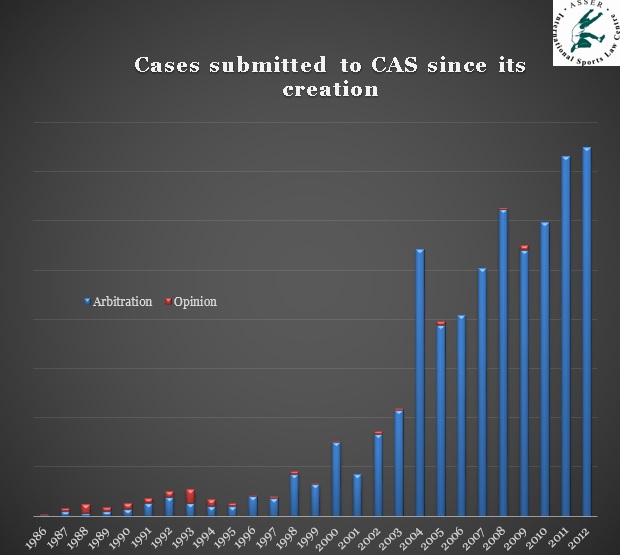
The time is ripe to take a closer look at the CAS and its transparency, as this is one of the ways to ensure its public accountability and its legitimacy. From 1986 to 2013, the number of arbitrations submitted to the CAS has grown from 2 to more than 400 a year. More specifically, the number of appeals submitted almost doubled in less than ten years (from 175 in 2006, to 349 in 2013[1]). Therefore, the Court can be considered the judicial apex of an emerging transnational sports law (or lex sportiva).[2] In turn, the increased authority and power of this institution calls for increased transparency, in order to ensure its legitimacy.[3]

More...


UEFA’s betting fraud detection system: How does the CAS regard this monitoring tool? By Emilio García.

Editor’s note: Emilio García (emilio.garcia@uefa.ch)  is a doctor in law and head of disciplinary and integrity at UEFA. Before joining UEFA, he was the Spanish Football Federation’s legal director (2004–12) and an arbitrator at the CAS (2012–13).In this blog, Emilio García provides a brief review of a recent case before the Court of Arbitration for Sport (CAS): Klubi Sportiv Skënderbeu v UEFA (CAS 2016/A/4650)[1], in which he acted as main counsel for UEFA. 


Sport and match-fixing – A quick overview

Match-fixing is now legally defined as “an intentional arrangement, act or omission aimed at an improper alteration of the result or the course of a sports competition in order to remove all or part of the unpredictable nature of the aforementioned sports competition with a view to obtaining an undue advantage for oneself or for others”.[2] It has been said that there has always been match-fixing in sport.[3] From the ancient Olympic Games to the most important global sports competitions of today, manipulation of results has always been an all-too-frequent occurrence.

We have seen a number of very prominent instances of this kind of issue over the years. One of the most remarkable examples, which was even the subject of a film,[4] was the match-fixing episode during the 1919 World Series, where several players from the Chicago White Sox were found guilty of accepting bribes and deliberately losing matches against the Cincinnati Reds.[5]

The situation has changed considerably since then. In particular, the globalisation of the sports betting industry has had a massive impact, with recent studies estimating that between €200bn and €500bn is betted on sport every year.[6] Match-fixing does not just affect football either;[7] it is also affecting other sports, most notably tennis.[8] More...


The Diarra Ruling of the Tribunal of Charleroi: The New Pechstein, Bosman or Mutu?

Yesterday the sports law world was buzzing due to the Diarra decision of the Tribunal de Commerce du Hainaut (the Tribunal) based in Charleroi, Belgium. Newspapers were lining up (here, here and here) to spread the carefully crafted announcement of the new triumph of Jean-Louis Dupont over his favourite nemesis: the transfer system. Furthermore, I was lucky enough to receive on this same night a copy of the French text of the judgment. My first reaction while reading quickly through the ruling, was ‘OMG he did it again’! “He” meaning Belgian lawyer Jean-Louis Dupont, who after a string of defeats in his long shot challenge against FIFA’s TPO ban or UEFA’s FFP (see here and here), had [at least I be