Editor's note: Marine Montejo is a graduate from the College of
Europe in Bruges and is currently an intern at the ASSER International Sports
Law Centre.
The result of the Brexit referendum on 23
June 2016 took the European Union (almost) by surprise. A lot has been said and
written about the impact of the United Kingdom leaving the EU. As in all other
areas, the British sport sector will also face the effects of the modification
of the relationship between the EU and its (probable) former Member State, the
UK. It is nearly impossible to foresee all consequences as the UK has not even
triggered article 50 TFEU yet to officially start the exit negotiations.
However, as the UK position toward the EU will change in any case, this two-part
blog aims to examine the main practical implications of such an exit for the
UK, but also for the EU, in relation to the actual application of EU law in
sport and the EU sport policy.
Unless stated otherwise, the use of the
terms Brexit in this blog should be understood as a complete exit of the UK
from the European Union. This blog focus in particular on this worst case
scenario and its consequences for UK sport. However, it is highly improbable
that the future Brexit negotiations with the EU will end up without some kind
of special agreement between the two parties the first of which being an EEA
type of agreement with full access to the internal market and applicability of
EU law.
The first part of this blog will examined
the consequences for UK sport in terms of access to the EU internal market and
the applicability of free movement principles. The second part is focused on specific
impacts with regard of others domain of EU law for professional and grassroots
UK sport. More...
Editor’s note: This report compiles all relevant news,
events and materials on International and European Sports Law based on the
daily coverage provided on our twitter feed @Sportslaw_asser. You are
invited to complete this survey via the comments section below, feel free to
add links to important cases, documents and articles we might have
overlooked.
The headlines
What a month June
turned out to be. Waking up the morning after the 23rd, the results
of the UK referendum on EU membership were final. The words of Mark Twain: “Apparently
there is nothing that cannot happen today”, might provide the most apt
description of the mood felt at the time.[1]
The Leave campaign’s narrow victory has brought along tremendous economic,
political and legal uncertainties for both the UK and the (other) Member
States. To give but one example, with regard to the implications of Brexit on Europe’s
most profiting football league, we recommend an older blog
by Daniel Geey and Jonny Madill. More...
It’s been a long wait, but they’re finally here!
On Monday, the European Commission released its decisions regarding State aid to seven Spanish professional football clubs (Real Madrid on two occasions) and five Dutch professional football clubs. The decisions mark the end of the formal
investigations, which were opened in 2013. The Commission decided as follows:
no State aid to PSV Eindhoven (1); compatible aid to the Dutch clubs FC Den
Bosch, MVV Maastricht, NEC Nijmegen and Willem II (2); and incompatible aid granted
to the Spanish football clubs Real Madrid, FC Barcelona, Valencia CF, Athletic
Bilbao, Atlético Osasuna, Elche and Hércules (3).
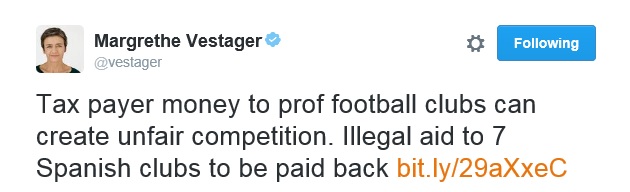
The recovery decisions in particular are truly historic.
The rules on State aid have existed since the foundation of the European
Economic Community in 1958, but it is the very first time
that professional football clubs have been ordered to repay aid received from
(local) public authorities.[1]
In a way, these decisions complete a development set in motion with the Walrave
and Koch ruling of 1974, where
the CJEU held that professional sporting activity, and therefore also football,
is subject to EU law. The landmark Bosman case of 1995 proved to be of great significance as
regards free movement of (professional) athletes and the Meca-Medina case of 2006 settled that EU competition rules were
equally applicable to the regulatory activity of sport. The fact that the first
ever State aid recovery decision concerns major clubs like Real Madrid, FC
Barcelona and Valencia, give the decisions extra bite. Therefore, this blog
post will focus primarily on the negative/recovery decisions[2],
their consequences and the legal remedies available to the parties involved.[3]
More...
Editor’s note: This report compiles all relevant news, events and
materials on International and European Sports Law based on the daily coverage
provided on our twitter feed @Sportslaw_asser. You are invited to complete this survey via the
comments section below, feel free to add links to important cases, documents
and articles we might have overlooked.
The Headlines
Challenged
membership put a lot of emphasis on football federations in May. The Court of Arbitration for Sport (“CAS”) has
rendered an award, on 27 April 2016, ordering the FIFA Council to
submit the application of the Gibraltar Football Association (GFA) for FIFA
membership to the FIFA Congress (the body authorised to admit new members to FIFA). The GFA has sought since 1999 to become a member of
UEFA and FIFA. In May 2013, it became a
member of the UEFA and went on to seek membership of FIFA. More...
Forget the European Championship currently held in France or the
upcoming Olympic Games in Rio. Doping scandals are making the headlines more than
ever in 2016. From tennis star Sharapova receiving a two-year ban for her use of
the controversial ‘meldonium’, to the seemingly never-ending doping scandals in
athletics. As if this was not enough, a new chapter
was added on 14 June to one of the most infamous and obscure doping sagas in
history: the Operación Puerto.
The special criminal appeal chamber,
the Audiencia Provincial, has held that the more than 200 blood bags of
professional athletes that have been at the center of the investigations since
2006 can be delivered to the relevant sporting authorities, such as the Spanish
Anti-Doping Agency (AEPSAD), WADA, the UCI and the Italian Olympic Committee
(CONI). In other words, there is now a good chance that the identities of the
involved athletes might eventually be revealed.
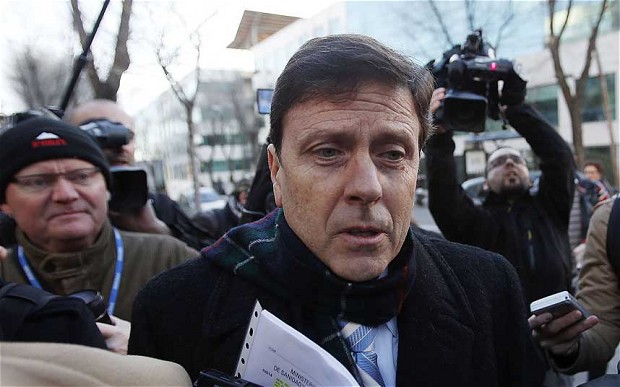
Source: http://www.telegraph.co.uk/sport/othersports/cycling/9834122/Operation-Puerto-doctor-Eufemiano-Fuentes-treated-tennis-players-athletes-footballers-and-a-boxer.html
This case note will analyze the court’s ruling and summarize its most
important findings. Given the amount of time passed since the scandal first
came to light (2004), the blog will commence with a short background summary of
the relevant facts. More...
Editor's note: Marine Montejo is a graduate from the College of Europe in Bruges and is currently an intern at the ASSER International Sports Law Centre.
On 3 June 2016, the Landgericht München (“Munich
Regional Court”) ordered temporary injunctions against the International Basketball Federation (“FIBA”)
and FIBA Europe, prohibiting them from sanctioning clubs who want to
participate in competitions organized by Euroleague Commercial Assets (“ECA”).
The reasoning of the Court is based on breaches of German and EU competition
law provisions. FIBA and FIBA Europe are, according to the judge, abusing their
dominant position by excluding or threatening to exclude national teams from
their international competitions because of the participation of their clubs in
the Euroleague. This decision is the first judicial step taken in the ongoing
legal battle between FIBA and ECA over the organization of European basketball competitions.
This judgment raises several interesting points with
regard to how the national judge deals with the alleged abuse of a dominant
position by European and international federations. A few questions arise
regarding the competence of the Munich Regional Court that may be interesting
to first look at in the wake of an appeal before examining the substance of the
case. More...
Editor’s note: Kester Mekenkamp is an LL.M. student in European Law at Leiden University and an intern at the ASSER International Sports Law Centre.
On 17 February 2016,
the Landesarbeitsgericht Rheinland-Pfalz
delivered its highly anticipated decision in the appeal
proceedings between German goalkeeper Heinz Müller and his former employer,
German Bundesliga club Mainz 05.[1]
The main legal debate revolved around the question (in general terms) whether
the use of a fixed term contract in professional football is compatible with
German and EU law.
In first instance (see
our earlier blog posts, here and here), the Arbeitsgericht Mainz had ruled that the
‘objective reasons’ provided in Section 14 (1) of the German
Part-time and Fixed-term Employment Act (Gesetz über Teilzeitarbeit und befristete
Arbeitsverträge, “TzBfG”), the national law implementing EU
Directive 1999/70/EC on fixed-term work, were not applicable
to the contract between Müller and Mainz 05 and therefore could not justify the
definite nature of that contract.[2]
In its assessment the court devoted special attention to the objective reason
relating to the nature of the work, declining justifications based thereupon.[3]
Tension rose and the verdict was soon labelled to be able to have Bosman-like
implications, if held up by higher courts.[4]
More...
The decision of the
Bundesgerichtshof (BGH), the Highest Civil Court in Germany, in the Pechstein case was eagerly awaited. At
the hearing in March, the Court decided it would pronounce itself on 7 June,
and so it did. Let’s cut things short: it is a striking victory for the Court
of Arbitration for Sport (CAS) and a bitter (provisory?) ending for Claudia
Pechstein. The BGH’s press
release is abundantly clear that the German judges endorsed the CAS
uncritically on the two main legal questions: validity of forced CAS
arbitration and the independence of the CAS. The CAS and ISU are surely right
to rejoice and celebrate the ruling in their respective press releases that
quickly ensued (here
and here).
At first glance, this ruling will be comforting the CAS’ jurisdiction for years
to come. Claudia Pechstein’s dire financial fate - she faces up to 300 000€ in
legal fees – will serve as a powerful repellent for any athlete willing to
challenge the CAS.More...
On 18 May 2016, the day the first part
of this blog was published, the Commission said in response
to the Hungarian MEP Péter Niedermüller’s question, that it
had “not specifically monitored the tax relief (…) but would consider doing so.
The Commission cannot prejudge the steps that it might take following such
monitoring. However, the Commission thanks (Niedermüller) for drawing its
attention to the report of Transparency International.”
With the actual implementation in Hungary appearing to
deviate from the original objectives and conditions of the aid scheme, as discussed
in part 1 of this blog, a possible monitoring exercise by the Commission of the
Hungarian tax benefit scheme seems appropriate. The question remains, however,
whether the Commission follows up on the intent of monitoring, or whether the
intent should be regarded as empty words. This second part of the blog will outline
the rules on reviewing and monitoring (existing) aid, both substantively and
procedurally. It will determine,
inter
alia, whether the State aid rules impose an obligation upon the Commission
to act and, if so, in what way. More...
Yesterday, 18 May 2016, the licensing committee of the Dutch football
federation (KNVB) announced its decision to sanction FC Twente with relegation to
the Netherland’s second (and lowest) professional league. The press release also
included a link to a document outlining the reasons underlying the
decision. For those following the saga surrounding Dutch football club FC
Twente, an unconditional sanction by the licensing committee appeared to be
only a matter of time. Yet, it is the sanction itself, as well as its
reasoning, that will be the primary focus of this short blog.More...