The International Sports Law Digest will be a bi-annual post gathering recent material on International and European Sports Law. This is an attempt at providing a useful overview of the new, relevant, academic contributions, cases, awards and disciplinary decisions in the field of European and International Sports Law. If you feel we have overlooked something please do let us know (we will update the post).
Antoine Duval More...
This year’s FIFA congress in Sao Paulo should not be
remembered only for the controversy surrounding the bid for the World Cup 2022
in Qatar. The controversy was surely at the centre of the media coverage, but
in its shadow more long-lasting decisions were taken. For example, the new Regulations on
Working with Intermediaries was approved, which is probably the most
important recent change to FIFA regulations. These new Regulations will
supersede the Regulations on Players’
Agents
when they come into force on 1 April 2015. In this blog post we compare the old and
the new Regulations followed by a short analysis and prospective view on the
effects this change could have. More...
Luis Suarez did it again. The serial biter that
he is couldn’t refrain
its impulse to taste a bit of Chiellini’s shoulder (not really the freshest
meat around though). Notwithstanding his amazing theatrical skills and escaping
the sight of the referee, Suarez could not in the information age get away with
this unnoticed. Seconds after the incident, the almighty “social networks” were
already bruising with evidence, outrage and commentaries over Suarez’s misdeed.
Since then, many lawyers have weighed in (here,
here
and here)
on the potential legal consequences faced by Suarez. Yesterday FIFA’s
disciplinary committee decided to sanction him with a 4 months ban from any
football activity and a 9 International games ban. In turn, Suarez announced that
he would challenge the decision[1],
and plans on going to the Court of Arbitration for Sport if necessary[2]. Let’s be the advocates of the cannibal!More...
In 2009, Sepp
Blatter expressed his concerns that half of the
players participating in the 2014 FIFA World Cup would be Brazilians naturalized
by other countries. The Official list of Players released a few weeks ago tends to prove him
wrong[1].
However, some players have changed their eligibility in the past and will even be
playing against their own country of origin[2].
This post aims at explaining the key legal aspects in changes of national
affiliation and to discuss the regulations pertaining to the constitution of
national sides in general[3]. More...
Our first report on the FIFA business dealt with FIFA’s revenues and highlighted
their impressive rise and progressive diversification. In parallel to this
growth of FIFA’s income, it is quite natural that its expenses have been
following a similar path (see Graph 1). However, as we will see FIFA makes it
sometimes very difficult to identify precisely where the money is going. Nonetheless,
this is precisely what we wish to tackle in this post, and to do so we
will rely on the FIFA Financial reports over the last 10 years.
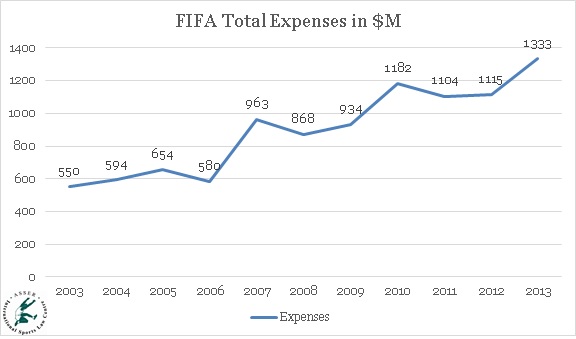
Graph 1: FIFA Expenses in USD million (adjusted for inflation),
2003-2013.
More...
After a decade of financial misery,
it appears that Valencia CF’s problems are finally over. The foreign takeover by
Singaporean billionaire Peter Lim will be concluded in the upcoming weeks, and
the construction on the new stadium will resume after five years on hold due to
a lack of money. On 3 June Bankia, the Spanish bank that “saved” Valencia CF in
2009 by providing a loan of €81 million, gave the green light for the takeover. However, appearances can be
deceiving.More...
In
April 2014, the Swedish Gambling Authority (Lotteriinspektionen) warned the
organisers of the Stockholm
Marathon that it would impose a fine of SEK 2
million (ca. € 221.000) for its sponsorship agreement with online betting
operator Unibet. The Authority found that the sponsorship agreement violates
§38 of the Swedish Lotteries Act, which prohibits the promotion of gambling
services that are not authorized in Sweden.[1] The
organisers, however, refused to withdraw Unibet as its sponsor and prominently
displayed the Unibet logo at the event, which took place on 31 May 2014. As a
result, the organisers of the Stockholm Marathon now face legal action before
the Swedish administrative courts. More...
On next Thursday the 2014 World
Cup will kick off in Sao Paulo. But next week will also see the FIFA members meeting on Tuesday and Wednesday at a
much awaited FIFA congress. For this special occasion we decided to review
FIFA’s financial
reports over the
last ten years. This post is the first of two, analysing the reports and
highlighting the main economic trends at play at FIFA. First, we will study the
revenue streams and their evolution along the 2003-2013 time span. In order to ensure
an accurate comparison, we have adjusted the revenues to inflation, in order to
provide a level playing field easing the comparative analysis over the years
and types of revenues. Our first two graphs gather the main revenue streams
into two comparative overviews. Graph 1 brings together the different types of
revenues in absolute numbers, while Graph 2 lays down the share of each type of
revenues for any given year (the others category covers a bundle of minor
revenue streams not directly relevant to our analysis).
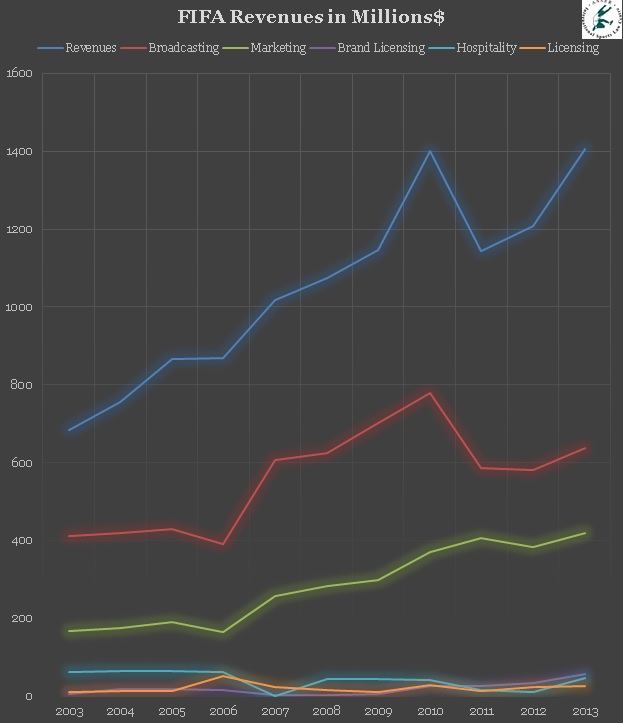
Graph 1: FIFA revenues
in Millions of Dollars, 2003-2013 (adjusted for inflation). More...
This year the race for UEFA Europa League places in Serie A was
thrilling. In the final minutes of the last game of the season, Alessio Cerci,
Torino FC striker, had the opportunity to score a penalty that would have
qualified his team to the 2014-2015 edition of the UEFA Europa League. However,
he missed and Parma FC qualified instead. More...
Shortly after his election as IOC President, Thomas Bach announced his intention to initiate an introspective reflection and reform cycle dubbed (probably a reference to former German Chancellor Gerhard Schröder’s publicly praised Agenda 2010) the Olympic Agenda 2020. The showdown of a year of intense brainstorming is to take place in the beginning of December 2014 during an IOC extraordinary session, in which fundamental reforms are expected. More...