Asser International Sports Law Blog

Our International Sports Law Diary
The Asser International Sports Law Centre is part of the T.M.C. Asser Instituut

A Short Guide to the New FIFA Regulations on Working with Intermediaries

This year’s FIFA congress in Sao Paulo should not be remembered only for the controversy surrounding the bid for the World Cup 2022 in Qatar. The controversy was surely at the centre of the media coverage, but in its shadow more long-lasting decisions were taken. For example, the new Regulations on Working with Intermediaries was approved, which is probably the most important recent change to FIFA regulations. These new Regulations will supersede the Regulations on Players’ Agents when they come into force on 1 April 2015. In this blog post we compare the old and the new Regulations followed by a short analysis and prospective view on the effects this change could have. More...

Cannibal's Advocate – In defence of Luis Suarez

Luis Suarez did it again. The serial biter that he is couldn’t refrain its impulse to taste a bit of Chiellini’s shoulder (not really the freshest meat around though). Notwithstanding his amazing theatrical skills and escaping the sight of the referee, Suarez could not in the information age get away with this unnoticed. Seconds after the incident, the almighty “social networks” were already bruising with evidence, outrage and commentaries over Suarez’s misdeed. Since then, many lawyers have weighed in (here, here and here) on the potential legal consequences faced by Suarez. Yesterday FIFA’s disciplinary committee decided to sanction him with a 4 months ban from any football activity and a 9 International games ban. In turn, Suarez announced that he would challenge the decision[1], and plans on going to the Court of Arbitration for Sport if necessary[2]. Let’s be the advocates of the cannibal!More...

Blurred Nationalities: The list of the “23” and the eligibility rules at the 2014 FIFA World Cup. A guest Post by Yann Hafner (Université de Neuchâtel)

In 2009, Sepp Blatter expressed his concerns that half of the players participating in the 2014 FIFA World Cup would be Brazilians naturalized by other countries. The Official list of Players released a few weeks ago tends to prove him wrong[1]. However, some players have changed their eligibility in the past and will even be playing against their own country of origin[2]. This post aims at explaining the key legal aspects in changes of national affiliation and to discuss the regulations pertaining to the constitution of national sides in general[3]. More...

The FIFA Business – Part 2 - Where is the money going? By Antoine Duval and Giandonato Marino

Our first report on the FIFA business dealt with FIFA’s revenues and highlighted their impressive rise and progressive diversification. In parallel to this growth of FIFA’s income, it is quite natural that its expenses have been following a similar path (see Graph 1). However, as we will see FIFA makes it sometimes very difficult to identify precisely where the money is going. Nonetheless, this is precisely what we wish to tackle in this post, and to do so we will rely on the FIFA Financial reports over the last 10 years.
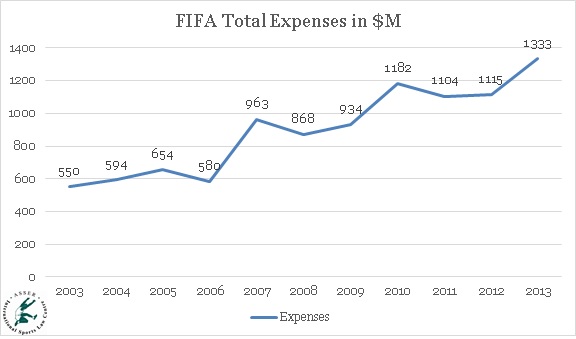


Graph 1: FIFA Expenses in USD million (adjusted for inflation), 2003-2013.

More...


The EU State aid and Sport Saga - A legal guide to the bailout of Valencia CF

After a decade of financial misery, it appears that Valencia CF’s problems are finally over. The foreign takeover by Singaporean billionaire Peter Lim will be concluded in the upcoming weeks, and the construction on the new stadium will resume after five years on hold due to a lack of money. On 3 June Bankia, the Spanish bank that “saved” Valencia CF in 2009 by providing a loan of €81 million, gave the green light for the takeover. However, appearances can be deceiving.More...

Gambling advertising regulations: pitfalls for sports sponsorship - By Ben van Rompuy

In April 2014, the Swedish Gambling Authority (Lotteriinspektionen) warned the organisers of the Stockholm Marathon that it would impose a fine of SEK 2 million (ca. € 221.000) for its sponsorship agreement with online betting operator Unibet. The Authority found that the sponsorship agreement violates §38 of the Swedish Lotteries Act, which prohibits the promotion of gambling services that are not authorized in Sweden.[1] The organisers, however, refused to withdraw Unibet as its sponsor and prominently displayed the Unibet logo at the event, which took place on 31 May 2014. As a result, the organisers of the Stockholm Marathon now face legal action before the Swedish administrative courts. More...

The FIFA Business – Part 1 – Where Does The Money Come From? - By Antoine Duval and Giandonato Marino

On next Thursday the 2014 World Cup will kick off in Sao Paulo. But next week will also see the FIFA members meeting on Tuesday and Wednesday at a much awaited FIFA congress. For this special occasion we decided to review FIFA’s financial reports over the last ten years. This post is the first of two, analysing the reports and highlighting the main economic trends at play at FIFA. First, we will study the revenue streams and their evolution along the 2003-2013 time span. In order to ensure an accurate comparison, we have adjusted the revenues to inflation, in order to provide a level playing field easing the comparative analysis over the years and types of revenues. Our first two graphs gather the main revenue streams into two comparative overviews. Graph 1 brings together the different types of revenues in absolute numbers, while Graph 2 lays down the share of each type of revenues for any given year (the others category covers a bundle of minor revenue streams not directly relevant to our analysis).
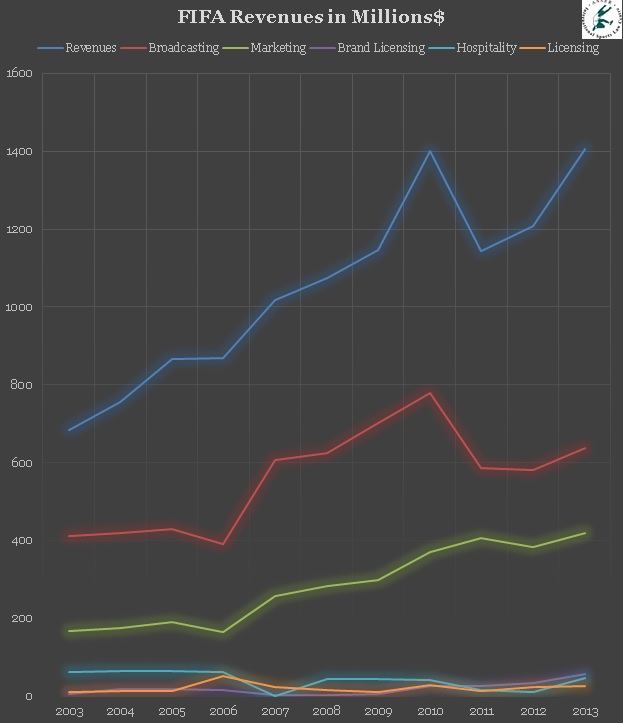


Graph 1: FIFA revenues in Millions of Dollars, 2003-2013 (adjusted for inflation). More...


Losing the UEFA Europa League on the Legal Turf: Parma FC’s bitter defeat by Giandonato Marino

This year the race for UEFA Europa League places in Serie A was thrilling. In the final minutes of the last game of the season, Alessio Cerci, Torino FC striker, had the opportunity to score a penalty that would have qualified his team to the 2014-2015 edition of the UEFA Europa League. However, he missed and Parma FC qualified instead. More...

Olympic Agenda 2020: Window Dressing or New Beginning?

Shortly after his election as IOC President, Thomas Bach announced his intention to initiate an introspective reflection and reform cycle dubbed (probably a reference to former German Chancellor Gerhard Schröder’s publicly praised Agenda 2010) the Olympic Agenda 2020. The showdown of a year of intense brainstorming is to take place in the beginning of December 2014 during an IOC extraordinary session, in which fundamental reforms are expected. More...

The French collective agreement for professional Rugby tackled by Kelsen’s Pyramid - Guest Post by Patrick Millot

Pursuant to Kelsen’s famous pyramid, the authority of norms may be ranked according to their sources: Constitution is above the Law, which is in turn superior to the Regulations, which themselves stand higher to the Collective Agreement etc…Under French labour law, this ranking can however be challenged by a “principle of favourable treatment” which allows a norm from a lower rank to validly derogate from a superior norm, if (and only if) this derogation benefits to the workers.

On 2 April 2014, the Cour de Cassation (the French Highest Civil Court) considered that these principles apply in all fields of labour law, regardless of the specificity of sport[1].  In this case, Mr. Orene Ai’i, a professional rugby player, had signed on 13 July  2007 an employment contract with the Rugby Club Toulonnais (RCT) for two sport seasons with effect on 1 July 2007. More...


one single person.  

Overall, I found this book to be a great initiative and a very useful and comprehensive guide written by some of the most reputable experts. The chapters are drafted in a clear and understandable way and the editor did a great job putting together some of the most relevant and topical legal and regulatory issues from the football field, thus filling a much-needed gap in the “football law” literature.

I’m A Loser Baby, So Let’s Kill Transparency – Recent Changes to the Olympic Games Host City Selection Process - By Ryan Gauthier (Thompson Rivers University)

Editor's Note: Ryan Gauthier is Assistant Professor at Thompson Rivers University in Canada. Ryan’s research addresses the governance of sports organisations, with a particular focus on international sports organisations. His PhD research examined the accountability of the International Olympic Committee for human rights violations caused by the organisation of the Olympic Games.


Big June 2019 for Olympic Hosting

On June 24, 2019, the International Olympic Committee (IOC) selected Milano-Cortina to host the 2026 Winter Olympic Games. Milano-Cortina’s victory came despite a declaration that the bid was “dead” just months prior when the Italian government refused to support the bid. Things looked even more dire for the Italians when 2006 Winter Games host Turin balked at a three-city host proposal. But, when the bid was presented to the members of the IOC Session, it was selected over Stockholm-Åre by 47 votes to 34. 

Just two days later, the IOC killed the host selection process as we know it. The IOC did this by amending two sections of the Olympic Charter in two key ways. First, the IOC amended Rule 33.2, eliminating the requirement that the Games be selected by an election seven years prior to the Games. While an election by the IOC Session is still required, the seven-years-out requirement is gone.

Second, the IOC amended Rule 32.2 to allow for a broader scope of hosts to be selected for the Olympic Games. Prior to the amendment, only cities could host the Games, with the odd event being held in another location. Now, while cities are the hosts “in principle”, the IOC had made it so: “where deemed appropriate, the IOC may elect several cities, or other entities, such as regions, states or countries, as host of the Olympic Games.”

The change to rule 33.2 risks undoing the public host selection process. The prior process included bids (generally publicly available), evaluation committee reports, and other mechanisms to make the bidding process transparent. Now, it is entirely possible that the IOC may pre-select a host, and present just that host to the IOC for an up-or-down vote. This vote may be seven years out from the Games, ten years out, or two years out. More...


International and European Sports Law – Monthly Report – April and May 2019. By Tomáš Grell

Editor's note: This report compiles all relevant news, events and materials on International and European Sports Law based on the daily coverage provided on our twitter feed @Sportslaw_asser. You are invited to complete this survey via the comments section below, feel free to add links to important cases, documents and articles we might have overlooked.


The Headlines 

Caster Semenya learns that it is not always easy for victims of discrimination to prevail in court

The world of sport held its breath as the Secretary General of the Court of Arbitration for Sport (CAS) Matthieu Reeb stood before the microphones on 1 May 2019 to announce the verdict reached by three arbitrators (one of them dissenting) in the landmark case involving the South African Olympic and world champion Caster Semenya. Somewhat surprisingly, the panel of arbitrators came to the conclusion that the IAAF’s regulations requiring female athletes with differences of sexual development to reduce their natural testosterone level below the limit of 5 nmol/L and maintain that reduced level for a continuous period of at least six months in order to be eligible to compete internationally at events between 400 metres and a mile, were necessary, reasonable and proportionate to attain the legitimate aim of ensuring fair competition in female athletics, even though the panel recognised that the regulations were clearly discriminatory. Ms Semenya’s legal team decided to file an appeal against the ruling at the Swiss Federal Tribunal. For the time being, this appears to be a good move since the tribunal ordered the IAAF at the beginning of June to suspend the application of the challenged regulations to Ms Semenya with immediate effect, which means that Ms Semenya for now continues to run medication-free.


Champions League ban looms on Manchester City

On 18 May 2019, Manchester City completed a historic domestic treble after defeating Watford 6-0 in the FA Cup Final. And yet there is a good reason to believe that the club’s executives did not celebrate as much as they would under normal circumstances. This is because only two days before the FA Cup Final the news broke that the chief investigator of the UEFA Club Financial Control Body (CFCB) had decided to refer Manchester City’s case concerning allegations of financial fair play irregularities to the CFCB adjudicatory chamber for a final decision. Thus, the chief investigator most likely found that Manchester City had indeed misled UEFA over the real value of its sponsorship income from the state-owned airline Etihad and other companies based in Abu Dhabi, as the leaked internal emails and other documents published by the German magazine Der Spiegel suggested. The chief investigator is also thought to have recommended that a ban on participation in the Champions League for at least one season be imposed on the English club. The club’s representatives responded to the news with fury and disbelief, insisting that the CFCB investigatory chamber had failed to take into account a comprehensive body of irrefutable evidence it had been provided with. They eventually decided not to wait for the decision of the CFCB adjudicatory chamber, which is yet to be adopted, and meanwhile took the case to the CAS, filing an appeal against the chief investigator’s referral.


The Brussels Court of Appeal dismisses Striani’s appeal on jurisdictional grounds

The player agent Daniele Striani failed to convince the Brussels Court of Appeal that it had jurisdiction to entertain his case targeting UEFA’s financial fair play regulations. On 11 April 2019, the respective court dismissed his appeal against the judgment of the first-instance court without pronouncing itself on the question of compatibility of UEFA’s financial fair play regulations with EU law. The court held that it was not competent to hear the case because the link between the regulations and their effect on Mr Striani as a player agent, as well as the link between the regulations and the role of the Royal Belgian Football Association in their adoption and enforcement, was too remote (for a more detailed analysis of the decision, see Antoine’s blog here). The Brussels Court of Appeal thus joined the European Court of Justice and the European Commission as both these institutions had likewise rejected to assess the case on its merits in the past.


Sports Law Related Decisions


Official Documents and Press Releases

CAS

FIFA