Asser International Sports Law Blog

Our International Sports Law Diary
The Asser International Sports Law Centre is part of the T.M.C. Asser Instituut

The 2006 World Cup Tax Evasion Affair in Germany: A short guide. By Gesa Kuebek

Editor's note:

Gesa Kuebek holds an LLM and graduated from the University of Bologna, Gent and Hamburg as part of the Erasmus Mundus Master Programme in Law and Economics and now work as an intern for the Asser Instituut.


On Monday, 9 November, the German Football Association (DFB) announced in a Press Release the resignation of its head, Wolfgang Niersbach, over the 2006 World Cup Affair. In his statement, Niersbach argued that he had “no knowledge whatsoever” about any “payments flows” and is now being confronted with proceedings in which he was “never involved”. However, he is now forced to draw the “political consequences” from the situation. His resignation occurred against the backdrop of last week’s raid of the DFB’s Frankfurt headquarters and the private homes Niersbach, his predecessor Theo Zwanziger and long-standing DFB general secretary Horst R. Schmidt. The public prosecutor’s office investigates a particularly severe act of tax evasion linked to awarding the 2006 World Cup. The 2006 German “summer fairy-tale” came under pressure in mid-October 2015, after the German magazine “Der Spiegel” shocked Fußballdeutschland by claiming that it had seen concrete evidence proving that a €6.7 million loan, designated by the FIFA for a “cultural programme”, ended up on the account of Adidas CEO Robert-Louis Dreyfuß. The magazine further argued that the money was in fact a secret loan that was paid back to Dreyfuß. Allegedly, the loan was kept off the books intentionally in order to be used as bribes to win the 2006 World Cup bid. The public prosecutor now suspects the DFB of failing to register the payment in tax returns. German FA officials admit that the DFB made a “mistake” but deny all allegations of vote buying. However, the current investigations show that the issues at stakes remain far from clear, leaving many questions regarding the awarding of the 2006 World Cup unanswered.

The present blog post aims to shed a light on the matter by synthetizing what we do know about the 2006 World Cup Affair and by highlighting the legal grounds on which the German authorities investigate the tax evasion. More...


Blog Symposium: Ensuring proportionate sanctions under the 2015 World Anti-Doping Code. By Mike Morgan

Introduction: The new WADA Code 2015
Day 1: The impact of the revised World Anti-Doping Code on the work of National Anti-Doping Agencies
Day 2: The “Athlete Patient” and the 2015 World Anti-Doping Code: Competing Under Medical Treatment
Day 3: Proof of intent (or lack thereof) under the 2015 World Anti-Doping Code

Editor's note
Mike Morgan is the founding partner of Morgan Sports Law LLP. His practice is focused exclusively on the sports sector. He advises on regulatory and disciplinary issues and has particular experience advising on doping and corruption disputes.

Mike acted on behalf of National Olympic Committees at three of the last four Olympic Games and has represented other sports bodies, clubs and high profile athletes in proceedings before the High Court, the FIFA Dispute Resolution Chamber, the American Arbitration Association and the Court of Arbitration for Sport. More...


Blog Symposium: Proof of intent (or lack thereof) under the 2015 World Anti-Doping Code. By Howard L. Jacobs

Introduction: The new WADA Code 2015
Day 1: The impact of the revised World Anti-Doping Code on the work of National Anti-Doping Agencies
Day 2: The “Athlete Patient” and the 2015 World Anti-Doping Code: Competing Under Medical Treatment
Day 4: Ensuring proportionate sanctions under the 2015 World Anti-Doping Code

Editor's note

Howard Jacobs is solo practitioner in the Los Angeles suburb of Westlake Village, California. Mr. Jacobs has been identified by various national newspapers and publications as one of the leading sports lawyers in the world. His law practice focuses on the representation of athletes in all types of disputes, with a particular focus on the defense of athletes charged with doping offenses.Mr. Jacobs has represented numerous professional athletes, Olympic athletes, world record holders,  and amateur athletes in disputes involving doping, endorsements, unauthorized use of name and likeness, salary issues, team selection issues, and other matters.  He is at the forefront of many cutting edge legal issues that affect athletes, winning cases that have set precedents that have benefited the athlete community. More information is available at www.athleteslawyer.com. More...


Blog Symposium: The “Athlete Patient” and the 2015 World Anti-Doping Code: Competing Under Medical Treatment. By Marjolaine Viret and Emily Wisnosky

Introduction: The new WADA Code 2015
Day 1: The impact of the revised World Anti-Doping Code on the work of National Anti-Doping Agencies
Day 3: Proof of intent (or lack thereof) under the 2015 World Anti-Doping Code
Day 4: Ensuring proportionate sanctions under the 2015 World Anti-Doping Code

Editor's Note
Marjolaine Viret: An attorney-at-law at the Geneva bar, specialising in sports and health law. Her doctoral work in anti-doping was awarded a summa cum laude by the University of Fribourg in early 2015. She gained significant experience in sports arbitration as a senior associate in one of Switzerland’s leading law firms, advising clients, including major sports federations, on all aspects of anti-doping. She also holds positions within committees in sports organisations and has been involved in a variety of roles in the implementation of the 2015 WADC. Her book “Evidence in Anti-Doping at the Intersection of Science & Law” is scheduled for publication in 2015.

Emily Wisnosky: An attorney-at-law admitted to the California bar, she currently participates in the WADC 2015 Commentary research project as a doctoral researcher. She also holds an LLM from the University of Geneva in International Dispute Settlement, with a focus on sports arbitration. Before studying law, she worked as a civil engineer. More...


Blog Symposium: The impact of the revised World Anti-Doping Code on the work of National Anti-Doping Agencies. By Herman Ram

Introduction: The new WADA Code 2015
Day 2: The “Athlete Patient” and the 2015 World Anti-Doping Code: Competing Under Medical Treatment
Day 3: Proof of intent (or lack thereof) under the 2015 World Anti-Doping Code
Day 4: Ensuring proportionate sanctions under the 2015 World Anti-Doping Code

Editor's note
Herman Ram is the Chief Executive Officer of the Anti-Doping Authority the Netherlands, which is the National Anti-Doping Organization of the country. He has held this position since 2006. After working twelve years as a librarian, Herman Ram started his career in sport management in 1992, when he became Secretary general of the Royal Netherlands Chess Federation. In 1994, he moved on to the same position at the Netherlands Badminton Federation. He was founder and first secretary of the Foundation for the Promotion of Elite Badminton that was instrumental in the advancement of Dutch badminton. In 2000 he was appointed Secretary general of the Netherlands Ski Federation, where he focused, among other things, on the organization of large snowsports events in the Netherlands. Since his appointment as CEO of the Anti-Doping Authority, he has developed a special interest in legal, ethical and managerial aspects of anti-doping policies, on which he has delivered numerous presentations and lectures. On top of that, he acts as Spokesperson for the Doping Authority. Herman Ram holds two Master’s degrees, in Law and in Sport Management. More...


Blog Symposium: The new WADA Code 2015 - Introduction

Day 1: The impact of the revised World Anti-Doping Code on the work of National Anti-Doping Agencies
Day 2: The “Athlete Patient” and the 2015 World Anti-Doping Code: Competing Under Medical Treatment
Day 3: Proof of intent (or lack thereof) under the 2015 World Anti-Doping Code
Day 4: Ensuring proportionate sanctions under the 2015 World Anti-Doping Code

On 1 January, a new version of the World Anti-Doping Code (WADC or Code) entered into force. This blog symposium aims at taking stock of this development and at offering a preliminary analysis of the key legal changes introduced. The present blog will put the WADC into a more general historical and political context. It aims to briefly retrace the emergence of the World Anti-Doping Agency (WADA) and its Code. It will also reconstruct the legislative process that led to the adoption of the WADC 2015 and introduce the various contributions to the blog symposium.More...


To pay or not to pay? That is the question. The case of O’Bannon v. NCAA and the struggle of student athletes in the US. By Zlatka Koleva

Editor's note
Zlatka Koleva is a graduate from the Erasmus University Rotterdam and is currently an Intern at the ASSER International Sports Law Centre.

The decision on appeal in the case of O’Bannon v. NCAA seems, at first sight, to deliver answers right on time regarding the unpaid use of names, images and likenesses (NILs) of amateur college athletes, which has been an ongoing debate in the US after last year’s district court decision that amateur players in the college games deserve to receive compensation for their NILs.[1] The ongoing struggle for compensation in exchange for NILs used in TV broadcasts and video games in the US has reached a turning point and many have waited impatiently for the final say of the Court of Appeal for the 9th circuit. The court’s ruling on appeal for the 9th circuit, however, raises more legitimate concerns for amateur sports in general than it offers consolation to unprofessional college sportsmen. While the appellate court agreed with the district court that NCAA should provide scholarships amounting to the full cost of college attendance to student athletes, the former rejected deferred payment to students of up to 5,000 dollars for NILs rights. The conclusions reached in the case relate to the central antitrust concerns raised by NCAA, namely the preservation of consumer demand for amateur sports and how these interests can be best protected under antitrust law. More...


The European Commission’s ISU antitrust investigation explained. By Ben Van Rompuy

In June 2014, two prominent Dutch speed skaters, Mark Tuitert (Olympic Champion 1500m) and Niels Kerstholt (World Champion short track), filed a competition law complaint against the International Skating Union (ISU) with the European Commission.
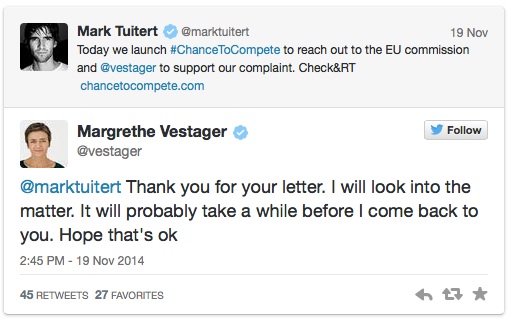

ChanceToCompeteTwitter.png (50.4KB)


Today, the European Commission announced that it has opened a formal antitrust investigation into International Skating Union (ISU) rules that permanently ban skaters from competitions such as the Winter Olympics and the ISU World and European Championships if they take part in events not organised or promoted by the ISU. The Commissioner for Competition, Margrethe Vestager, stated that the Commission "will investigate if such rules are being abused to enforce a monopoly over the organisation of sporting events or otherwise restrict competition. Athletes can only compete at the highest level for a limited number of years, so there must be good reasons for preventing them to take part in events."

Since the case originates from legal advice provided by the ASSER International Sports Law Centre, we thought it would be helpful to provide some clarifications on the background of the case and the main legal issues at stake. More...


Interview with Wil van Megen (Legal Director of FIFPro) on FIFPro’s EU Competition Law complaint against the FIFA Transfer System

Editor’s note
Wil is working as a lawyer since 1980. He started his legal career at Rechtshulp Rotterdam. Later on he worked for the Dutch national trade union FNV and law firm Varrolaan Advocaten. Currently he is participating in the Labour Law Section of lawfirm MHZ-advocaten in Schiedam in the Netherlands. He is also a member of a joint committee advising the government in labour issues.

Since 1991 he is dealing with the labour issues of the trade union for professional football players VVCS and cyclists’ union VVBW. Since 2002, he works for FIFPro, the worldwide union for professional football players based in Hoofddorp in the Netherlands. He is involved in many international football cases and provides legal support for FIFPro members all over the world. Wil was also involved in the FIFPro Black Book campaign on match fixing and corruption in Eastern Europe. More...


The Scala reform proposals for FIFA: Old wine in new bottles?

Rien ne va plus at FIFA. The news that FIFA’s Secretary General Jérôme Valcke was put on leave and released from his duties has been quickly overtaken by the opening of a criminal investigation targeting both Blatter and Platini.

With FIFA hopping from one scandal to the next, one tends to disregard the fact that it has been attempting (or rather pretending) to improve the governance of the organisation for some years now. In previous blogs (here and here), we discussed the so-called ‘FIFA Governance Reform Project’, a project carried out by the Independent Governance Committee (IGC) under the leadership of Prof. Dr. Mark Pieth of the Basel Institute on Governance. Their third and final report, published on 22 April 2014, listed a set of achievements made by FIFA in the area of good governance since 2011, such as establishing an Audit and Compliance Committee (A&C). However, the report also indicated the reform proposals that FIFA had not met. These proposals included the introduction of term limits for specific FIFA officials (e.g. the President) as well as introducing an integrity review procedure for all the members of the Executive Committee (ExCo) and the Standing Committees. More...

Asser International Sports Law Blog | Our International Sports Law Diary <br/>The <a href="http://www.sportslaw.nl" target="_blank">Asser International Sports Law Centre</a> is part of the <a href="https://www.asser.nl/" target="_blank"><img src="/sportslaw/blog/media/logo_asser_horizontal.jpg" style="vertical-align: bottom; margin-left: 7px;width: 140px" alt="T.M.C. Asser Instituut" /></a>

Asser International Sports Law Blog

Our International Sports Law Diary
The Asser International Sports Law Centre is part of the T.M.C. Asser Instituut

International and European Sports Law – Monthly Report – June 2016. By Kester Mekenkamp

Editor’s note: This report compiles all relevant news, events and materials on International and European Sports Law based on the daily coverage provided on our twitter feed @Sportslaw_asser. You are invited to complete this survey via the comments section below, feel free to add links to important cases, documents and articles we might have overlooked.   


The headlines

What a month June turned out to be. Waking up the morning after the 23rd, the results of the UK referendum on EU membership were final. The words of Mark Twain: “Apparently there is nothing that cannot happen today”, might provide the most apt description of the mood felt at the time.[1] The Leave campaign’s narrow victory has brought along tremendous economic, political and legal uncertainties for both the UK and the (other) Member States. To give but one example, with regard to the implications of Brexit on Europe’s most profiting football league, we recommend an older blog by Daniel Geey and Jonny Madill. More...


The EU State aid and sport saga: The Showdown

It’s been a long wait, but they’re finally here! On Monday, the European Commission released its decisions regarding State aid to seven Spanish professional football clubs (Real Madrid on two occasions) and five Dutch professional football clubs. The decisions mark the end of the formal investigations, which were opened in 2013. The Commission decided as follows: no State aid to PSV Eindhoven (1); compatible aid to the Dutch clubs FC Den Bosch, MVV Maastricht, NEC Nijmegen and Willem II (2); and incompatible aid granted to the Spanish football clubs Real Madrid, FC Barcelona, Valencia CF, Athletic Bilbao, Atlético Osasuna, Elche and Hércules (3). 

The recovery decisions in particular are truly historic. The rules on State aid have existed since the foundation of the European Economic Community in 1958, but it is the very first time that professional football clubs have been ordered to repay aid received from (local) public authorities.[1] In a way, these decisions complete a development set in motion with the Walrave and Koch ruling of 1974, where the CJEU held that professional sporting activity, and therefore also football, is subject to EU law. The landmark Bosman case of 1995 proved to be of great significance as regards free movement of (professional) athletes and the Meca-Medina case of 2006 settled that EU competition rules were equally applicable to the regulatory activity of sport. The fact that the first ever State aid recovery decision concerns major clubs like Real Madrid, FC Barcelona and Valencia, give the decisions extra bite. Therefore, this blog post will focus primarily on the negative/recovery decisions[2], their consequences and the legal remedies available to the parties involved.[3] More...

International and European Sports Law – Monthly Report – May 2016. By Marine Montejo

Editor’s note: This report compiles all relevant news, events and materials on International and European Sports Law based on the daily coverage provided on our twitter feed @Sportslaw_asser. You are invited to complete this survey via the comments section below, feel free to add links to important cases, documents and articles we might have overlooked.   


The Headlines

Challenged membership put a lot of emphasis on football federations in May. The Court of Arbitration for Sport (“CAS”) has rendered an award, on 27 April 2016, ordering the FIFA Council to submit the application of the Gibraltar Football Association (GFA) for FIFA membership to the FIFA Congress (the body authorised to admit new members to FIFA). The GFA has sought since 1999 to become a member of UEFA and FIFA. In May 2013, it became a member of the UEFA and went on to seek membership of FIFA. More...


Operación Puerto Strikes Back!

Forget the European Championship currently held in France or the upcoming Olympic Games in Rio. Doping scandals are making the headlines more than ever in 2016. From tennis star Sharapova receiving a two-year ban for her use of the controversial ‘meldonium’, to the seemingly never-ending doping scandals in athletics. As if this was not enough, a new chapter was added on 14 June to one of the most infamous and obscure doping sagas in history: the Operación Puerto.

The special criminal appeal chamber,  the Audiencia Provincial, has held that the more than 200 blood bags of professional athletes that have been at the center of the investigations since 2006 can be delivered to the relevant sporting authorities, such as the Spanish Anti-Doping Agency (AEPSAD), WADA, the UCI and the Italian Olympic Committee (CONI). In other words, there is now a good chance that the identities of the involved athletes might eventually be revealed.

Source: http://www.telegraph.co.uk/sport/othersports/cycling/9834122/Operation-Puerto-doctor-Eufemiano-Fuentes-treated-tennis-players-athletes-footballers-and-a-boxer.html

This case note will analyze the court’s ruling and summarize its most important findings. Given the amount of time passed since the scandal first came to light (2004), the blog will commence with a short background summary of the relevant facts. More...

FIBA/Euroleague: Basketball’s EU Competition Law Champions League- first leg in the Landgericht München. By Marine Montejo

Editor's note: Marine Montejo is a graduate from the College of Europe in Bruges and is currently an intern at the ASSER International Sports Law Centre.

On 3 June 2016, the Landgericht München (“Munich Regional Court”) ordered temporary injunctions against the International Basketball Federation (“FIBA”) and FIBA Europe, prohibiting them from sanctioning clubs who want to participate in competitions organized by Euroleague Commercial Assets (“ECA”). The reasoning of the Court is based on breaches of German and EU competition law provisions. FIBA and FIBA Europe are, according to the judge, abusing their dominant position by excluding or threatening to exclude national teams from their international competitions because of the participation of their clubs in the Euroleague. This decision is the first judicial step taken in the ongoing legal battle between FIBA and ECA over the organization of European basketball competitions.

This judgment raises several interesting points with regard to how the national judge deals with the alleged abuse of a dominant position by European and international federations. A few questions arise regarding the competence of the Munich Regional Court that may be interesting to first look at in the wake of an appeal before examining the substance of the case. More...

The Müller case: Revisiting the compatibility of fixed term contracts in football with EU Law. By Kester Mekenkamp

Editor’s note: Kester Mekenkamp is an LL.M. student in European Law at Leiden University and an intern at the ASSER International Sports Law Centre.

On 17 February 2016, the Landesarbeitsgericht Rheinland-Pfalz delivered its highly anticipated decision in the appeal proceedings between German goalkeeper Heinz Müller and his former employer, German Bundesliga club Mainz 05.[1] The main legal debate revolved around the question (in general terms) whether the use of a fixed term contract in professional football is compatible with German and EU law. 

In first instance (see our earlier blog posts, here and here), the Arbeitsgericht Mainz had ruled that the ‘objective reasons’ provided in Section 14 (1) of the German Part-time and Fixed-term Employment Act (Gesetz über Teilzeitarbeit und befristete Arbeitsverträge, “TzBfG”), the national law implementing EU Directive 1999/70/EC on fixed-term work, were not applicable to the contract between Müller and Mainz 05 and therefore could not justify the definite nature of that contract.[2] In its assessment the court devoted special attention to the objective reason relating to the nature of the work, declining justifications based thereupon.[3] Tension rose and the verdict was soon labelled to be able to have Bosman-like implications, if held up by higher courts.[4] More...

The BGH’s Pechstein Decision: A Surrealist Ruling


The decision of the Bundesgerichtshof (BGH), the Highest Civil Court in Germany, in the Pechstein case was eagerly awaited. At the hearing in March, the Court decided it would pronounce itself on 7 June, and so it did. Let’s cut things short: it is a striking victory for the Court of Arbitration for Sport (CAS) and a bitter (provisory?) ending for Claudia Pechstein. The BGH’s press release is abundantly clear that the German judges endorsed the CAS uncritically on the two main legal questions: validity of forced CAS arbitration and the independence of the CAS. The CAS and ISU are surely right to rejoice and celebrate the ruling in their respective press releases that quickly ensued (here and here). At first glance, this ruling will be comforting the CAS’ jurisdiction for years to come. Claudia Pechstein’s dire financial fate - she faces up to 300 000€ in legal fees – will serve as a powerful repellent for any athlete willing to challenge the CAS.More...


The EU State aid and Sport Saga: Hungary revisited? (Part 2)

On 18 May 2016, the day the first part of this blog was published, the Commission said in response to the Hungarian MEP Péter Niedermüller’s question, that it had “not specifically monitored the tax relief (…) but would consider doing so. The Commission cannot prejudge the steps that it might take following such monitoring. However, the Commission thanks (Niedermüller) for drawing its attention to the report of Transparency International.”

With the actual implementation in Hungary appearing to deviate from the original objectives and conditions of the aid scheme, as discussed in part 1 of this blog, a possible monitoring exercise by the Commission of the Hungarian tax benefit scheme seems appropriate. The question remains, however, whether the Commission follows up on the intent of monitoring, or whether the intent should be regarded as empty words. This second part of the blog will outline the rules on reviewing and monitoring (existing) aid, both substantively and procedurally. It will determine, inter alia, whether the State aid rules impose an obligation upon the Commission to act and, if so, in what way. More...

The Rise and Fall of FC Twente

Yesterday, 18 May 2016, the licensing committee of the Dutch football federation (KNVB) announced its decision to sanction FC Twente with relegation to the Netherland’s second (and lowest) professional league. The press release also included a link to a document outlining the reasons underlying the decision. For those following the saga surrounding Dutch football club FC Twente, an unconditional sanction by the licensing committee appeared to be only a matter of time. Yet, it is the sanction itself, as well as its reasoning, that will be the primary focus of this short blog.More...

The EU State aid and Sport Saga: Hungary’s tax benefit scheme revisited? (Part 1)

The tax benefit scheme in the Hungarian sport sector decision of 9 November 2011 marked a turning point as regards the Commission’s decisional practice in the field of State aid and sport. Between this date and early 2014, the Commission reached a total of ten decisions on State aid to sport infrastructure and opened four formal investigations into alleged State aid to professional football clubs like Real Madrid and Valencia CF.[1] As a result of the experience gained from the decision making, it was decided to include a Section on State aid to sport infrastructure in the 2014 General Block Exemption Regulation. Moreover, many people, including myself, held that Commission scrutiny in this sector would serve to achieve better accountability and transparency in sport governance.[2]

Yet, a recent report by Transparency International (TI), published in October 2015, raises questions about the efficiency of State aid enforcement in the sport sector. The report analyzes the results and effects of the Hungarian tax benefit scheme and concludes that:

“(T)he sports financing system suffers from transparency issues and corruption risks. (…) The lack of transparency poses a serious risk of collusion between politics and business which leads to opaque lobbying. This might be a reason for the disproportionateness found in the distribution of the subsidies, which is most apparent in the case of (football) and (the football club) Felcsút.”[3]

In other words, according to TI, selective economic advantages from public resources are being granted to professional football clubs, irrespective of the tax benefit scheme greenlighted by the Commission or, in fact, because of the tax benefit scheme. More...

Asser International Sports Law Blog | Our International Sports Law Diary <br/>The <a href="http://www.sportslaw.nl" target="_blank">Asser International Sports Law Centre</a> is part of the <a href="https://www.asser.nl/" target="_blank"><img src="/sportslaw/blog/media/logo_asser_horizontal.jpg" style="vertical-align: bottom; margin-left: 7px;width: 140px" alt="T.M.C. Asser Instituut" /></a>

Asser International Sports Law Blog

Our International Sports Law Diary
The Asser International Sports Law Centre is part of the T.M.C. Asser Instituut

De- or Re-regulating the middlemen? The DFB’s regulation of intermediaries under EU law scrutiny at the OLG Frankfurt. By Antoine Duval and Kester Mekenkamp.

Football intermediaries, or agents, are again under attack in the news. For some, corrupt behaviour has become endemic in football’s culture. It is always dangerous to scapegoat a whole profession or a group of people. Many intermediaries are trying their best to lawfully defend the interests of their clients, but some are not. The key focus should be on providing an adequate legal and administrative framework to limit the opportunities for corrupt behaviour in the profession. This is easier said than done, however. We are dealing with an intrinsically transnationalized business, often conducted by intermediaries who are not subjected to the disciplinary power of federations. Sports governing bodies are lacking the police power and human resources necessary to force the intermediaries to abide by their private standards. In this context, this blog aims to review a recent case in front of the regional court of Frankfurt in Germany, which highlights the legal challenges facing (and leeway available to) national federations when regulating the profession. More...

Case note: TAS 2016/A/4474 Michel Platini c. Fédération Internationale de Football Association. By Marine Montejo

Editor's note: Marine Montejo is a graduate from the College of Europe in Bruges and is currently an intern at the ASSER International Sports Law Centre.

On 3 June 2015, Sepp Blatter resigned as President of FIFA after another corruption scandal inside the world’s football governing body was brought to light by the American authorities supported by the Swiss prosecutor office. Two months after Michel Platini announced he would be a candidate for the next FIFA Presidential election, on 25 September 2015, the Swiss prosecutor opened an investigation against S. Blatter on an alleged disloyal payment he authorised to M. Platini. On 8 October 2015, the FIFA Ethics Committee announced both of them were provisionally suspended upon their hearings, a suspension that was later confirmed by CAS. In the end, M. Platini was sanctioned with an eight years ban from all football activities, later reduced to a six years ban by FIFA Appeal Commission on 24 February 2016. In the meantime, he withdrew his candidacy to become the next FIFA President. On 9 May 2016, after M. Platini appealed this sanction, the CAS confirmed the suspension but reduced it to four years, leading to his resignation from the UEFA presidency and the announcement of his intention to challenge the CAS award in front of the Swiss Federal Tribunal.

On 19 September, the CAS finally published the full text of the award in the dispute between M. Platini and FIFA. The award is in French as M. Platini requested that the procedure be conducted in that language. You will find below a summary of the ‘highlights’ of the 63-page decision. More...

The Russian Ballet at the CAS Ad Hoc Division in Rio - Act V: Saving the last (Russian) woman standing: The Klishina miracle

Editor's note: This is the (belated) fifth part/act of our blog series on the Russian eligibility cases at the CAS ad hoc Division in Rio. The other acts are available at:


Act V: Saving the last (Russian) woman standing: The Klishina miracle 

Darya Klishina is now an Olympic celebrity. She will enter the history books not because she won a gold medal or beat a world record. Instead, her idiosyncrasy lies in her nationality: she was the sole Russian athlete authorized to stand in the athletics competitions at the Rio Olympics. And yet, a few days before the start of the long jumping contest in which she was due to take part, the IAAF surprisingly decided to revoke her eligibility (‘And Then There Were None’). But Klishina appealed the decision to the CAS ad hoc Division and, as all of you well-informed sports lawyers will know, she was allowed to compete at the Olympics and finished at a decent ninth place of the long jump finals.

Two important questions are raised by this case:

  • Why did the IAAF changed its mind and decide to retract Klishina’s authorization to participate?
  • Why did the CAS overturn this decision? More...


The Russian Ballet at the CAS Ad Hoc Division in Rio - Act IV: On Bringing a sport into disrepute

Editor's note: This is the fourth part/act of our blog series on the Russian eligibility cases at the CAS ad hoc Division in Rio.


Act IV: On Bringing a sport into disrepute

Paragraph 2 of the IOC Decision: “The IFs will also have to apply their respective rules in relation to the sanctioning of entire NFs.” 


In paragraph 2 of its Decision, the IOC mentioned the possibility for IFs to “apply their respective rules in relation to the sanctioning of entire NF's”.This is exactly what the International Weightlifting Federation (IWF) did when it decided on 29 July 2016 to exclude the whole Russian Weightlifting Federation (RWF) from the Rio Olympics for having brought the sport into disrepute. Indeed, Article 12. 4 of the IWF Anti-doping Policy, foresees that:

“If any Member federation or members or officials thereof, by reason of conduct connected with or associated with doping or anti-doping rule violations, brings the sport of weightlifting into disrepute, the IWF Executive Board may, in its discretion, take such action as it deems fit to protect the reputation and integrity of the sport.”More...


The Russian Ballet at the CAS Ad Hoc Division in Rio - Act III: On being sufficiently tested

Editor's note: This is the third part/act of our blog series on the Russian eligibility cases at the CAS ad hoc Division in Rio.


Act III: On being sufficiently tested 

Paragraph 2 of the IOC Decision: “The IFs should carry out an individual analysis of each athlete’s anti-doping record, taking into account only reliable adequate international tests, and the specificities of the athlete’s sport and its rules, in order to ensure a level playing field.”

Daniil Andienko and 16 other members of the Russian rowing team challenged the decision of the World Rowing Federation (FISA) to declare them ineligible for the Rio Olympics. The FISA Executive Committee took the decision on 24 July 2016 because they had not “undergone a minimum of three anti-doping tests analysed by a WADA accredited laboratory other than the Moscow laboratory and registered in ADAMS from 1 January 2015 for an 18 month period”.[1] In their submissions, the Russian applicants did not challenge the IOC Decision, and thus the criteria enshrined in paragraph 2, but only its application by FISA.[2] The Russian athletes argued that FISA’s decision deviated from the IOC Decision in that it was imposing as an additional requirement that rowers must “have undergone a minimum of three anti-doping tests analysed by a WADA accredited laboratory other than the Moscow laboratory and registered in ADAMS from 1 January 2015 for an 18-month period”.[3] The Panel acknowledged that “the IOC Executive Board decision does not refer explicitly to the requirement of three tests or to a period of 18 months”.[4] Nonetheless, it “finds that the Challenged Decision is in line with the criteria established by the IOC Executive Board decision”.[5] Indeed, the IOC’s Decision “provides that in order to examine whether the level playing field is affected or not (when admitting a Russian athlete to the Rio Olympic Games), the federation must look at the athlete's respective anti-doping record, i.e. examine the athlete's anti-doping tests” and that “[i]n doing so, the IOC Executive Board decision specifies that only "reliable adequate international tests" may be taken into account”.[6] In this regard, the Panel, and FISA, share the view that “a reliable adequate international test can only be assumed if the sample has been analyzed in a WADA-accredited laboratory outside Russia”.[7]More...


The Russian Ballet at the CAS Ad Hoc Division in Rio - Act II: On being implicated

Editor's note: This is the second part/act of our blog series on the Russian eligibility cases at the CAS ad hoc Division in Rio.


Act II: On being implicated


Paragraph 2 of the IOC Decision: The IFs to examine the information contained in the IP Report, and for such purpose seek from WADA the names of athletes and National Federations (NFs) implicated. Nobody implicated, be it an athlete, an official, or an NF, may be accepted for entry or accreditation for the Olympic Games.”


The second, and by far largest, wave of complaints involved Russian athletes barred from the game under paragraph 2 of the IOC Decision. None of those were successful in their appeals as the CAS sided with those IFs which took a tough stance with regard to the Russian State doping system. The first set of cases turned on the definition of the word “implicated” in the sense of paragraph 2 of the IOC Decision. In this regard, on 2 August the IOC sent a communication to the IFs aiming at providing some general guidelines. It reads as follows:

"In view of the recent appeals filed by Russian Athletes with CAS, the IOC considers it necessary to clarify the meaning of the notion "implicated" in the EB Decision.

The IOC does not consider that each athlete referred to in the McLaren Lists shall be considered per se "implicated. It is for each International federation to assess, on the basis of the information provided in the McLaren lists and the Independent Person Report, whether it is satisfied that the Athlete in question was implicated in the Russian State-controlled doping scheme.

To assist the International Federations in assessing each individual case, the IOC wishes to provide some information. In the IOC's opinion, an athlete should not be considered as "implicated" where:

·       The order was a "quarantine".

·       The McLaren List does not refer to a prohibited substance which would have given rise to an anti-doping rule violation or;

·       The McLaren List does not refer to any prohibited substance with respect to a given sample."

The CAS went on to address this question concretely in three cases analysed below. More...


The Russian Ballet at the CAS Ad Hoc Division in Rio - Act I: Saved by the Osaka Déjà-Vu

Since it was first introduced at the Atlanta Games in 1996,[1] the CAS ad hoc Division has never been as crowded as it was during this year’s Rio Olympics. This is mainly due to the Russian doping scandal, which has fuelled the CAS with Russian athletes challenging their ineligibility to compete at the Games. The CAS recently revealed that out of 28 awards rendered, 16 involved Russian athletes challenging their ineligibility. This Russian ballet is a direct result of the shocking findings of Richard McLaren’s Independent Person (IP) Report ordered by the World Anti-Doping Agency (WADA). McLaren’s investigation demonstrated that the Russian State was coordinating a sophisticated doping system. The revelation triggered an outrage in the media and amongst other competitors. Numerous calls (especially by WADA and various National Anti-Doping Organisations) were heard urging the IOC to ban the entire Russian delegation from the Olympics. The IAAF decided to exclude the whole Russian athletics team, [2] with the exception of Darya Klishina, but, to the disappointment of many, the IOC refused to heed these calls and decided, instead, to put in place a specific procedure to assess on a case-by-case basis the eligibility of Russian athletes.

The IOC’s Decision (IOC Decision) of 24 July foresees that the International Federations (IFs) are competent to determine whether each Russian athlete put forward by the Russian Olympic Committee (ROC) to participate in the Olympics meets a specific set of conditions. Moreover, the ROC was also barred from entering athletes who were sanctioned for doping in the past, even if they have already served their doping sanction. In the end, a majority of the Russian athletes (278 out of 389 submitted by the ROC) cleared the IOC’s bar relatively easily, but some of them did not, and many of the latter ended up fighting for their right to compete at the Rio Olympics before the CAS ad hoc Division.[3] In the following blogs, I will analyse the ten published CAS awards related to Russian athletes.[4] It is these legal fights that I suggest to chronicle in the following parts of this blog. To do so, I have divided them in five different (and analytically coherent) Acts:

International and European Sports Law – Monthly Report – August 2016. By Kester Mekenkamp.

Editor’s note: This report compiles all relevant news, events and materials on International and European Sports Law based on the daily coverage provided on our twitter feed @Sportslaw_asser. You are invited to complete this survey via the comments section below, feel free to add links to important cases, documents and articles we might have overlooked.    


The Headlines

For the world of Sport, the elsewhere known “sleepy month” of August turned out to be the total opposite. Having only just recuperated from this year’s Tour de France, including a spectacular uphill sprint on bicycle shoes by later ‘Yellow Jersey’ winner Chris Froome, August brought another feast of marvellous sport (and subsequent legal drama): The 2016 Olympic Games in Rio de Janeiro.More...


Sports arbitration and EU Competition law: the Belgian competition authority enters the arena. By Marine Montejo

Editor's note: Marine Montejo is a graduate from the College of Europe in Bruges and is currently an intern at the ASSER International Sports Law Centre.

On 14 July 2016, the Belgian competition authority refused to grant provisional measures to the White Star Woluwe Football Club (“The White Star”), which would have allowed it to compete in the Belgian top football division. The club was refused a licence to compete in the above mentioned competition first by the Licences Commission of the national football federation (“Union Royale Belge des Sociétés de Foootball Association” or “URBSFA”) and then by the Belgian court of arbitration for sports (“Cour Belge d’Arbitrage pour le Sport” or “CBAS”). The White Star lodged a complaint to the national competition authority (“NCA”) and requested provisional measures. The Belgian competition authority rendered a much-overlooked decision (besides one commentary) in which it seems to accept the reviewability of an arbitral award’s conformity with EU competition law (articles 101 and 102 TFEU). More...

From Lord of the Rings to Lord of the Drinks – A legal take on the downfall of Yuri van Gelder at the Rio Olympics. By Guido Hahn (Erasmus University Rotterdam)

Editor’s note: Guido graduated cum laude from the Vrije Universiteit Amsterdam. He teaches law at the Erasmus Universiteit Rotterdam. He specializes in sports law and provides legal advice for the professional sports sector.


Introduction

This blog is a commentary on a recent case that hit like a bombshell in the Netherlands (and beyond) during the recent Olympic Games in Rio. The case concerns a Dutch athlete, Yuri van Gelder, who reached the Olympic finals in his sport, got sent home by ‘his’ NOC (NOC*NSF) after a night out in Rio and launched legal proceedings in front of a Dutch court to claim back his place in the finals. This commentary will attempt to explain the Dutch ruling and evaluate whether a different legal route would have been possible and preferable. More...