Asser International Sports Law Blog

Our International Sports Law Diary
The Asser International Sports Law Centre is part of the T.M.C. Asser Instituut

A Short Guide to the New FIFA Regulations on Working with Intermediaries

This year’s FIFA congress in Sao Paulo should not be remembered only for the controversy surrounding the bid for the World Cup 2022 in Qatar. The controversy was surely at the centre of the media coverage, but in its shadow more long-lasting decisions were taken. For example, the new Regulations on Working with Intermediaries was approved, which is probably the most important recent change to FIFA regulations. These new Regulations will supersede the Regulations on Players’ Agents when they come into force on 1 April 2015. In this blog post we compare the old and the new Regulations followed by a short analysis and prospective view on the effects this change could have. More...

Cannibal's Advocate – In defence of Luis Suarez

Luis Suarez did it again. The serial biter that he is couldn’t refrain its impulse to taste a bit of Chiellini’s shoulder (not really the freshest meat around though). Notwithstanding his amazing theatrical skills and escaping the sight of the referee, Suarez could not in the information age get away with this unnoticed. Seconds after the incident, the almighty “social networks” were already bruising with evidence, outrage and commentaries over Suarez’s misdeed. Since then, many lawyers have weighed in (here, here and here) on the potential legal consequences faced by Suarez. Yesterday FIFA’s disciplinary committee decided to sanction him with a 4 months ban from any football activity and a 9 International games ban. In turn, Suarez announced that he would challenge the decision[1], and plans on going to the Court of Arbitration for Sport if necessary[2]. Let’s be the advocates of the cannibal!More...

Blurred Nationalities: The list of the “23” and the eligibility rules at the 2014 FIFA World Cup. A guest Post by Yann Hafner (Université de Neuchâtel)

In 2009, Sepp Blatter expressed his concerns that half of the players participating in the 2014 FIFA World Cup would be Brazilians naturalized by other countries. The Official list of Players released a few weeks ago tends to prove him wrong[1]. However, some players have changed their eligibility in the past and will even be playing against their own country of origin[2]. This post aims at explaining the key legal aspects in changes of national affiliation and to discuss the regulations pertaining to the constitution of national sides in general[3]. More...

The FIFA Business – Part 2 - Where is the money going? By Antoine Duval and Giandonato Marino

Our first report on the FIFA business dealt with FIFA’s revenues and highlighted their impressive rise and progressive diversification. In parallel to this growth of FIFA’s income, it is quite natural that its expenses have been following a similar path (see Graph 1). However, as we will see FIFA makes it sometimes very difficult to identify precisely where the money is going. Nonetheless, this is precisely what we wish to tackle in this post, and to do so we will rely on the FIFA Financial reports over the last 10 years.
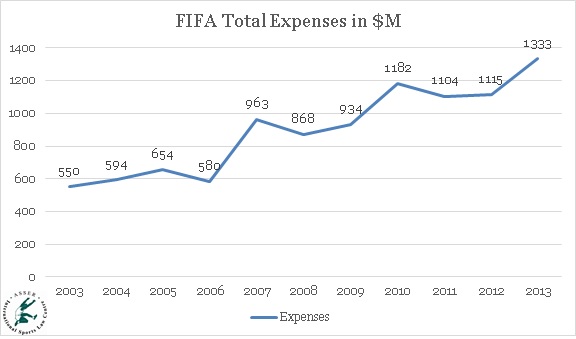


Graph 1: FIFA Expenses in USD million (adjusted for inflation), 2003-2013.

More...


The EU State aid and Sport Saga - A legal guide to the bailout of Valencia CF

After a decade of financial misery, it appears that Valencia CF’s problems are finally over. The foreign takeover by Singaporean billionaire Peter Lim will be concluded in the upcoming weeks, and the construction on the new stadium will resume after five years on hold due to a lack of money. On 3 June Bankia, the Spanish bank that “saved” Valencia CF in 2009 by providing a loan of €81 million, gave the green light for the takeover. However, appearances can be deceiving.More...

Gambling advertising regulations: pitfalls for sports sponsorship - By Ben van Rompuy

In April 2014, the Swedish Gambling Authority (Lotteriinspektionen) warned the organisers of the Stockholm Marathon that it would impose a fine of SEK 2 million (ca. € 221.000) for its sponsorship agreement with online betting operator Unibet. The Authority found that the sponsorship agreement violates §38 of the Swedish Lotteries Act, which prohibits the promotion of gambling services that are not authorized in Sweden.[1] The organisers, however, refused to withdraw Unibet as its sponsor and prominently displayed the Unibet logo at the event, which took place on 31 May 2014. As a result, the organisers of the Stockholm Marathon now face legal action before the Swedish administrative courts. More...

The FIFA Business – Part 1 – Where Does The Money Come From? - By Antoine Duval and Giandonato Marino

On next Thursday the 2014 World Cup will kick off in Sao Paulo. But next week will also see the FIFA members meeting on Tuesday and Wednesday at a much awaited FIFA congress. For this special occasion we decided to review FIFA’s financial reports over the last ten years. This post is the first of two, analysing the reports and highlighting the main economic trends at play at FIFA. First, we will study the revenue streams and their evolution along the 2003-2013 time span. In order to ensure an accurate comparison, we have adjusted the revenues to inflation, in order to provide a level playing field easing the comparative analysis over the years and types of revenues. Our first two graphs gather the main revenue streams into two comparative overviews. Graph 1 brings together the different types of revenues in absolute numbers, while Graph 2 lays down the share of each type of revenues for any given year (the others category covers a bundle of minor revenue streams not directly relevant to our analysis).
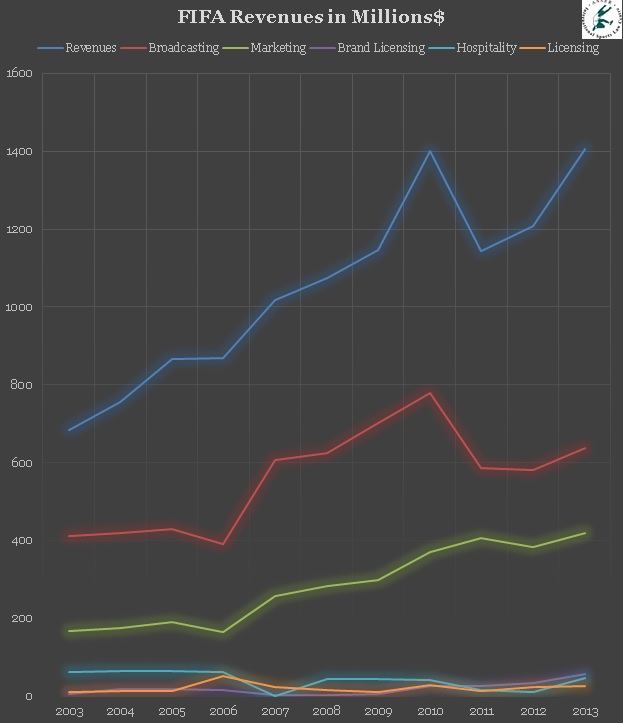


Graph 1: FIFA revenues in Millions of Dollars, 2003-2013 (adjusted for inflation). More...


Losing the UEFA Europa League on the Legal Turf: Parma FC’s bitter defeat by Giandonato Marino

This year the race for UEFA Europa League places in Serie A was thrilling. In the final minutes of the last game of the season, Alessio Cerci, Torino FC striker, had the opportunity to score a penalty that would have qualified his team to the 2014-2015 edition of the UEFA Europa League. However, he missed and Parma FC qualified instead. More...

Olympic Agenda 2020: Window Dressing or New Beginning?

Shortly after his election as IOC President, Thomas Bach announced his intention to initiate an introspective reflection and reform cycle dubbed (probably a reference to former German Chancellor Gerhard Schröder’s publicly praised Agenda 2010) the Olympic Agenda 2020. The showdown of a year of intense brainstorming is to take place in the beginning of December 2014 during an IOC extraordinary session, in which fundamental reforms are expected. More...

The French collective agreement for professional Rugby tackled by Kelsen’s Pyramid - Guest Post by Patrick Millot

Pursuant to Kelsen’s famous pyramid, the authority of norms may be ranked according to their sources: Constitution is above the Law, which is in turn superior to the Regulations, which themselves stand higher to the Collective Agreement etc…Under French labour law, this ranking can however be challenged by a “principle of favourable treatment” which allows a norm from a lower rank to validly derogate from a superior norm, if (and only if) this derogation benefits to the workers.

On 2 April 2014, the Cour de Cassation (the French Highest Civil Court) considered that these principles apply in all fields of labour law, regardless of the specificity of sport[1].  In this case, Mr. Orene Ai’i, a professional rugby player, had signed on 13 July  2007 an employment contract with the Rugby Club Toulonnais (RCT) for two sport seasons with effect on 1 July 2007. More...


Asser International Sports Law Blog | Our International Sports Law Diary <br/>The <a href="http://www.sportslaw.nl" target="_blank">Asser International Sports Law Centre</a> is part of the <a href="https://www.asser.nl/" target="_blank"><img src="/sportslaw/blog/media/logo_asser_horizontal.jpg" style="vertical-align: bottom; margin-left: 7px;width: 140px" alt="T.M.C. Asser Instituut" /></a>

Asser International Sports Law Blog

Our International Sports Law Diary
The Asser International Sports Law Centre is part of the T.M.C. Asser Instituut

Bailing out your local football club: The Willem II and MVV State Aid decisions as blueprint for future rescue aid (Part 2)

This is part two of the blog on the Willem II and MVV State Aid decisions. Where part one served as an introduction on the two cases, part two will analyze the compatibility assessment made by the Commission in two decisions.


The compatibility of the aid to MVV and Willem II (re-)assessed

Even though it was the Netherlands’ task to invoke possible grounds of compatibility and to demonstrate that the conditions for such compatibility were met, the aid granted to both Willem II and MVV was never notified. The Netherland’s failure to fulfill its notification obligation, therefore, appears to be at odds with the Commission’s final decision to declare the aid compatible with EU law. Yet, a closer look at the Commission’s decision of 6 March 2013 to launch the formal investigation shows that the Commission was giving the Netherlands a ‘second chance’ to invoke grounds that would lead to a justification of the measures.More...


Bailing out your local football club: The Willem II and MVV State Aid decisions as blueprint for future rescue aid (Part 1)

The European Commission’s decisions of 4 July 2016 to order the recovery of the State aid granted to seven Spanish professional football clubs[1] were in a previous blog called historic. It was the first time that professional football clubs have been ordered to repay aid received from (local) public authorities. Less attention has been given to five other decisions also made public that day, which cleared support measures for five football clubs in the Netherlands. The clubs in question were PSV Eindhoven, MVV Maastricht, NEC Nijmegen, FC Den Bosch and Willem II.

Given the inherent political sensitivity of State aid recovery decisions, it is logical that the “Spanish decisions” were covered more widely than the “Dutch decisions”. Furthermore, clubs like Real Madrid and FC Barcelona automatically get more media attention than FC Den Bosch or Willem II. Yet, even though the “Dutch decisions” are of a lower profile, from an EU State aid law perspective, they are not necessarily less interesting.

A few days before entering the quiet month of August, the Commission published the non-confidential versions of its decisions concerning PSV Eindhoven, Willem II and MVV Maastricht (hereinafter: “MVV”). The swiftness of these publications is somewhat surprising, since it often takes at least three months to solve all the confidentiality issues. Nonetheless, nobody will complain (especially not me) about this opportunity to analyze in depth these new decisions. More...

Fear and Loathing in Rio de Janeiro – Displacement and the Olympics by Ryan Gauthier (Thompson Rivers University)

‎Editor's Note: Ryan is Assistant Professor at Thompson Rivers University, he defended his PhD at Erasmus University Rotterdam in December 2015. His dissertation examined human rights violations caused by international sporting events, and how international sporting organisations may be held accountable for these violations.

Introduction

On Sunday, August 21, the 2016 Summer Olympic Games in Rio de Janeiro will end. The spotlight will dim not only on the athletes who return to their home countries to ply their trade in relative obscurity, but also on the country of Brazil.[1] Once the Games have ended, life will go ‘back to normal’, although for many residents of Rio de Janeiro, what is ‘normal’ is anything but. More...


Why we should stop focusing on Caster Semenya by Marjolaine Viret (University of Neuchâtel)

Editor's Note:  Marjolaine is an attorney admitted to the Geneva bar (Switzerland) who specialises in sports and life sciences.  She currently participates as a scientific collaborator at the University of Neuchâtel on a research project to produce the first article-by-article legal commentary of the 2015 World Anti-Doping Code.

Over the past days, we have been flooded by media reports discussing the “Caster Semenya-case”, reports rapidly relayed in social networks. Since the debate has a distinct legal component and since almost every report appears to draw significantly from the legal background, I granted myself permission – as compensation so to speak - to publish a somewhat more personal, less legal, post than I usually would.

Let me make one thing clear from the outset – I am still ‘agnostic’ about the question of how to solve the issues surrounding the male versus female divide in sports. Each time I have been asked to write or speak on the subject, I have tried to stick to describing the legal situation and its implications. I do not have the miracle solution as to how to handle this infinitely complex issue. And I am not sure anyone can claim to hold that solution at this point. Like everyone, I am doing my research and trying to be humble enough to stay within the realm of my competences. More...


Sporting nationality and the Olympic Games: selected issues by Yann Hafner (University of Neuchâtel)

Editor’s note: Yann Hafner is a Phd researcher at the University of Neuchâtel specialized in sports and nationality issues. He is also Legal Affairs Manager at the Fédération Internationale de Volleyball. Yann is an editor of the ASSER International Sports Law Blog and has previously published on the blog on nationality conundrums at the FIFA World Cup 2014 in Brazil (see here).  

This contribution aims to decipher the relationship between sporting nationality and the Olympic Games. To this end, the author will first define sporting nationality and discuss athletes’ eligibility in national team in the context of the Olympic Games. Then, selected issues in relation with sporting nationality and the Olympic Games (with an emphasis on issues related to the Rio 2016 Olympic Games) will be investigated. More...


Regulating the human body in sports: Lessons learned from the Dutee Chand case - by Dr Marjolaine Viret & Emily Wisnosky

Editor's note: Marjolaine Viret and Emily Wisnosky are both editors of the ASSER International Sports Law Blog specialized in anti-doping matters, they are also involved in the World Anti-Doping Commentary project funded by the Swiss National Science Fund.

Introduction

A remarkable aspect of the run-up to the 2016 Rio Olympic Games was the stream of negative media reports portraying broad-scale public mistrust in sport, with the most prominent topic being the doping scandals in athletics and questions surrounding the participation of Russia.  

A different controversy, but one also directed at the credibility of sports, has exposed a few female Olympians to repeated, and at times rather intrusive, media scrutiny. In June 2016, it was reported that Indian track-and-field athlete Dutee Chand had qualified for the Rio Olympic Games by breaking the national record, thus to become the first Indian athlete to run the 100m at the Olympics since 1980. The attention that Dutee Chand’s qualification attracted within international media, however, was not related only to her outstanding results. It came as part of a medical, ethical and legal controversy that has existed for many years relating to ‘policing’ the male versus female divide in sports. Another athlete who has found herself in the midst of this controversy is South African runner Semenya Caster, whose participation in the Olympics has been the object of much conjecture.

The divide between male and female athletes forms the core of most sports’ competition rules, including athletics. The justification for this basic divide has rarely been questioned as such, but has been a matter for debate when it comes to handling atypical situations on both sides of the ‘dividing line’ ­ such as ‘transgender’ or ‘intersex’ athletes. A category of athletes that has, especially, been viewed as a challenge to the divide is composed of female athletes affected by ‘hyperandrogenism’, a health condition that results in naturally elevated androgen levels, including testosterone levels.

On 24 July 2015, a CAS panel rendered a decision involving Dutee Chand (“Dutee Chand” or “the Athlete”) that has fuelled the ongoing debate about the policies regulating hyperandrogenism in sport. Much has been reported in the media about the case: controversial issues include whether the CAS was the appropriate forum to assess these questions; whether the decision was appropriate, both on the merits and on the procedure; and what the consequences of the CAS award would be, for the parties, for athletics and for the sporting community at large.

Much like the current crisis surrounding doping in sports, the public attention on women with (proven or suspected) hyperandrogenism is driven by a concern that an athlete’s physiology – natural or artificially induced ­ could distort competition, destroying the ‘level playing field’ that supports the Olympic ideal. Both topics are also often brought back to the goal of protecting an athlete’s health. Parallels are further found in the strong reactions both topics evoke, and the steps taken by the regulating authorities to convince the public that everything in their power is being done to preserve a level playing field.

A less obvious but equally important point of comparison can be found in the issues both topics raise concerning the legal validity of decisions made by sports organizations, especially in a science-related context. This blog focuses on those more ‘legal’ aspects, through the prism of the decision of the CAS in the Dutee Chand matter and its legal implications. After touching briefly on the background of the case, we will comment on two aspects of the Chand award with respect to challenges in regulating hyperandrogenism in sport within the confines of the law: First from the viewpoint of a CAS panel called upon to evaluate the validity of a set of regulations, and second from the viewpoint of the sports organizations seeking to both adequately protect fairness in sport and to provide a legally valid (and effective) regulatory solution.[1]

More...


International and European Sports Law – Monthly Report – July 2016 - By Marine Montejo

Editor’s note: This report compiles all relevant news, events and materials on International and European Sports Law based on the daily coverage provided on our twitter feed @Sportslaw_asser. You are invited to complete this survey via the comments section below, feel free to add links to important cases, documents and articles we have overlooked. 

The Headlines

The McLaren Report on Russia’s State Doping System

It is difficult not to start this monthly report without referring to the never-ending Russian doping investigation that is shaking the sporting world. On 18 July, the independent investigation on Sochi 2014 winter Olympics led by Prof. McLaren, a Canadian law professor, and requested by the World Anti-Doping Agency (“WADA”), released its report. It confirmed evidence of widespread, State-sponsored doping in Russian sports and called for a full ban on the country from the next Rio Olympics. In response to the report, the International Olympic Committee (“IOC”) vowed to take the “toughest sanctions available”. However, and despite the race against time in the run-up to Rio 2016, the IOC delayed its decision for several days amid a WADA statement and several press articles calling for a ban of Russia from Rio Olympics. Meanwhile, it did open an investigation against Russia’s sports minister, Vitaly Mutko, the head official who allegedly supervised the overall doping cover up and explored all possible legal actions against Russia. On 21 July, the Court of Arbitration for Sport (“CAS”) rejected the appeal of the Russian Olympic Committee and 68 Russian athletes against the International Association of Athletics Federations (“IAAF”) decisions to suspend All Russia Athletics Federation (ARAF) from IAAF membership given the evidence of a state-sponsored doping system. As a consequence, Russian track and field athletes were also banned from Rio 2016 Olympics. With the IAAF welcoming this decision, one could think that nothing was standing in the way of a full Olympic ban for all Russian athletes. While some Russian athletes announced that they would appeal the CAS award to the Swiss Federal Court. Yelena Isinbayeva, the banned pole vault champion, even took it a step further by claiming that she would challenge the IAAF decision as far as the European Court of Human Rights. Yet, it is very improbable that any of these challenges be decided in time for the Rio Games.More...

Brexit and EU law: Beyond the Premier League (Part 2). By Marine Montejo

Editor's note: Marine Montejo is a graduate from the College of Europe in Bruges and is currently an intern at the ASSER International Sports Law Centre. 


Part 2. EU competition law and sports funding

The first analysed impact of Brexit on sport was the one regarding EU internal market rules and free movement. However, all sport areas that are of interest to the European Union will be impacted by the result of the future Brexit negotiations. This second part of the blog will focus on EU competition law and the media sector as well as direct funding opportunities keeping in mind that if the UK reaches for an EEA type agreement competition law and state aid rules will remain applicable as much as the funding programs.  More...


With or without them? Russia’s state doping system and the Olympic fate of Russian athletes. By Antoine Duval, Kester Mekenkamp and Oskar van Maren

On Monday 18 July 2016, Canadian lawyer Richard McLaren presented the Independent Person Report to the World Anti-Doping Agency (WADA), regarding the alleged Russian doping program surrounding the 2014 Sochi Winter Olympics. The report was expected to seriously threaten the participation of Russian Athletes to the rapidly approaching Rio Games, starting on 5 August. In the weekend prior to the report’s publishing, Reuters obtained a leaked letter drafted by the CEO’s of the US and Canadian anti-doping agencies, which according to the New York Times was backed by “antidoping officials from at least 10 nations— including those in the United States, Germany, Spain, Japan, Switzerland and Canada — and 20 athlete groups”, urging the International Olympic Committee (IOC) to ban all Russian athletes from the upcoming Olympics.

Source: http://ww4.hdnux.com/photos/50/23/01/10563667/3/920x920.jpg

More...

Brexit and EU law: Beyond the Premier League (Part 1). By Marine Montejo

Editor's note: Marine Montejo is a graduate from the College of Europe in Bruges and is currently an intern at the ASSER International Sports Law Centre.

The result of the Brexit referendum on 23 June 2016 took the European Union (almost) by surprise. A lot has been said and written about the impact of the United Kingdom leaving the EU. As in all other areas, the British sport sector will also face the effects of the modification of the relationship between the EU and its (probable) former Member State, the UK. It is nearly impossible to foresee all consequences as the UK has not even triggered article 50 TFEU yet to officially start the exit negotiations. However, as the UK position toward the EU will change in any case, this two-part blog aims to examine the main practical implications of such an exit for the UK, but also for the EU, in relation to the actual application of EU law in sport and the EU sport policy.

Unless stated otherwise, the use of the terms Brexit in this blog should be understood as a complete exit of the UK from the European Union. This blog focus in particular on this worst case scenario and its consequences for UK sport. However, it is highly improbable that the future Brexit negotiations with the EU will end up without some kind of special agreement between the two parties the first of which being an EEA type of agreement with full access to the internal market and applicability of EU law. 

The first part of this blog will examined the consequences for UK sport in terms of access to the EU internal market and the applicability of free movement principles. The second part is focused on specific impacts with regard of others domain of EU law for professional and grassroots UK sport.  More...

Asser International Sports Law Blog | Our International Sports Law Diary <br/>The <a href="http://www.sportslaw.nl" target="_blank">Asser International Sports Law Centre</a> is part of the <a href="https://www.asser.nl/" target="_blank"><img src="/sportslaw/blog/media/logo_asser_horizontal.jpg" style="vertical-align: bottom; margin-left: 7px;width: 140px" alt="T.M.C. Asser Instituut" /></a>

Asser International Sports Law Blog

Our International Sports Law Diary
The Asser International Sports Law Centre is part of the T.M.C. Asser Instituut

The CAS jurisprudence on match-fixing in football: What can we learn from the Turkish cases? - Part 1 - By Thalia Diathesopoulou

The editor’s note:

Two weeks ago we received the unpublished CAS award rendered in the Eskişehirspor case and decided to comment on it. In this post Thalia Diathesopoulou (Intern at the ASSER International Sports Law Centre) analyses the legal steps followed and interpretations adopted by CAS panels in this case and in a series of other Turkish match-fixing cases. The first part of the post will deal with the question of the legal nature of the ineligibility decision opposed by UEFA to clubs involved in one way or another into match-fixing and with the personal and material scope of UEFA’s rule on which this ineligibility is based. The second part is dedicated to the procedural rules applied in match-fixing cases.


Introduction

The unpredictability of the outcome is a sine qua non feature of sports. It is this inherent uncertainty that draws the line between sports and entertainment and triggers the interest of spectators, broadcasters and sponsors. Thus, match-fixing by jeopardising the integrity and unpredictability of sporting outcomes has been described, along with doping, as one of the major threats to modern sport.[1] More...


Sport and EU Competition Law: uncharted territories - (I) The Swedish Bodybuilding case. By Ben Van Rompuy

The European Commission’s competition decisions in the area of sport, which set out broad principles regarding the interface between sports-related activities and EU competition law, are widely publicized. As a result of the decentralization of EU competition law enforcement, however, enforcement activity has largely shifted to the national level. Since 2004, national competition authorities (NCAs) and national courts are empowered to fully apply the EU competition rules on anti-competitive agreements (Article 101 TFEU) and abuse of a dominant position (Article 102 TFEU).

Even though NCAs have addressed a series of interesting competition cases (notably dealing with the regulatory aspects of sport) during the last ten years, the academic literature has largely overlooked these developments. This is unfortunate since all stakeholders (sports organisations, clubs, practitioners, etc.) increasingly need to learn from pressing issues arising in national cases and enforcement decisions. In a series of blog posts we will explore these unknown territories of the application of EU competition law to sport.More...

The Legia Warszawa case: The ‘Draconian’ effect of the forfeiture sanction in the light of the proportionality principle. By Thalia Diathesopoulou

The CAS denial of the urgent request for provisional measures filed by the Legia Warszawa SA in the course of its appeal against the UEFA Appeals Body Decision of 13 August 2014 put a premature end to Legia’s participation in the play-offs of the UEFA Champion’s League (CL) 2014/2015. Legia’s fans- and fans of Polish football - will now have to wait at least one more year to watch a Polish team playing in the CL group stage for the first time since 1996. More...

The EU State aid and Sport Saga – A blockade to Florentino Perez’ latest “galactic” ambitions (part 1)

This is the first part of a blog series involving the Real Madrid State aid case.

Apart from being favoured by many of Spain’s most important politicians, there have always been suspicions surrounding the world’s richest football club regarding possible financial aid by the Madrid City Council. Indeed, in the late 90’s a terrain qualification change by the Madrid City Council proved to be tremendously favourable to the king’s club. The change allowed Real Madrid to sell its old training grounds for a huge sum. Though the exact price for the grounds remains unknown, Real Madrid was suddenly capable of buying players like Figo and Zidane for record fees. However, the European Commission, even though agreeing that an advantage was conferred to the club, simply stated that the new qualification of the terrain in question does not appear to involve any transfer of resources by the State and could therefore not be regarded as State aid within the meaning of article 107 TFEU.

Agreements between the club and the Council have been a regularity for the last 25 years.  A more recent example concerns an agreement signed on 29 July 2011 (Convenio29-07-2011.pdf (8MB). More...

UEFA Financial Fair Play Regulations Put PSG and Manchester City on a Transfer Diet

The main lesson of this year’s transfer window is that UEFA’s Financial Fair Play (FFP) rules have a true bite (no pun intended). Surely, the transfer fees have reached usual highs with Suarez’s move to FC Barcelona and Rodriguez’s transfer from AS Monaco to Real Madrid and overall spending are roughly equal to 2013 (or go beyond as in the UK). But clubs sanctioned under the FFP rules (prominently PSG and Manchester City) have seemingly complied with the settlements reached with UEFA capping their transfer spending and wages. More...

Right to Privacy 1:0 Whereabouts Requirement - A Case Note on a Recent Decision by the Spanish Audiencia Nacional

On the 24th June 2014 the Spanish Audiencia Nacional issued its ruling on a hotly debated sports law topic: The whereabouts requirements imposed to athletes in the fight against doping. This blog aims to go beyond the existing commentaries (here and here) of the case, by putting it in the wider context of a discussion on the legality of the whereabouts requirements. More...

The Rules of the Electoral Game for the FIFA 2015 Presidential Elections

After the success of this year’s World Cup in Brazil, FIFA President Sepp Blatter can start concentrating on his Presidential campaign for next June’s FIFA elections. Even though the 78-year old Swiss is not officially a candidate yet, he is still very popular in large parts of the world, and therefore the favourite to win the race. Nonetheless, even for the highly experienced Mr. Blatter these elections will be different. All candidates will have to respect the newly introduced Electoral Regulations for the FIFA PresidencyMore...

Can (national or EU) public policy stop CAS awards? By Marco van der Harst (LL.M, PhD Candidate and researcher at the AISLC)

Introduction[1]

The Court of Arbitration for Sport (CAS) registers approximately 300 cases every year. Recently, the Swiss Federal Supreme Court – which is the sole judicial authority to review arbitral awards rendered in Switzerland – reminded in the Matuzalém Case (Case 4A_558/2011) that CAS awards may be enforced in other States that are parties to the New York Convention on the recognition and enforcement of foreign arbitral awards.More...

Chess and Doping: Two ships passing in the Night? By Salomeja Zaksaite, Postdoctoral researcher at Mykolas Romeris University (Lithuania), and Woman International Chess Master (WIM)

It may come as a surprise to laymen, but chess players are subjected to doping testing. Naturally, then, the questions follow as to why they are tested, and if they are really tested (at least, with a level of scrutiny comparable to that which physically-oriented athletes are regularly subjected). More...

The International Sports Law Digest – Issue I – January-June 2014 (by Frédérique Faut)

The International Sports Law Digest will be a bi-annual post gathering recent material on International and European Sports Law. This is an attempt at providing a useful overview of the new, relevant, academic contributions, cases, awards and disciplinary decisions in the field of European and International Sports Law. If you feel we have overlooked something please do let us know (we will update the post).

Antoine Duval More...


Asser International Sports Law Blog | Our International Sports Law Diary <br/>The <a href="http://www.sportslaw.nl" target="_blank">Asser International Sports Law Centre</a> is part of the <a href="https://www.asser.nl/" target="_blank"><img src="/sportslaw/blog/media/logo_asser_horizontal.jpg" style="vertical-align: bottom; margin-left: 7px;width: 140px" alt="T.M.C. Asser Instituut" /></a>

Asser International Sports Law Blog

Our International Sports Law Diary
The Asser International Sports Law Centre is part of the T.M.C. Asser Instituut

The UN and the IOC: Beautiful friendship or Liaison Dangereuse?

The IOC has trumpeted it worldwide as a « historical milestone »: the United Nations has recognised the sacrosanct autonomy of sport. Indeed, the Resolution A/69/L.5 (see the final draft) adopted by the General Assembly on 31 October states that it  “supports the independence and autonomy of sport as well as the mission of the International Olympic Committee in leading the Olympic movement”. This is a logical conclusion to a year that has brought the two organisations closer than ever. In April, UN Secretary General Ban Ki-moon appointed former IOC President, Jacques Rogge, Special Envoy for Youth Refugees and Sport. At this occasion, the current IOC President, Thomas Bach, made an eloquent speech celebrating a “historic step forward to better accomplish our common mission for humanity” and a memorandum understanding was signed between the UN and the IOC. This is all sweet and well, but is there something new under the sun?More...

Image Rights in Professional Basketball (Part I): The ‘in-n-out rimshot’ of the Basketball Arbitral Tribunal to enforce players’ image rights contracts. By Thalia Diathesopoulou

A warning addressed to fans of French teams featuring in the recently launched video game NBA 2K15: Hurry up! The last jump ball for Strasbourg and Nanterre in NBA 2K 15 may occur earlier than expected. The French Labour Union of Basketball (Syndicat National du Basket, SNB) is dissatisfied that Euroleague and 2K Games did not ask (nor paid) for its permission before including the two teams of Pro A in the NBA 2K15 edition. What is at issue? French basketball players’ image rights have been transferred to SNB, which intends to start proceedings before the US Courts against 2K Games requesting 120.000 euros for unauthorized use of the players’ image rights. SNB is clear: it is not about the money, but rather to defend the players’ rights.[1] Strasbourg and Nanterre risk to “warm up” the virtual bench if this litigation goes ahead. 

Source: http://forums.nba-live.com/viewtopic.php?f=149&t=88661&start=250 More...

Sport and EU Competition Law: uncharted territories - (II) Mandatory player release systems with no compensation for clubs. By Ben Van Rompuy

The European Commission’s competition decisions in the area of sport, which set out broad principles regarding the interface between sports-related activities and EU competition law, are widely publicized. As a result of the decentralization of EU competition law enforcement, however, enforcement activity has largely shifted to the national level. Since 2004, national competition authorities (NCAs) and national courts are empowered to fully apply the EU competition rules on anti-competitive agreements (Article 101 TFEU) and abuse of a dominant position (Article 102 TFEU).

Even though NCAs and national courts have addressed a series of interesting competition cases (notably dealing with the regulatory aspects of sport) during the last ten years, the academic literature has largely overlooked these developments. This is unfortunate since all stakeholders (sports organisations, clubs, practitioners, etc.) increasingly need to learn from pressing issues arising in national cases and enforcement decisions. In a series of blog posts we will explore these unknown territories of the application of EU competition law to sport.

In this second installment of this blog series, we discuss a recent judgment of the regional court (Landgericht) of Dortmund finding that the International Handball Federation (IHF)’s mandatory release system of players for matches of national teams without compensation infringes EU and German competition law.[1] More...

The CAS Ad Hoc Division in 2014: Business as usual? – Part.1: The Jurisdiction quandary

The year is coming to an end and it has been a relatively busy one for the CAS Ad Hoc divisions. Indeed, the Ad Hoc division was, as usual now since the Olympic Games in Atlanta in 1996[1], settling  “Olympic” disputes during the Winter Olympics in Sochi. However, it was also, and this is a novelty, present at the Asian Games 2014 in Incheon.  Both divisions have had to deal with seven (published) cases in total (four in Sochi and three in Incheon). The early commentaries available on the web (here, here and there), have been relatively unmoved by this year’s case law. Was it then simply ‘business as usual’, or is there more to learn from the 2014 Ad Hoc awards? Two different dimensions of the 2014 decisions by the Ad Hoc Division seem relevant to elaborate on : the jurisdiction quandary (part. 1) and the selection drama (part. 2). More...

Sports Politics before the CAS II: Where does the freedom of speech of a Karate Official ends? By Thalia Diathesopoulou

On 6 October 2014, the CAS upheld the appeal filed by the former General Secretary of the World Karate Federation (WKF), George Yerolimpos, against the 6 February 2014 decision of the WKF Appeal Tribunal. With the award, the CAS confirmed a six-months membership suspension imposed upon the Appellant by the WKF Disciplinary Tribunal.[1] At a first glance, the case at issue seems to be an ordinary challenge of a disciplinary sanction imposed by a sports governing body. Nevertheless, this appeal lies at the heart of a highly acrimonious political fight for the leadership of the WKF, featuring two former ‘comrades’:  Mr Yerolimpos and Mr Espinos (current president of WKF). As the CAS puts it very lucidly, "this is a story about a power struggle within an international sporting body"[2], a story reminding the Saturn devouring his son myth.

This case, therefore, brings the dirty laundry of sports politics to the fore. Interestingly enough, this time the CAS does not hesitate to grapple with the political dimension of the case. More...

The new “Arrangement” between the European Commission and UEFA: A political capitulation of the EU

Yesterday, the European Commission stunned the European Sports Law world when it announced unexpectedly that it had signed a “partnership agreement with UEFA named (creatively): ‘The Arrangement for Cooperation between the European Commission and the Union of European Football Associations (UEFA)’. The press release indicates that this agreement is to “commit the two institutions to working together regularly in a tangible and constructive way on matters of shared interest”. The agreement was negotiated (as far as we know) secretly with UEFA. Despite recent meetings between EU Commissioner for sport Vassiliou and UEFA President Platini, the eventuality of such an outcome was never evoked. It is very unlikely that third-interested-parties (FIFPro, ECA, Supporters Direct etc.) were consulted in the process of drafting this Arrangement. This surprising move by an outgoing Commission will be analysed in a three-ponged approach. First, we will discuss the substance of the Arrangement (I). Thereafter, we will consider its potential legal value under EU law (II). Finally, and maybe more importantly, we will confront the political relevance of the agreement (III).  More...

Sports Politics before the CAS: Early signs of a ‘constitutional’ role for CAS? By Thalia Diathesopoulou

It took almost six months, a record of 26 witnesses and a 68 pages final award for the CAS to put an end to a long-delayed, continuously acrimonious and highly controversial presidential election for the Football Association of Thailand (FAT). Worawi Makudi can sit easy and safe on the throne of the FAT for his fourth consecutive term, since the CAS has dismissed the appeal filed by the other contender, Virach Chanpanich.[1]

Interestingly enough, it is one of the rare times that the CAS Appeal Division has been called to adjudicate on the fairness and regularity of the electoral process of a sports governing body. Having been established as the supreme judge of sports disputes, by reviewing the electoral process of international and national sports federations the CAS adds to its functions a role akin to the one played by a constitutional court in national legal systems. It seems that members of international and national federations increasingly see the CAS as an ultimate guardian of fairness and validity of internal electoral proceedings. Are these features - without prejudice to the CAS role as an arbitral body- the early sign of the emergence of a Constitutional Court for Sport? More...

Olympic Agenda 2020: To bid, or not to bid, that is the question!

This post is an extended version of an article published in August on hostcity.net.

The recent debacle among the candidate cities for the 2022 Winter Games has unveiled the depth of the bidding crisis faced by the Olympic Games. The reform process initiated in the guise of the Olympic Agenda 2020 must take this disenchantment seriously. The Olympic Agenda 2020 took off with a wide public consultation ending in April and is now at the end of the working groups phase. One of the working groups was specifically dedicated to the bidding process and was headed by IOC vice-president John Coates.  More...

The CAS jurisprudence on match-fixing in football: What can we learn from the Turkish cases? - Part 2: The procedural aspects. By Thalia Diathesopoulou

With this blog post, we continue the blog series on Turkish match-fixing cases and our attempt to map the still unchartered waters of the CAS’s match-fixing jurisprudence.

The first blog post addressed two issues related to the substance of match-fixing disputes, namely the legal characterization of the match-fixing related measure of ineligibility under Article 2.08 of the UEL Regulations as administrative or disciplinary measure and the scope of application of Article 2.08. In addition, The Turkish cases have raised procedural and evidentiary issues that need to be dealt with in the framework of match-fixing disputes.

The CAS panels have drawn a clear line between substantial and procedural matters. In this light, the Eskişehirspor panel declared the nature of Article 2.08 UEL Regulations to be administrative and rejected the application of UEFA Disciplinary Regulations to the substance. Nonetheless, it upheld that disciplinary rules and standards still apply to the procedure. This conclusion, however, can be considered puzzling in that disciplinary rules apply to the procedural matters arising by a pure administrative measure. To this extent, and despite the bifurcation of different applicable rules into substantial and procedural matters, the credibility of the qualification of Article 2.08 as administrative seems to be undermined. And here a question arises: How can the application of rules of different nature to substantial and procedural matters in an identical match-fixing dispute be explained?More...

The EU State aid and Sport Saga – A blockade to Florentino Perez’ latest “galactic” ambitions (part 2)

This is the second part of a blog series on the Real Madrid State aid case. In the previous blog on this case, an outline of all the relevant facts was provided and I analysed the first criterion of Article 107(1) TFEU, namely the criterion that an advantage must be conferred upon the recipient for the measure to be considered State aid. Having determined that Real Madrid has indeed benefited from the land transactions, the alleged aid measure has to be scrutinized under the other criteria of Article 107(1): the measure must be granted by a Member State or through State resources; the aid granted must be selective; and it must distorts or threatens to distort competition. In continuation, this blog will also analyze whether the alleged aid measure could be justified and declared compatible with EU law under Article 107(3) TFEU.More...