


Interview with Masuma Shahid – Max van der Stoel Human Rights Award 2025
Published 10 March 2026
Photo credit: Masuma Shahid
Following the announcement of the Max van der Stoel Human Rights Award 2025, we spoke with Dr. Masuma Shahid (Erasmus University Rotterdam), recipient of the award for the best doctoral dissertation. Her dissertation, “Queering courts: Analysing equal marriage rights cases before the European Court of Human Rights, the Court of Justice of the European Union and the United States Supreme Court”, offers a critical analysis of judicial reasoning on equal marriage rights through the lens of queer legal theory. In this interview, she reflects on the significance of the award, the key insights from her research, and the value of critical approaches in human rights scholarship.
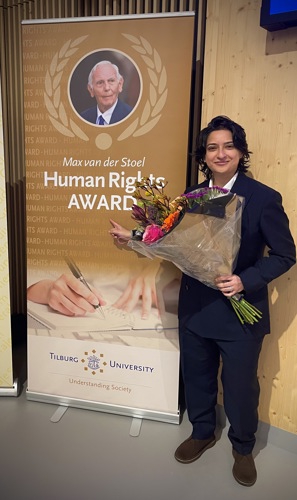
1. What does receiving the Max van der Stoel Human Rights Award mean to you personally and professionally at this stage of your academic career?
Winning the Award is an immense honour. On a personal level, it is encouraging to receive acknowledgment for all of the effort and years of hard work that I put towards writing my PhD while simultaneously teaching fulltime. It also demonstrates that ‘first-generation students’ deserve a place in academia. Professionally, it’s an incentive Award that encourages me to continue my research in the field of LGBTQIA+ rights and non-discrimination, and have societal impact.
2. What was the most striking difference you identified between the European and U.S. judicial approaches regarding equal marriage rights?
What struck me most is how certain Supreme Court Justices in the past have done so much for the LGBTQIA+ rights movement in the US while the approach of the current ones is more inclined towards regression. The ‘Kennedy Court’ singlehandedly brought the most LGBTQIA+ rights progress in the history of the country with cases like Romer, Lawrence, Windsor and Obergefell. Now that the ‘Roberts Court’ is in session, a countermovement is visible and the LGBTQIA+ community fears that same-sex marriage might be overturned sooner than later.
This ‘dance’ of progress and regression directly linked to the political climate is less visible in the approaches of European courts, though they are also not immune to anti-gender and religiously conservative arguments of States.
3. Through a queer lens, your dissertation critically engages with judicial reasoning. What did this perspective allow you to see that more traditional legal analyses might overlook?
One of the key aspects of queer legal theory is that it allows the researcher to uncover certain aspects of ideological thinking, underpinnings, assumptions and/or beliefs that underlie the law, legal texts or their interpretations by courts. It does this through a ‘deconstruction’ of the texts, which brings to light any hierarchies that are contained therein.
Queering the equal marriage rights case law of the European Court of Human Rights (ECtHR), the Court of Justice of the European Union (CJEU), and the United States Supreme Court (US Supreme Court) has allowed me to uncover these hierarchies and find out what courts find important in their reasoning. This process has also revealed underlying reasons and factors that influence court decisions on equal marriage rights. Traditional legal analyses are not always capable of exposing such aspects.
4. Given the current context, what lessons should policymakers and academic institutions draw from your research?
That rights and freedoms should not be taken for granted. They are hard-fought and can be ‘taken away’ or ‘overturned’ by the influence of movements that have their own agenda, such as the current anti-gender movement. We have seen it happen in the US with the anti-abortion movement, and similar ‘regressive’ lobbies are also present in Europe.
We should not assume that courts are neutral or immune to such sentiments and abstain from promoting heteronormativity and certain gender roles and norms. Critical legal research using queer legal theory should therefore be encouraged.
5. What advice would you give to early-career scholars who want to pursue critical or queer approaches in human rights law?
Go for it! These approaches are meticulous, comprehensive and have demonstrated their value for legal research and other disciplines for decades, albeit mainly in the US. I would be happy to see more scholars applying such approaches worldwide.
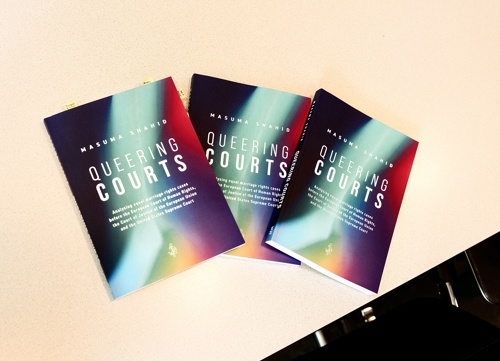
Dr. Shahid’s dissertation has recently been published as a book. More information about the publication Queering Courts can be found here.